



by Daniel Hathaway & Mike Telin
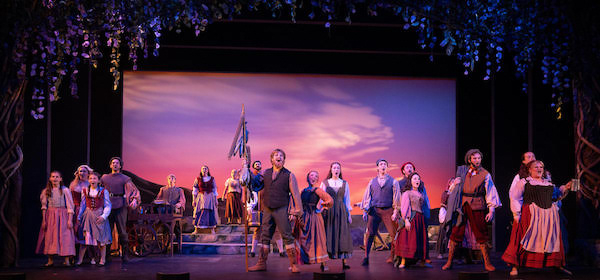 Immediately following Ohio Light Opera’s wonderful opening performance of Alan J. Lerner and Frederick Loewe’s Brigadoon on June 19, we had the opportunity to sit down at The College of Wooster’s Freedlander Theatre with director Jacob Allen, conductor Wilson Southerland, choreographer and cast member Spencer Reese, and cast members Maggie Langhorne and Jack Murphy to talk about the production.
CC: Great job, everyone! Jacob, please share your thoughts about the show.
 Jacob Allen (director): This is my fifth Brigadoon, so I have known and loved this piece for a very long time. I think it’s a particularly apt title for our company for a variety of reasons, but one of the biggest is that it’s a Lerner & Loewe piece — Frederick Loewe was the son of a famous operetta star who was particularly known for playing Count Danilo in The Merry Widow in Europe, so he grew up steeped in the operetta tradition.
One of the things that tradition brings to American musicial theater is a heightened sense of romance, and I think you can hear that in this score for sure. So it’s great for the company’s mission of bridging the gap between operetta and musical theater.
In approaching the piece it was important to me to find a way to match romanticism with some sense of mysticism, because it is a crazy story at the end of the day. It’s kind of hard to buy it, to suspend disbelief.
CC: It’s beautiful music, but the story makes you wonder. Wilson, the orchestra sounded fantastic. What are your thoughts on the score?
 Wilson Southerland (conductor): One thing we do here at Ohio Light Opera is to use the orchestrations as they were originally conceived. Nowadays a lot of companies are saving money by using electronic keyboards that can mirror other instruments. But in our production you’re hearing the score as audiences heard it in 1947.
I’ve been here 14 years and I’ve done several shows with Jack and Spencer and Maggie and my favorite moments are those that are unscripted musically, where almost like one organism the singing actors decide, today we’re going to take a little less time here or a little more time there. And to be able to do that takes people who know their craft so well. So to come here in the summer working with consummate professionals is such a blessing.
Then there’s the communication between the stage and the pit — how can 26 players be exactly with a singer at a certain moment? It doesn’t seem like it should be possible. But that’s certainly what I try to craft.
CC: Maggie, your character Meg is a wild woman.
 Maggie Longhorne (Meg Brockie): She sure is something. A lot of characters that I’m playing this season fit a certain archetype, and it’s fun to play the variations on the archetype. But Meg is bawdier and very brash and bold. And it’s fun to embody that — because it’s not really me.
It’s fun to work with Spencer. Last year in Me and My Girl we had a similar scene where I’m coming on to him and he does not want it at all. I feel like we’ve found a little bit of magic working together in that sense. But someday we’ll be in love.
Meg’s songs have a lot of words, but they’re really fun. I think they represent a lot of the importance of culture and storytelling in the Brigadoon universe. To be told a story is a communal experience, because what other entertainment do they have? They wake up for a day every hundred years, they dance, they milk their cows, and they tell stories to one another.
CC: Speaking of dance, Spencer, how many thousand hours of dance rehearsals have you had?
 Spencer Reese (choregrapher): Not as many thousands as you would think. This is my second Brigadoon and it’s been fun to come back to it a decade later with more experience.
In an effort to present both Carousel and Brigadoon as they were originally conceived we have taken the scores in their entirety, which is really exciting but a big challenge because it’s a lot of dancing. Carousel has 30 minutes of ballet alone, no singing. Brigadoon is about 18 minutes of dancing and no singing.
For me, the dance is a really beautiful addition to the story. Especially in Act Two, in the parts of the story that we are asked to invest in and be changed by, are not the front row characters but people we don’t see quite as much. And I think by restoring those dances in the first act, we become more invested not only in the town, but also in the people that we are then going to be asked to really feel for after intermission.
CC: How much research did you do into Scottish dance?
I researched a lot of Scottish Island dance, so many of the shapes and images you are seeing are really from that culture. But then I certainly imagined a sort of balletic style of dance that really serves to tell the story.
CC: About your character Jeff, he’s kind of an odd one.
Spencer Reese (Jeff Douglas): He is and he’s a bit of a change from my usual character — I’m usually a Mickey Rooney. But it’s been wonderful and engaging and I’m so grateful to Jacob for the opportunity to dig into somebody with a little bit more variation and shade throughout the show.
So for me, Jeff is probably a more PTSD-ridden character than the others. He uses humor to deal with things that he doesn’t want to talk about. But eventually he has to talk about them because the situation requires him to do that in the second act. And the more that I can have the audience laughing with me in Act One, the more I can then really get to them in Act Two.
Jacob Allen: Tommy and Jeff’s relationship is not explicitly described in any way, but Lerner and Loewe are on record as having said that they are war buddies from World War II. So that is something that we also played with — the idea that the experience post-war has been very different for Tommy than it has been for Jeff.
CC: Jack, how did you get inside the role of Tommy?
 Jack Murphy (Tommy Albright): I’ve been thinking a lot about this idea that he is somebody who has come back home and is just not connecting. And the challenge with Brigadoon is believing from the get-go that Tommy does not belong in New York.
I think that in his own way he’s also facing some kind of disconnect and is looking for an escape. At the time the show was written a lot of audiences were coming out of World War II and wanting that too. So I tried to approach him as someone hoping to find a community that he feels that he belongs with.
Spencer and I and both of the Fionas have talked about this — what is the moment that Tommy really feels like Brigadoon is where Tommy wants to be.
I think it’s at Charlie and Jean’s wedding. He knows that this is something that he wants, but he just doesn’t see it happening with Jane back in the city.
It’s like he can’t even believe that such a thing could exist. I think for him it’s about that journey of belonging and finding a community he really feels like he can actually be a part of — even if it’s not in 1940s New York.
CC: But there’s that one point when Tommy tells Jeff that he wants to remain in Brigadoon and Jeff says “You want to believe so bad that this is real, even though it isn’t.”
Spencer: We’ve often talked about how OLO can feel like a Brigadoon sometimes in that it appears for these few months and then we go. And the company itself has touched us in so many ways.
Next week, the same group talks about their activities during the rest of the season
Published on ClevelandClassical.com July 1, 2025
Click here for a printable copy of this article
