

by Stephanie Manning
 This article was originally published on Cleveland.com
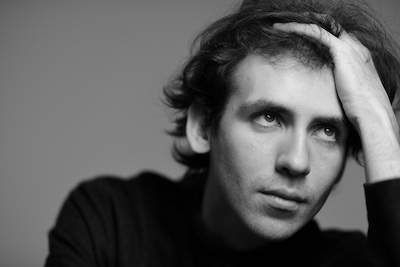
CLEVELAND, Ohio — On the cover of the Severance Music Center’s April 16 program book, Alexandre Kantorow stares at the viewer from one end of the piano keyboard, his face mirrored in the glossy fallboard. That stylistic presentation felt quite fitting for the French pianist, a musician who brings out the contrasting sides in every piece and whose playing often produces a reflective, translucent quality.
Currently on a multi-week tour of the U.S., Kantorow made his Cleveland debut on Thursday night at Severance Music Center. Dressed in all black, he initially cut an unassuming figure, an impression that quickly dissolved with the intense opening chords of Franz Liszt’s Variations on Weinen, Klagen, Sorgen, Zagen after J.S. Bach.
Kantorow is often favorably compared to Liszt, so it was no wonder to hear him treat the Hungarian composer’s arrangement with reverence. The performance became more mesmerizing as the variations grew in complexity.
His intense focus in the lagrimoso (tearful) section commanded silence as he considered every note. The final minutes, where the immediately-recognizable sound of a Bach chorale builds to a finale, were a period of true joy for both player and listener.
The pianist designed his program around Nikolai Medtner’s emotional Sonata in F minor, Op. 5. Kantorow skillfully crafted the initial appearance of both of the main themes to prepare the listener to seek them out, since Medtner ceaselessly iterates on those themes throughout the four-movement work.
As Kantorow narrowed his focus and the intensity grew, he curved his body towards the piano, seemingly anticipating the notes before he played them.
After intermission, he prefaced the evening’s Beethoven sonata with a set of three shorter pieces by Frédéric Chopin, Charles-Valentin Alkan, and Alexander Scriabin. Chopin’s meditative Prelude in C sharp minor, Op. 45 stands apart in the Polish composer’s famous Op. 28 preludes, and the pianist rightfully presented it as its own distinct sound world.
Alkan’s Prelude No. 8 in A-flat minor, Op. 31 creates a gulf of octaves between the player’s hands, allowing Kantorow to contrast his weighty, rumbling left hand with the lonesome melodies of his right.
The arc of the set then built to its peak with Scriabin’s Vers la flamme, Op. 72, which increased both the density of notes and the hand crossings. Kantorow made this famously difficult piece sound as effortless as everything else.
He seamlessly transitioned into late Beethoven with the composer’s Sonata No. 32 in C minor, Op. 111. Again, the pianist pointed up the piece’s contrasts, lending a tasteful rubato to the opening melody before repeating it more forcefully. He brought a delightfully delicate quality to the high-register sections of the second movement, as airy yet precise as a music box.
Although the Beethoven was over all too soon, the excited audience quickly brought Kantorow out for an encore, the pianist looking both surprised and delighted by the warm reception. Unsurprisingly, he closed the evening out with another selection from Liszt: the composer’s transcription of Wagner’s “Liebestod” from Tristan und Isolde, complete with fluttery trills and a breathlessly gentle resolution.
Published on ClevelandClassical.com April 23, 2026
Click here for a printable copy of this article
