


by Daniel Hathaway
 During his visit to New York in 1907 to supervise the Metropolitan Opera’s first productions of Madama Butterfly and Manon Lescaut, Giacomo Puccini got the idea of writing an opera to be set during the 1849 California Gold Rush after seeing David Belasco’s 1905 play, The Girl of the Golden West. The opera received its world premiere by the MET in 1910.
This week, three concert performances of La Fanciulla del West serve as the centerpiece of The Cleveland Orchestra’s Jack, Joseph and Morton Mandel Opera & Humanities Festival this month at Severance Music Center and around town, a richly-programmed look into the concept of what James Truslow Adams dubbed “The American Dream” in his 1931 Great Depression Era book, The Epic of America.
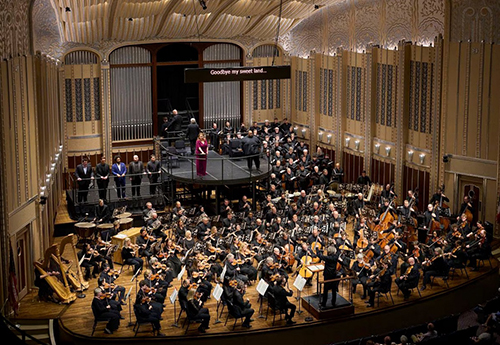
For the Cleveland production, which opened on May 13, the Orchestra is front and center. The principal singers perform from a raised platform connected to the organ chamber whose front pipes have been removed for entrances and exits. Secondary characters sing from another platform on stage right, and the male chorus is located on the other side.
There are few visual cues about the physical setting. Singers are in concert dress, and no ten-gallon hats are worn, horses hinted at, or other Wild West themes invoked. Probably no discouraging words are heard, and the skies are not cloudy all day, but those are elements to be imagined.
Stripped down to its essentials, the plot is simple. Paraphrasing the words of Kunio Nara, individuals struggle to transform themselves, to shed their pasts and to fashion new lives against the majestic backdrop of the Wild West. “Their dreams, however, are not singular but diverse and often in conflict with each other, forcefully propelling the drama forward.”
 The cast is uniformly superb. As Minnie, the proprietor of the Polka Saloon, the fabulous Emily Magee — so late a substitution in the cast that her name doesn’t appear in the program book — has the pipes of a Wagnerian soprano and used them skillfully. As Dick Johnson, Limmie Pulliam, who made his mark in last season’s Otello, unleashed his glorious tenor voice, investing it with a range of vocal subtleties. On Sunday, the two leads achieved a remarkable dramatic chemistry.
As Jack Rance the Sheriff (who also had feelings for Minnie), Roman Burdenke brought his stentorian voice and strong physical presence to the stage.
The male chorus of miners opens the show with a raucous Saloon scene, returning later to dramatically narrate the pivotal poker game that will determine Minnie’s fate. No matter how small the roles of the individual compromarios, each contributes real personalities to the story.
But the central cast member is really the Orchestra, which provides all the dramatic context and commentary necessary for what happens behind them onstage. Their sonorous playing reveals Puccini to be a master orchestrator, and Welser-Möst once again asserts his credentials as a natural opera conductor who can tease details out of the score that others may pass over.
The Opera and Humanities Festival affords Cleveland audiences the rare opportunity to hear and see a piece that Puccini believed to be one of his best, and which Welser-Möst favorably compares to another famous score. In his program book essay he writes, “Most people don’t believe me, but I find the first act of Fanciulla harder to conduct than Berg’s Wozzeck. It’s true.”
But back to the connection between Fanciulla and the American Dream. As Festival Curator Elena Dubinete writes in one of several essays about Puccini’s opera in the elaborate, 71-page festival program book, “It remains a thriving aspirational concept related to the promise of this country that embraces optimism for the future and the ability to shape it, as well as recognition of every person’s potential as a dignified human being. However, for many the American Dream was and remains, a dream, a cruel illusion, an unfulfilled promise.”
The third and final performance is on Saturday, May 20 at 7:30 pm.
Photos by Roger Mastroianni courtesy of The Cleveland Orchestra.
Published on ClevelandClassical.com May 18, 2023.
Click here for a printable copy of this article
