


by Jarrett Hoffman
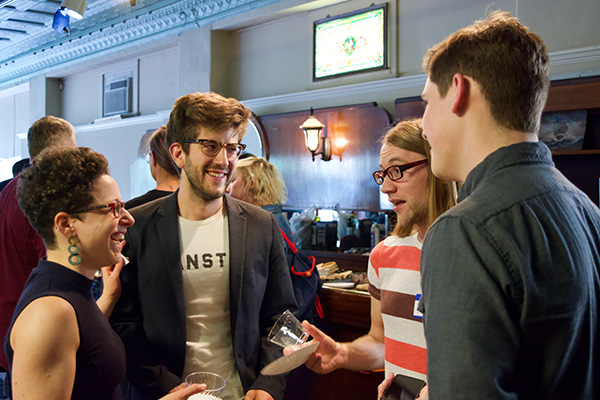 June 8 was the busiest day for the Re:Sound Festival, with three concerts around the city. I heard the first two, beginning in the afternoon at Praxis Fiber Workshop, where the duo Dykes & Young set a high bar for the acts that would follow over the course of the day. Bassist Laura Dykes and violinist Jeffrey Young performed three original works that had their genesis in joint improvisation, but which have solidified over the years into fixed structures. In particular, the second of the three was riveting. After Young’s wistfully played, folk-like opening, things moved in a different direction when Dykes began de-tuning her bass, descending into the depths of sound while Young rose ever higher. In her closing solo, Dykes ground away at her the strings until sputtering to a stop, like something unplugged.
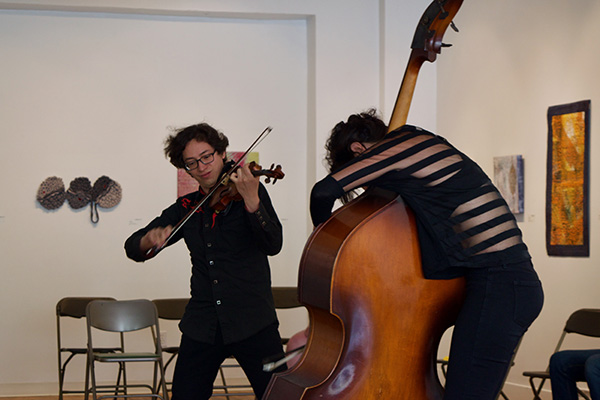 Even as it grew loud and buzzy, the first piece seemed like a meditation — until it wasn’t, having crossed some threshold into an angry awakening. Delightfully, the third found its way into a minimalist and pop-like sound world.
The second half at Praxis belonged to soprano Stephanie Lamprea, who began by inviting a volunteer from the audience to join her for Louis d’Heudieres’ Laughter Studies 2. They sat side by side, wearing earbuds and listening to the same sounds (inaudible to us), which one of them was to describe in words, and the other was to re-enact vocally.
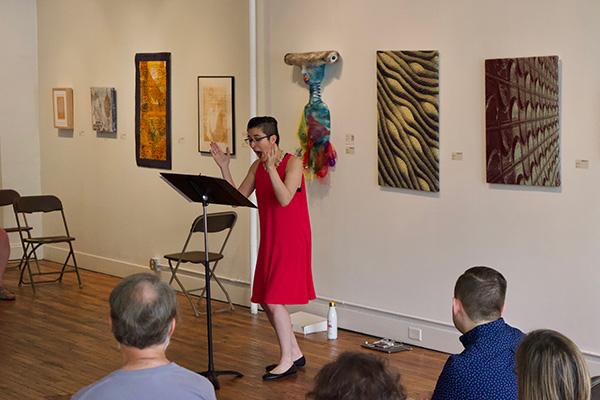 Lamprea was captivating in the latter role, conjuring a wide spectrum of sounds. The volunteer, for her part, was a fantastic narrator, describing what she heard in the most perfectly plain terms. In one instance she announced with some surprise, “Oh, there’s a chicken.” Towards the end of the piece, she observed, “Someone’s taking a shower, but they’re also frying eggs.” Several times the pair switched tasks, and at one point they joined together, making a sort of scat duo.
The world premiere of Aaron Jay Myers’ Lichens III saw Lamprea vocalizing with one consonant sound after another like each was its own drum. Along the way she also hummed, clapped, and sang operatically, showing off her pure tone and her ability to pluck any pitch out of the air. Her dedication to every gesture was total.
She closed with another world premiere, Cullyn D. Murphy’s according. At the heart of the piece is a tug-of-war between innocence and nonsense. Lamprea brought out different things from a cardboard box and played with them — notably a toy car and some masking tape. All the while she declaimed a set of continuously-looping instructions about using those items, often in monotone and at hyper-speed.
On first listen, a few moments of the piece could be cut to keep the spell going strong. But there’s no denying the ingenuity of some of the sounds created, like ripping masking tape from the table and dragging the toy car violently back and forth. Near the end, a hammer emerged from the box, which Lamprea was happy to introduce to the toy car — repeatedly, and while wearing a pink crown.
Later that day at the Bop Stop, the cello-percussion duo New Morse Code opened the concert with two multimedia works whose composers were both in attendance. Recordings of interviews with emigrant musicians in Queens, New York are combined with instrumental music in George Lam’s three-movement The Emigrants.
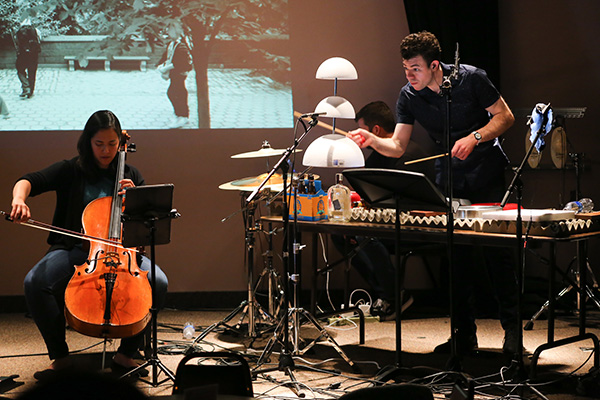 Percussionist Michael Compitello brought fascinating sounds from an intriguing setup. At his disposal were a variety of unique cymbals, and later an array of objects laid out over a table, including bottles, bowls, cans, and blocks of wood. Cellist Hannah Collins played with skill and vivid emotion. The relationship between the spoken word and the music was not always clear, but when rhythms lined up between them, it was compelling.
Next was Christopher Stark’s The Language of Landscapes. Stark, who was running the electronics, juxtaposes different types of sound in this piece: acoustic, looped, and purely synthetic. The looping created some wonderfully eerie moments, like when the playback was very close but not quite in line with what was happening onstage — double vision in sound.
The piece was being presented for the first time with projected video. It was abstract: what I saw was mostly colors and scenes from New York City (and glimpses of a horse race?). With so much already going on musically, it didn’t feel necessary.
“Dear self, I hope you aren’t a dropout,” violinist Maya Bennardo read aloud to open Leah Asher’s Letters to my future self. Bennardo and violist Hannah Levinson, who make up the duo andPlay, began on opposite ends of the stage before joining each other in the center — kneeling and facing each other — and later splitting apart. At times the text was boiled down to single words: wait, or don’t, matched well by short musical gestures. A moment of high, squealing virtuosity provided contrast.
Bethany Younge’s ing ing ing ing ing ing ing ing ing ing ing into is like a dystopian short story in music. Electronics provided a grooving beat as well as some unsettling sounds, like moans and a piercing pitch. At one point, Bennardo and Levinson rotated their bodies from the hip like robots. Later they let out a couple of full-throated screams.
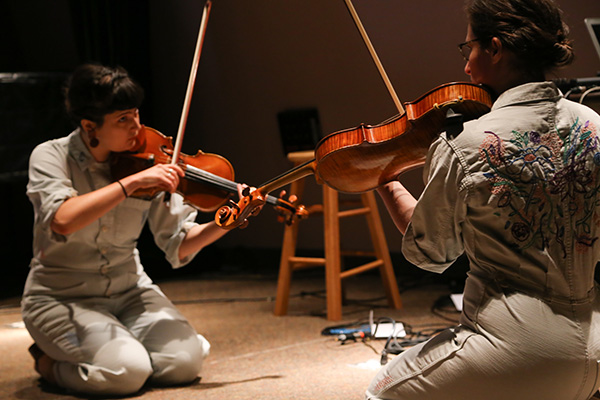 Sky Macklay’s Maps (of friendship) was just that, both musically and visually. Images from Google Maps were projected behind Bennardo and Levinson, showing a series of routes they’ve taken either together or toward one another to meet up. Nemeses of making plans, like train delays and bad weather, made their due appearances.
The visuals were a great starting point, even if they lost some freshness as the piece progressed, and the music was impressive throughout. Macklay not only matches the duo’s travels with a sense of movement, but also reflects their friendship with a charming, chummy, and riffing relationship between the violin and viola. Bennardo and Levinson played with obvious chemistry, genuinely at ease with one another in the kind of way that just makes an audience feel good.
Photos by Sophie Benn.
Published on ClevelandClassical.com June 24, 2019.
Click here for a printable copy of this article