

By Daniel Hathaway
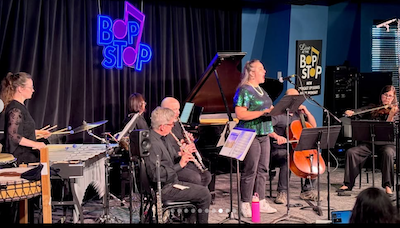 No Exit’s recent foray into art song brought new takes to sonnets by Edna St. Vincent Millay and traditional lullabies on Friday, May 29 at The Bop Stop. Cycles by Robert Honstein and Annika Sokefeldt were vividly realized by soprano Anika Kildegaard and the No Exit ensemble — Cara Tweed (violin), Nicholas Diodore (cello), Sean Gabriel (flutes), Gunnar Owen Hirthe (clarinets), Shuai Wang & Rob Kovacs (pianos), and Katalin La Favre (percussion).
The composers had colorful texts to work with. Millay’s sonnets follow the traditional fourteen-line format in which the final couplet often contains a surprise, and Sokefeldt has deconstructed familiar “Mother Goose” rhymes — along with English and French songs — into what she calls “feminist rager lullabies,” “retelling old lullabies for a new, queer age.”
Sonnets was commissioned by No Exit — the first five songs were premiered in 2023 by the ensemble and soprano Lauren Pearl. Songs six through eight received their debuts at these concerts.
Honstein’s setting of Millay’s clever verse closely follows the texts — except when he chooses to repeat several lines, which is sometimes to the detriment of the punchiness of her final couplet. His musical scores brilliantly support, but never obscure the text, often taking on a conversational role with the vocal line.
Kildegaard beautifully navigated the powerful musical arch of “Love, though for this you riddle me with darts,” which inspired her to sing with a focused sound and dramatic diction that filled the intimate, crescent-shaped room.
The soprano proved to be a great story teller in “I shall forget you presently, my dear,” and she wonderfully unveiled her voice during “Oh, my beloved, have you thought of this.”
During the concluding “When I too long have looked upon your face” the dissonant accents in the ensemble punctuated the ending lines, ‘Making my way, I pause, and feel, and hark, Till I become accustomed to the dark,’ followed by a beautiful final chord.
Annika Socolofsky has a talent for turning lullabies on their heads and taking them places you would have never imagined — something that is evident from the beginning of her song cycle Don’t say a word.
In “Don’t you cry” Socolofsky skillfully used an electronic reverb, conjuring up visions of Nordic ghosts hovering over the cradle promising impossible gifts like a Mocking Bird who won’t sing and “a looking glass that won’t mask those precious things that you bring.” Tight unison rhythms from the ensemble and Kildegaard created a wonderfully unnerving effect.
In her deconstruction of the traditional English text “Little boy blue” Socolofsky replaces “But where is the boy that looks after the sheep,” with “But where is the boy who will break from the flock? He’s you.”
Here Kildegaard used her expansive vocal range to good effect, putting Socolofsky’s long vocal lines across with authority against shimmering textures in the instruments.
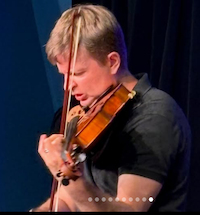 Between the two vocal works came Timothy Beyer’s Malekhamoves for solo viola. James Rhodes provided a deft reading of this evocative work that keeps you guessing about what might happen next.
Each of Beyer’s motives is fully developed in micro form — then long tones become pizzicatos, and scratches turn into a klezmer tune, and passages of beautiful rich sound alternate with craggy, high harmonics.
Published on ClevelandClassical.com June 11, 2026
Click here for a printable copy of this article
