



By Kevin McLaughlin
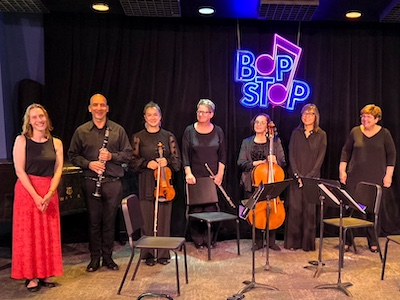 She ROARS!, a series celebrating living female composers, devoted its program at the Bop Stop on Sunday afternoon, May 31, to nine works by Cara Haxo performed by violinists Diana Pepelea Vardi and Callista Koh, violist Lauren Kuennen Poper, cellist Linda Atherton, flutist Linda White, and clarinetist Amitai Vardi.
Haxo’s use of varied instrumental combinations offered a glimpse into her creative process and Emily Laurance’s spoken introductions helped listeners understand the composer’s train of thought.
The opening work for string quartet, says the almanac (2024), inspired by Elizabeth Bishop’s poem “Sestina,” showed Haxo’s gift for turning literary structure into musical form.
Haxo adapts the poem’s formal pattern: six ending words return in new order across six stanzas and a final three-line envoi, or tag. In her quartet, that structure becomes six melodic fragments passed among the four instruments at shifting pitch levels that catch the poem’s quiet household sorrow.
Haxo calls Ripple (2018, rev. 2023), for flute and bass clarinet, “a game of registers,” and White and Vardi captured both its playfulness and strain. The two instrumental lines begin as twins, then pull toward their extremes with alternating notes, trills, and widening spaces that were easy to follow.
hold/release (2022), for violin and cello, suggests the act of holding and releasing breath, and Pepelea Vardi and Atherton found the work’s uneasy balance of agitation and calm. Fluttering harmonies, harmonics, sul ponticello colors, and contrary-motion lines created a sense of carefully managed tension.
The largest work on the program, The Weft and the Weave Between Us, gave White and Vardi more room to develop Haxo’s gift for dialogue. Its three movements, inspired by essays on climate change, might have carried too much programmatic weight, but the music stayed light. In “Just One Blade of Grass,” bass flute and bass clarinet found each other in a darker sonority, merging into a single line.
The final movement, “Love is an Action Verb,” returns to C flute and B-flat clarinet with brighter gestures and a more animated sense of collaboration. Hocket-like alternation, punctuated by sharp key slaps from the flute, added whimsy.
In The Passing of Grackles (2025), for alto flute alone, Haxo created one of the afternoon’s clearest images. Inspired by an Amy Lowell’s poem the piece paints a late-summer scene of garden stillness, gathering birds, and emptiness. Playing alto flute, White navigated the sudden turns with feline quickness. The piece was more than scene-painting. It found the sadness of summer’s end.
Shatter (2017) for solo clarinet, reflects Haxo’s experience of the 2017 Women’s March. its almost comic opening on a very loud high C-sharp becomes a force to be resisted by a lower motive gathering strength. Amitai Vardi made that struggle vivid, ending in the clarinet’s low range with an extreme pianissimo — at the edge of being inaudibile.
Et puis encore (2014) for string quartet takes its title from Baudelaire’s poem Le Voyage. The piece leans into late-Romantic volatility, giving it a darker, more rhetorical profile. Hearing Haxo’s two string quartets on the same program was enlightening — one built from formal rotation and fragmentary recurrence, the other from sorrowing sweep and pressure.
Inspired by the “leak windows” of Portland’s Lan Su Chinese Garden, Windows (2019), for clarinet and viola, gives listeners a glimpse into the lattice openings. Vardi and Kuennen Poper captured the work’,,s jagged, ragtime-tinged rhythms, making the “leak” image audible.
In A Few Figs from Thistles (2021), Haxo turned Millay’s images of beauty made memorable by its impermanence — a candle burning at both ends and a palace built on sand — into a delicate quartet for flute, clarinet, violin, and cello.
A single-composer program can be risky, but this one showed Haxo’s range as well as her consistency. Her music turned literary, experiential, and visual prompts into pieces that roared with clarity and purpose.
Photo by Leonard Di Cosimo
Published on ClevelandClassical.com June 6, 2026
Click here for a printable copy of this article
