


by Max Newman
 Oberlin College and Conservatory is a school of sonic opportunity. No matter where you wander on its campus, no matter which of its corners you choose to explore, you are bound to find an abundance of music.
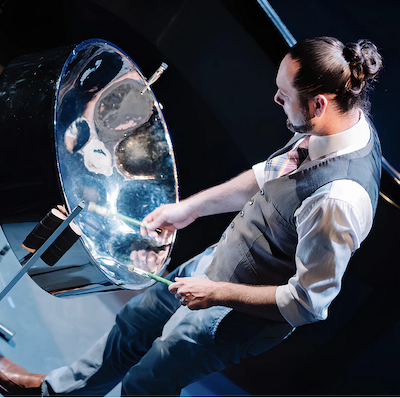
One of these many musical corners is the Birenbaum Performance Space, where on Thursday evening, November 20 in front of an intimately seated crowd, steelpan virtuoso Victor Provost strutted his stuff along with the Oberlin Performance and Improv (PI) Ensembles. The performance blended both genre and experience level in a delightful and holistic exploration of world music.
Considering the eclectic mix of instruments that were used, the spatial awareness of each member of the ensemble was impressive. Instruments seldom overlapped or obscured others. Indeed, there was a collective sound that could only be described as unbrokenly full.
There was also an element of transience to the performance, mainly due to the structuring of the ensembles which were divided in half — one group of students rotating in for the other around halfway into the performance. The music retained its round-edged, gallivanting jazz themes throughout.
Provost, who describes himself on his website as “one of the world’s leading voices on the steelpan,” remained on stage for the entire duration of the concert, but served less as a musical anchor for the set, and more as a perfect complement to the remainder of the whole. This role was one that he made look deceptively easy — amidst more traditional jazz instrumentation, Provost, a self-admitted mixer of genres, made the steelpan’s unusual timbres feel right at home. He was a true picture of versatility.
There were moments of individual brilliance during the opening two works. An emphatic trombone solo from Henry Newquist on the opener, and a halting, then tumbling, then driving drum introduction from Yunshen Tao on the second. Both were pieces that emphasized the collective. A bassoon, a violin, and a clarinet were enmeshed seamlessly into a more traditional jazz ensemble structure for both works, the first, a samba that sauntered forth carefree, and the second, a more brooding arrangement in a-minor with a tiptoeing central melody.
During moments of starker instrumentation, Provost’s stylings stood out. In his duo with jazz studies professor and trombonist Jay Ashby, Provost first backed his peer’s contemplative solo with a mellow, multitonal progression before effortlessly moving to the foreground, sharpening his axe to produce a head-bobbing solo of his own.
The final piece, “Rain-O-Rama,” was equally mesmerizing. Performing entirely alone, Provost played the steelpan like a jazz piano, highlighting chord stabs with rapid licks and fills, but allowing the natural reverb of the instrument to round out the sonic space. This was mastery not only of the instrument’s melodic capacities, but of its physical boundaries as well.
Bright Eyes, a Provost original, was the best selection of the evening. Its windswept melody was carried beautifully by pianist Riah Burrows, whose lush featherbed of chords was buoyed by shimmering cymbal work by Tyler Graf. There was a similar gentle restraint, but no lack of technical prowess during solos. Bohdan Kinal on alto saxophone was a standout with piercing tones clinging to the air like a human voice.
Provost himself was excellent as well — his heavily syncopated solo was wonderfully intricate, oscillating effortlessly between high and low. The overall effect was one of bottomless acoustic depth and collective alignment in spite of contrasting means — a fitting summation of this multi-faceted musical evening.
Published on ClevelandClassical.com November 25, 2025
Click here for a printable copy of this article