

by Max Newman
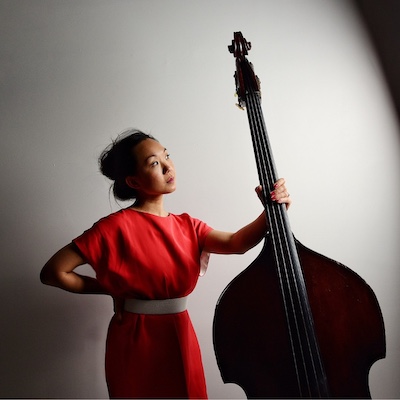 Upon first thought, you would think that conveying complex themes like “the fragility of time and life” through mostly wordless music would seem futile. Bassist Linda May Han Oh and her band would beg to differ.
On March 19 in Oberlin’s Finney Chapel, the group achieved exactly that with their performance of The Glass Hours. It was an uncategorizable concert, heavy with feeling and chock-full of technical prowess.
Some concerts in Finney Chapel are swallowed up by the venue’s cavernous qualities. This was not one of them. Oh and her band sent notes swimming to every corner of the space, building walls of sound that were dotted by well-defined lead lines and solos — the ensemble was able to simultaneously convey cacophony and sonic exactitude with exquisite dynamic control.
 On his website, Makaya McCraven refers to himself as a “Beat Scientist.” It’s an interesting moniker, but those who were present for McCraven’s performance at the Cleveland Museum of Art’s Gartner Auditorium on Wednesday, February 18 will know exactly what the spellbinding drummer was getting at. Indeed, his concert was a study of beat-making, an intersection of synthesized and organic sound, a beautiful amalgamation of the mechanical and the natural. Makaya McCraven was true to his word.
 Pianist Theron Brown wants you to be able to hear his own personality in his music. “I try not to think about it too much. My music is part of me, and I try to be authentic and true to myself within it. I want people to listen and be like, ‘Oh, that’s Theron.’ It’s real, it’s honest.”



 For sheer polish of performance, under the direction of Raphael Jiménez, the Oberlin Chamber Orchestra is an ensemble that can scarcely be faulted. On the crisp fall evening of September 25, the Orchestra kicked off its 2025-26 season at Finney Chapel in a familiar vein: the well-rounded performance of three pieces, monumental in sound and cinematic in narrative. The Orchestra was able to simultaneously create the sensation of enormous musical objects and patchworks of delicate moments.