


by Max Newman
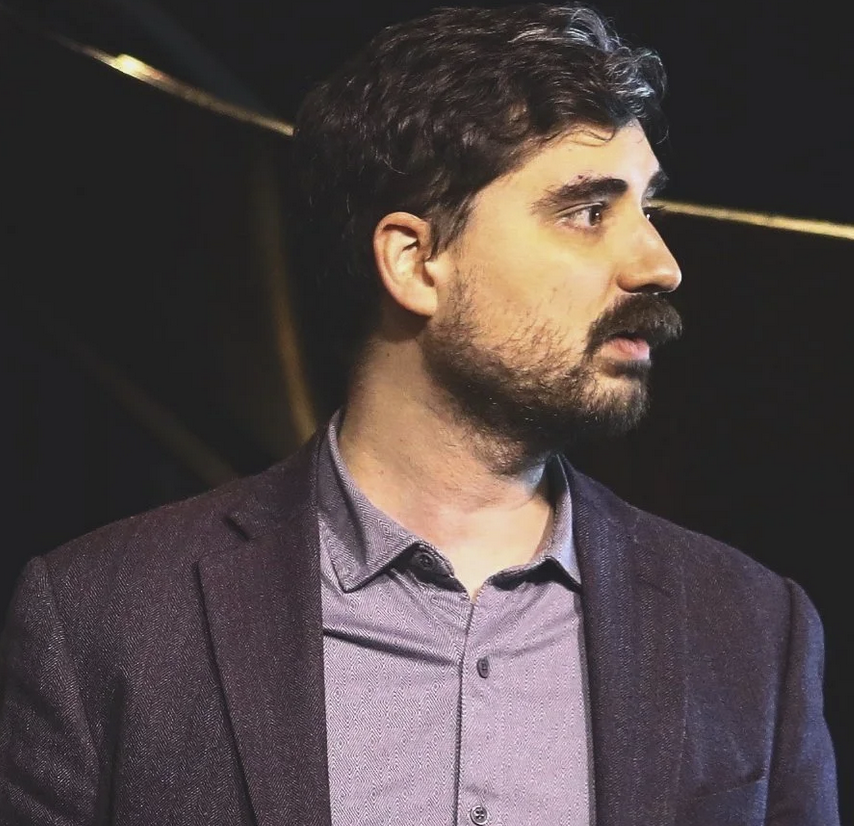 For lovers of Cleveland’s contemporary music scene, there is perhaps no group more acutely on the cutting edge than the Cleveland Uncommon Sound Project. The genre-blending organization, founded in 2017 and under the stewardship of Stephan Haluska (pictured, left) since 2021, has provided ample space for Cleveland’s new music artists to strut their stuff for the better part of a decade.
Now, as part of their 2025-26 run, they are continuing these groundbreaking traditions. On September 26 at 8pm, the project will play host to synthesist and composer Matthew Ryals, as well as the local piano, harp, and electronic trio of Harper/Haluska/Oicherman (featuring CUSP’s own director), for an evening of sonic mobility and spontaneity. I spoke with Haluska about the upcoming performance, as well as the past, present, and future of CUSP.
“I’ve known him for a long time,” said Haluska of headliner Matthew Ryals, whose fully improvised recording “Exalge” was released earlier this month. When Haluska learned that his friend’s tour would be stopping in Northeast Ohio, the lightbulb went off in his head. “Matthew studied classical guitar at CIM and has since moved to New York, but we’ve always kept in touch. He reached out to me about coming through Ohio, and of course I jumped at this opportunity. He’s someone who I’ve wanted to work with before, but we haven’t really had the opportunity until now.”
 Ryals’s current work incorporates his more classical training, but possesses heavily experimental influences. “He’s a modular synthesist, and is really fascinated by the acoustic timbres produced by the extended techniques from acoustic instruments,” Haluska said. “A large part of his work are these synthesis practices that are involved in creating these acoustic instrument sounds, but he takes it further. He really tries to emulate the multiphonics of woodwind instruments, the various bow pressures of string instruments, and his work is largely improvised.”
Haluska sees this connection between synthesized sounds, acoustic sounds, and improvisation in his own trio, the other act scheduled for September 26. The group, featuring Haluska on harp, Grace Harper on piano, and Boris Oicherman on synthesizer, will be playing graphic scores composed by its members, heavily utilizing extended techniques.
“I’ve been playing with Grace and Boris for some time now,” Haluska said. Grace organized this trio during the summer, and it became a vehicle for exploring structured improvisation through graphic notation.”
The group’s set will feature a composition to which all three members have contributed. “We are segmenting our work as movements within the larger set, all roughly 10 or 15 minutes. They all explore different things,” Haluska said. My work is very involved with the idea of layering and blending multiple sounds at once while maintaining stasis, Grace’s is more about dialogue and imitating action, and Boris’s is all about this idea of convergence and divergence of sound.
Haluska sees both sets as aligning with the forward-thinking mission of CUSP. “We cater to a broad range of what new music could be in the 21st century. A lot of the boundaries between new composition, chamber music, free improvisation, electronic music, and sound art have been eroded. It’s really exciting to be able to present a lot of works that aren’t clearly defined within one category, but can exist within many different categories all at once. And it’s great to have a space in Cleveland that contributes to the local scene, presenting the sort of work that might not find a home elsewhere.”
Haluska also feels a deep personal connection to the music that will be on display on Friday. “I think that synthesizers are often seen as very much robotic,” said the director, “and there’s been huge advances in talent and technology that have made it deep and complex, with a rich sort of interactivity that I people don’t acknowledge. I think it’s a very human instrument, but it takes that special kind of approach to be able to demonstrate its human capabilities. And I have this desire to treat acoustic instruments like synthesizers. I load my harp with a lot of preparations… I’m always thinking about how I can deconstruct or reconstruct my instrument to redefine it for myself.”
The concert will take place at CUSP’s concert space, located at 1433 East 33rd Street. The venue is a former Catholic church that was repurposed in the late 1990s to become a location suitable for both art displays and musical performances. “It’s a sanctuary with these 50ish-feet high, vaulted ceilings, which really contribute to the beautiful resonance that we get in our concerts. There’s a prominent reverb that envelops the space. Everything sounds great in there, and I feel very fortunate to be able to utilize it to present our work.”
CUSP has a variety of future events scheduled, including performance art by Ben Wretch and Maria Custer on October 10, and a concert featuring the intricately costumed group Ak’chamel, The Giver Of Illness on November 2nd. But through it all, Haluska wants CUSP to remain uninhibited. “We largely try to stay away from themes. If we tried to pin down any one specific theme, I feel like we would be limiting ourselves in what we could offer. What is new and experimental music in 2025, 2026? Anybody’s definition, right? It could be all sorts of things, so I think a huge part of our job is showcasing that variety.”
Published on ClevelandClassical.com September 23, 2025
Click here for a printable copy of this article