


by Mike Telin
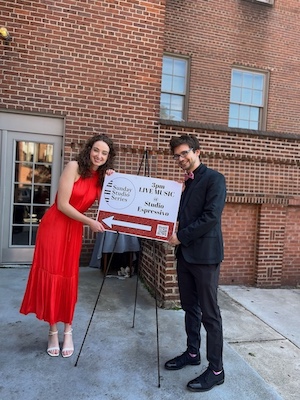 What do Colombina, Harlequin, Pantalone, Pierrot, and Pulcinella have in common? They are all characters of the commedia dell’arte. This weekend they will be brought to life musically when Studio Espressivo presents Masquerading Melodies.
Performances are on Saturday, June 6 at 3:00 pm & 8:00 pm, and Sunday June 7 at 3:00 pm at Studio Espressivo, 2026 Murray Hill Road #111. Pay-what-you-wish, tickets available Online.
Studio Espressivo concert series founders, pianist Allison Hillier and composer/pianist Chris Neiner, will open the program with Gabriel Fauré’s Overture from Masques et bergamasques for piano four hands.
“The overture is not even four minutes long, but it is so fun,” Neiner said during a Zoom call. “It was commissioned as incidental music for a theatrical entertainment for the Prince of Monaco in 1919. It was inspired by commedia dell’arte and designed to be first on a concert.”
Neiner will then take on Sergei Rachmaninoff’s Polichinelle in F-sharp minor. “The title is French for Punch, from Punch and Judy, which itself goes back to commedia dell’arte. So it’s very much a character piece.”
A work that is steeped in commedia dell’arte characters is Robert Schumann’s Carnaval. “The piece is 21 short pieces that depict the masked partygoers during Carnaval,” Hillier said during the same Zoom call. “I’m starting with the Préambule, which introduces the entire set of pieces. It’s fantastic and very satisfying to play. I’m also playing Pierrot, who is one of the servant trickster tropes. It’s a bumbling, stumbling movement, and I see him as leaving the back door into the alley never to be seen again. That is followed by Arlequin, who’s also a servant trickster character. I see him as more of a social butterfly and you certainly hear that in the music.
Hilliar will move on with two characters who depict both sides of Schumann’s personality. “Eusebius is more shy, and Florestan is more dramatic, the fiery representation that the composer had for himself.”
She will continue with the flirtatious woman Coquette, and will conclude the set with Pantalon et Colombine. “Pantalon is the representation of money and greed in the form of an old man who is always chasing younger women. And Colombine is a female servant who is sometimes with Arlequin and sometimes with Pierrot. She kind of bounces back and forth between her love interests.”
Debussy’s “Clair de lune” from his Suite bergamasque is also on the set list. “This has been a joy for me to work on because it is one of the most beautiful pieces in the piano repertoire,” Hilliar said. She noted that many people don’t think about the work’s Italian connection. “Bergamasque comes from the word for rustic dance, which comes from the city of Bergamo in Italy. So there is an underlying Italian connection even though Clair de lune doesn’t sound anything like a rustic dance.”
Hillier pointed out that the title, which is French for moonlight, is taken from Paul Verlaine’s poem Clair de lune that describes the masks and Bergamasque of the commedia dell’arte tradition. “If anyone has not read the poem, they should, because it pairs so well with Debussy’s music.”
 Debussy was not the only composer to use Verlaine’s poem as inspiration. “Polish composer Joseph Szulc included a vocal line in his Clair de lune, although it’s a different take on the poem that captures the more hopeful nature of the evening,” Hillier said. “I think it makes for an interesting pairing to hear what two different composers did with the same piece of literature. And I’m looking forward to performing it with tenor Timothy Culver.”
Culver and Hillier will come together for “Vesti la giubba” from act I of Ruggero Leoncavallo’s Pagliacci. “This aria is the tragic trope where the main character Canio, who’s playing a clown, has found out that his wife Nedda has cheated on him but he still has to dress up, put his makeup on, and perform,” the pianist said. “I’m really excited to perform it with Tim.”
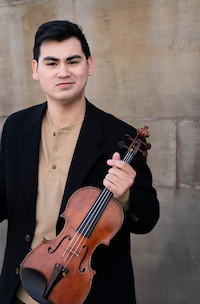 Violinist Zachary Brandon will join Hillier in Jean Sibelius’ Scène d’amour from Scaramouche.
The piece was originally a ballet pantomime and its history is quite interesting,” Hillier said. “There is correspondence from Sibelius who wrote that he regretted taking on the project, because he didn’t realize he needed to compose an hour’s worth of music. ‘My life has been ruined, I’ve signed on to this giant project.’”
Sibelius completed the ballet pantomime in 1913 and then later arranged the Scène de mort for violin and piano in 1925. “Scaramouche is another stock character who is trying to seduce the master’s wife with his viola playing. So it’s quite funny that Sibelius chose to depict a violinist and not a violist for this arrangement. The wife is tempted by Scaramouche and he wins her over — but in the end they both end up dying.”
“As soon as we found Riccardo Drigo’s “Serenade” from Harlequin’s Millions we knew it had to be on the program,” Neiner said. “The funny thing about Drigo is that he was an Italian, but made his biggest impact in Russia where he was a ballet master, conductor, composer, and pianist. He conducted the premiere of Tchaikovsky’s Sleeping Beauty and The Nutcracker. He also wrote this ballet, which is based on commedia dell’arte figures, in the early 20th century. The Serenade from Act 1 is his most famous piece and I look forward to playing it with Zachary.”
Neiner and Brandon will also come together for Neiner’s own Burlesquing. “This is a piece that’s gone through a lot of iterations going back to when I was in 9th grade,” Neiner said. “It’s just a fun, sassy ditty, and that’s exactly why it’s on the program. If this piece was an emoji, it would be the tango dancing lady.”
Brandon will also perform Niccolò Paganini’s 24th Caprice and Hillar and Neiner will return to piano four-hands to close the program with Ottorino Respighi’s Bergamasca from Suite No. 2 of Ancient Airs and Dances.
Published on ClevelandClassical.com June 1, 2026
Click here for a printable copy of this article
