



by Stephanie Manning
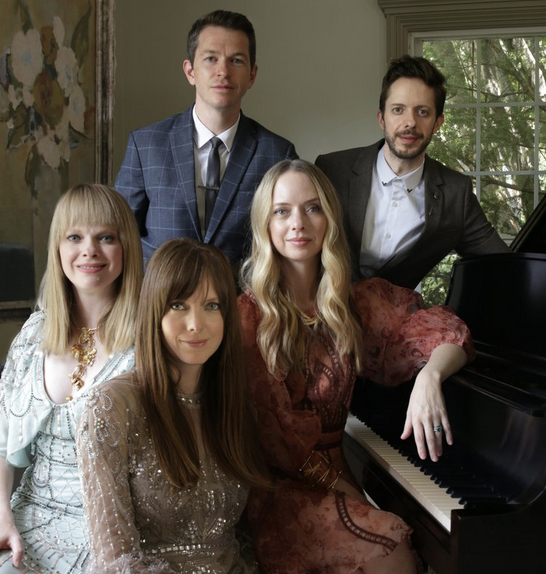 Music for five pianos is rare enough — so The 5 Browns knew that if they wanted to play a concerto together, they’d need to create their own. That’s exactly what the sibling quintet achieved in 2011, when the Ravinia Festival commissioned composer Nico Muhly to write The Edge of the World.
For their visit to Cleveland, the group gave their program the same title, with the theme of exploring uncharted territory. On July 20, they treated the audience at Playhouse Square’s Mimi Ohio Theatre to plenty of familiar tunes. But the visual and auditory spectacle of their performance, which opened Piano Cleveland’s 2025 Piano Days series, was the real draw.
Although they have kept their name the same, the group is technically now The 5 ‘B’s — four Browns and a Beus. Stephen Beus joined the Brown siblings Desirae, Deondra, Gregory, and Melody after Ryan Brown’s departure in 2023. But just by watching them play together, it’s impossible to tell Beus isn’t a Brown himself. The quintet’s synchronization never faltered during the almost two-hour program, even during Muhly’s challenging concerto.
No orchestra joined them on stage for this piano-only version of The Edge of the World. But the two selected movements — “Reykjavik” and “The Night Sky” were an interesting window into this post-minimalist piece. The pianists carefully fit all kinds of syncopated patterns together in layers of interlocking puzzles.
The original orchestral palette might have elevated the experience, as it also could have during Camille Saint-Saëns’ Danse Macabre. The iconic violin tritone lost some of its biting character when delivered via piano. However, George Gershwin’s Rhapsody in Blue felt exciting in this combination, and Melody Brown delivered a sensitive opening solo.
The arrangement of the five Steinways in a semicircle shape meant that the audience couldn’t quite see all 440 keys. Piano Cleveland’s solution was a live, multi-camera feed — unfortunately, the projected images lagged at least a second behind the musicians’ real-time movements.
Thankfully, the listening experience didn’t require the video, especially during more intimate works like Greg Anderson’s arrangement of Claude Debussy’s “Clair de Lune.” Murmurs of surprise went through the audience as the three sisters — Desirae, Deondra, and Melody — left their respective pianos to gather on one bench. The trio gracefully navigated the space of a single keyboard, bringing out the gentleness of the piece as the spotlight scattered the light like stars.
With all five pianists back at their keyboards, Anderson’s arrangement of Harold Arlen’s Over The Rainbow: Fantasy for Five Pianos cycled through many moods in selections from The Wizard of Oz, from the boisterous “Ding-Dong! The Witch Is Dead” to the delicate “Over the Rainbow.”
The three sisters again added their own touch to the evening during selections from Gustav Holst’s The Planets, vocalizing the wordless chorus in “Neptune, the Mystic.” The rumbling of “Mars, the Bringer of War” and cheerful “Jupiter, the Bringer of Jollity” sparkled with energy, even if the sheer force of five pianos created a wall of sound at points.
Another “Jupiter” — this one the “Molto allegro” from Mozart’s Symphony No. 41 — benefited from a greater separation of parts. The 5 Browns themselves arranged it, as they did The Beatles’ “Blackbird.”
Although “Blackbird” was short, it made a big impression, with the song’s famous, wistful harmonic progressions enhanced with pianistic flourishes. Melody Brown described it to the audience as the sound of wind through birds’ wings — and these five birds sounded like they could soar all the way to the edge of the world.
Published on ClevelandClassical.com July 31, 2025.
Click here for a printable copy of this article
