


by Mike Telin
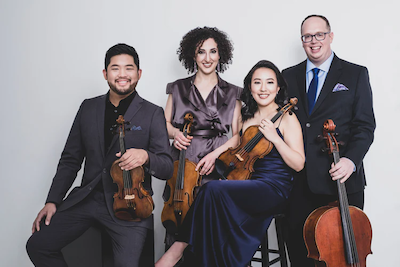 After winning top prizes at the Wigmore Hall, Melbourne, Osaka, M-Prize, and Fischoff International Chamber Music Competitions, as well as the 2015 Concert Artists Guild Competition, the Verona Quartet have enjoyed a quick rise to the upper echelon of the chamber music world.
Committed to mentoring the upcoming generations of musicians, the Quartet serves on the faculty of Oberlin College and Conservatory, ENCORE! Chamber Music, and as Artistic Directors of the Lunenburg Academy of Music Performance.
On Tuesday, April 28 at 7:30 pm in Gartner Auditorium at the Cleveland Museum of Art, the Verona Quartet — Jonathan Ong and Dorothy Ro (violins), Abigail Rojansky (viola), and Jonathan Dormand (cello) — will make their Cleveland Chamber Music Society debut. Their program features music by Scarlatti, Glass, and Janáček. The ensemble will be joined by pianist Yaron Kohlberg for Antonín Dvořák’s Piano Quintet in A. Tickets are available online.
I caught up with Jonathan Ong by phone and began our conversation by congratulating him on the Quartet’s Chamber Music Society debut.
Jonathan Ong: We’re very excited, and looking forward to playing Dvořák’s second piano quintet with Yaron Kohlberg. When the Cleveland Chamber Music Society approached us about the idea of collaborating, it made a lot of sense. He’s a fantastic pianist and so intricately tied to the Cleveland music scene and the Cleveland International Piano Competition. It’s nice, being an Ohio-based quartet to have an Ohio-based collaborator. I think that’s very special. There’s just such a wealth of music in the Cleveland area.
Mike Telin: You have a great program. I was unaware of the Scarlatti before I started preparing for this conversation.
JO: We think of Joseph Haydn as being the father of the string quartet, and he did champion the art form, but before him, Alessandro Scarlatti wrote these amazing works, the Sonate a Quattro. When we discovered No. 4, we thought it’d be a great way to start off a program and introduce people to the early beginnings of the string quartet, and how it later transitions into what it is today.
MT: How do Philip Glass’s String Quartet No. 2,“Company”and Leoš Janáček’s Kreutzer Sonata connect to each other?
JO: They are incredibly different but similar in the sense that they are both based on novellas. The Glass is based on Samuel Beckett’s Company, and the Janáček is based on Leo Tolstoy’s The Kreutzer Sonata. Both explore different parts of the human psyche. The Beckett centers around the theme of this fragmented voice in the dark and trying to understand what the voice is. And Leo Tolstoy’s is intense, emotional, volatile, and dramatic.
The Glass is such an interesting work. The novella plays on themes of loneliness and living in an age of godlessness. And just like in the novel, you have these fragments that repeat themselves, but not in the same way. They constantly evolve and go through a myriad of different colors and affects. I think it’s a perfect pairing — the novella and the piece.
Tolstoy’s novel evokes themes of jealousy and intense emotional volatility. In the story, the protagonist kills his wife in a fit of jealous rage because he assumes that she is having an affair with another musician. And in the novel they are playing Beethoven’s famous sonata, which is why the book is titled The Kreutzer Sonata. People often think the Janáček is directly tied to the Beethoven Sonata, but we have Leo Tolstoy’s book as the intermediary. It’s kind of cool.
MT: Is there anything else you would like people to know about the program?
JO: Just that the heart of the first half of the program is the Janáček. and the Glass, because they’re both based on stories, and that stems out of a deeper identity within the quartet. Obviously our name, Verona Quartet, is in part a tribute to Shakespeare and his love for that city. We believe that all forms of art are forms of storytelling so we always endeavor in our programs to tell some kind of story and to connect different disciplines of art.
One of our passions is exploring the intersection of different art forms. We’ve recently performed with a Shakespearean actor, programming a reading of Hamlet along with Schubert’s Death and the Maiden Quartet.
We’re always crossing different cultures. We’ve commissioned pieces for string quartet and Chinese instruments, and with Hindustani singers. We’re always trying to push the boundaries and see how we can connect different artforms.
MT: Switching topics — when did the quartet arrive on the Northeast Ohio scene?
JR: It was really a stealth entry because we moved here at the height of the pandemic, and it really was a fortuitous move. We were based in Boston, and I believe it was in February of 2020 that we got a call from Oberlin inviting us to join the faculty. And as you know, in March 2020 everything closed down. So we stayed in Boston for a little bit longer, and then in August, we moved here. We all live in the Oberlin area, but not together.
MT: That would be too weird.
JO: But it’s a question we often get on the road — ’Do you live together?” And we say, “No, we don’t.”
Oberlin is great. There’s a spark of creativity that runs through the veins of the school so we’re really enjoying it. And it’s close to the airport so it’s easy to travel.
MT: You’re also in residence at ENCORE Chamber Music.
JO: That’s right, so we spend almost the entirety of June in the Cleveland area with the Festival. Actually, Dorothy, our second violinist, myself and Jinjoo Cho, who is the director of the festival, were all students of Paul Kantor at the Cleveland Institute of Music. I played chamber music with Jinjoo and with Dorothy, and when ENCORE started in Cleveland, it felt like a very natural fit. It’s also very nice to be able to spend a month at home.
Published on ClevelandClassical.com April 22, 2026
Clickhere for a printable copy of this article
