



by Stephanie Manning
 The warm light spilling out onto the Waterloo Road sidewalk on February 14 came from Praxis Fiber Workshop, which had opened its doors that evening for a concert by Wit’s Folly. Beyond the large windows curtained with vertical string lights lay the open showroom area, with colorful art adorning the walls and even hanging from the ceiling. Quite the dynamic space to hear some 18th-century music.
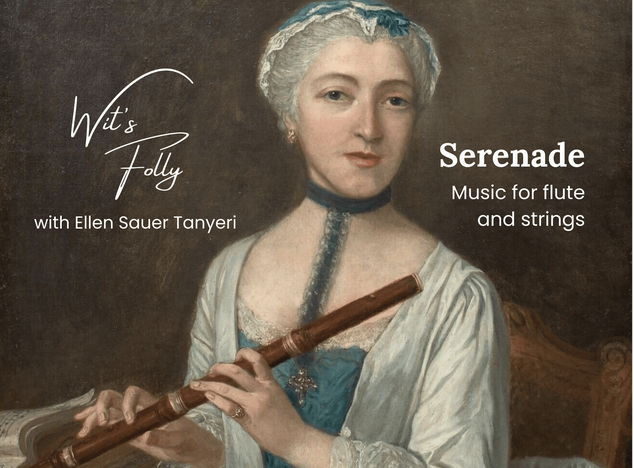
For this Valentine’s Day program, guest flutist Ellen Sauer Tanyeri joined violinist Guillermo Salas-Suárez, violist Jonathan Goya, and cellist Jane Leggiero in a collection of music featuring the flute, with a Wit’s Folly twist. The group decided to combine movements from two of Beethoven’s Serenades (Op. 8 and Op. 25), to make a serenade of their own.
The resulting work came together smoothly, alternating between the string trio combination of Op. 8 and the flute, violin, and viola combination of Op. 25. The opening movements from each were played back-to-back, establishing a sunny mood, before the third and fourth movements of the set relaxed into wider gestures.
Before the mashup Serenade began, Salas-Suárez explained that the “Adagio – Scherzo, allegro” from Op. 8 was his favorite because of how it vacillates between melodrama and energetic humor. To set the scene, he described the movement as the soundtrack to a sad clown — one who is suddenly surrounded by a group of wily clowns running around and pulling pranks. That created quite the image to live up to, but the players made the most of this lesson in contrast, with Leggiero putting particular force behind her double-stops.
During the sixth and final movement, a neat theme and variations from Op. 25, occasional noises from air or machinery drifted over from the back of the workshop — a temporary distraction, though one that would resurface from time to time.
Between pieces, Tanyeri took the time to explain more about her historical flute, an original from 1812. As she took apart the instrument’s pieces, swabbed, and reassembled them, she discussed how changes in keys and bore impacted the instrument’s sound. This helped add context to Mozart’s Flute Quartet No. 3 in C Major, which opened the program, and François Devienne’s Flute Quartet in A minor, which closed it.
The cheerful Mozart fit very well into the salon-like space. The acoustic helped uncover virtually every note in the gentle second-movement Andantino, including those from Goya and Leggiero, whose lower voices often anchored the chords and the overall sound. In the first movement, Tanyeri’s controlled, smooth sound helped her pass joyful melodic fragments back and forth with Salas-Suárez.
During the Devienne, Tanyeri minimized the number of keys she pressed, having explained that the composer — a flutist himself — much preferred the one-keyed flute of the early 1700s. This quartet featured a much more virtuosic flute playing than the rest of the program, and Tanyeri and Leggiero danced up and down their respective arpeggios.
Unlike Mozart, who famously disliked the flute, Devienne clearly adored it. And by the time the program was over, it seemed that most of the audience had learned to love the flute, too.
Published on ClevelandClassical.com February 28, 2026
Click here for a printable copy of this article
