

by Mike Telin
 On Saturday, June 7 at 7:30 pm at Disciples Christian Church, Margi Griebling-Haigh’s tragi-comic chamber opera The Higgler will receive its world premiere, directed by Marla Berg and conducted by Steven Smith.
The production will be repeated on Sunday, June 8 at 3:30 pm. Tickets are available online.
I spoke with Brian Skoog, Elizabeth Frey, and Gabrielle Haigh on Zoom.
Mike Telin: Brian, you’re Harvey Witlow, aka The Higgler. And unlike the leads in Don Giovanni or Pelléas and Mélisande, you actually have the biggest part.
Brian Skoog: Good point — I pretty much don’t leave the stage. Margi said from the beginning that I was going to be in every scene and that turned out to be true.
MT: Who is the Higgler?
 BS: That’s been fun to discover. The Higgler is such a grounded role but there’s a lot of subtlety to the character. So the challenge has been finding ways to bring out those qualities, because opera and subtle don’t often go together.
The Higgler himself was deployed in World War I in France and has come back to his town and is now trying to make a living for himself as a Higgler. But a Higgler is someone who deals in poultry but in livestock as well. So goes around trying to make deals and just being an intermediary.
He’s somebody who’s driven and very pragmatic. He’s trying to make wise decisions in his business and is at odds about how to do that in his personal life, because his driving force is being pragmatic.
There are emotions at play as well. And he doesn’t know what the best decision might be. And what we see in Coppard’s short story and Margi’s very interesting adaptation is a musical representation of him making those internal decisions.
MT: Is the music satisfying?
BS: Very much, Margi paints with a very broad musical color palette and uses rhythm to its fullest extent. Sometimes what I’m singing lines up with the orchestra and sometimes it’s the very opposite and I think that none of that is by accident. So it’s been fun exploring the score and decoding it.
MT: Elizabeth, Mrs. Sadgrove is a bit confusing. We don’t know a lot about her.
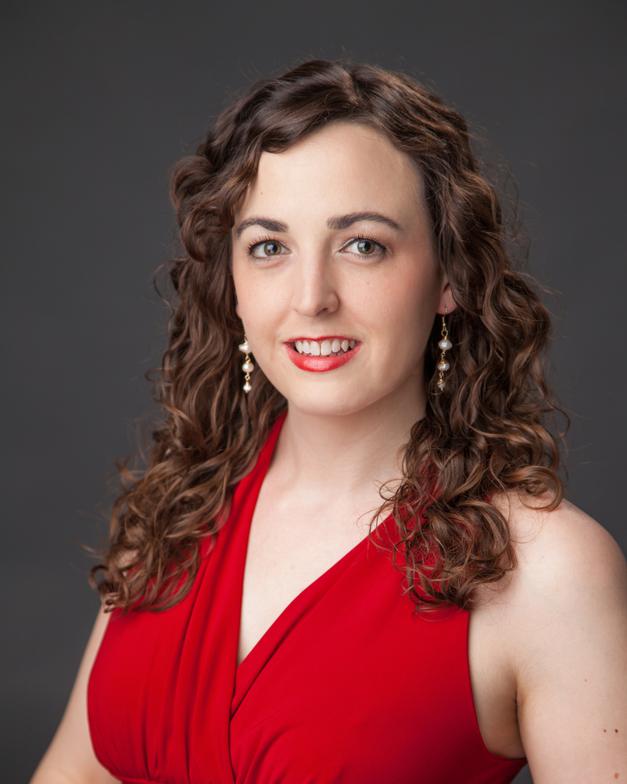 Elizabeth Frey: Exactly. And all of my scenes are with the Higgler — because he is in every scene. I would describe her as a shrewd businesswoman, very down to earth, and she makes good financial decisions.
She’s a widow and she and her husband had built a prosperous farm. And after he died, she continued to build the business.
They were able to afford their daughter Mary a high-class education. They are country farmers, but Mary has been educated in France and her aristocratic background is almost to her detriment.
In one of my act one scenes, Mrs Sadgrove says that “education is a fine thing, but a farm needs a farmer. Fine manners are disarming, but a scholar is for the school and a farmer is for the farm. But Mary is going to need help because she received too fine an education to continue what I have built.”
Mrs. Sadgrove is ill, although we don’t know from what. On first reading you’re thinking that she must be an older woman, but Mary is not that old. At one point she says, “I’m not going to live for much longer. And my daughter needs help with this place.” And she tells the Higgler, ‘you should marry her’ — so that’s a proposition in a very direct way.
MT: What is the relationship between your character and her daughter?
EF: I think that Mrs. Sadgrove loves her daughter and dotes on her only child, but there’s a frustration. She says her daughter is unlike her — ‘I’m a pragmatic woman.’ And Mary does not speak up for herself. She hasn’t found her voice.
Even though there is no scene where Mary and I are talking by ourselves, it’s implied that she cares deeply for her daughter and wants her to have a good life, but feels that she needs to step in and make things happen.
MT: Brian, how does the Higgler react when he realizes that Mrs Sadgrove wants him to marry her daughter?
BS: He doesn’t know what to make of it. But ultimately, I don’t think he fully trusts everything. He is, again, weighing his options and making pragmatic decisions. And I think he sees how shrewd Mrs. Sadgrove is and he recognizes that this is a scheme of hers.
MT: Gabrielle, how did you go about creating the character of Mary?
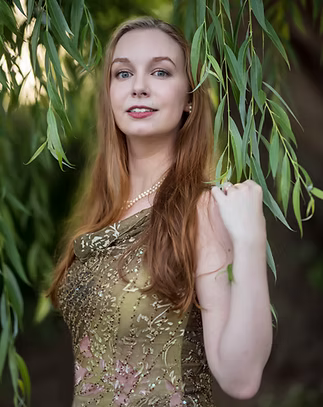 Gabrielle Haigh: I always start with the music, especially when I’m looking at a character like Mary who doesn’t have a lot of text.
I looked at what the music tells us about her inner world. Her music is very interesting, and it’s not simple music. So I think Mary is very intelligent. I think she’s very intense, but she doesn’t show it. I think perhaps because of the society and time she grew up in and maybe because of some of her life experiences, she’s learned to keep things to herself and to do that even to a fault.
MT: What does she see in the Higgler?
GH: This is not in Coppard’s story or in the libretto, but my theory is that when she was studying in France, she had some kind of an encounter with someone who was perhaps very different from the Higgler. Someone who was sophisticated and charming, and possibly a little wealthier than her family. And she learned a very difficult lesson the hard way from this encounter. I don’t know exactly what happened, but I think something did. And there’s something about Harvey (The Higgler) that’s reassuring because he’s kind of straightforward.
He’s not overly educated or sophisticated — he’s a little below her social class. And I think that that sort of grounded, down-to-earth type of person is very attractive to her.
I think it’s the same reason that she came back to the farm rather than trying to live a life in the wider world.
MT: How does the music capture Mary?
GH: It’s beautiful music. It’s complex, colorful, as well as harmonically and rhythmically varied. It makes me think of music that might have been happening in Paris when Mary was in France.
She’s so interested in birds and aware of all the different types of birds. Her first aria is all about these different types of birds. Her second aria is a little French children’s song about birds, but set to her own melody.
To me, that’s one thing the music tells us about her. — it’s like she’s always walking in this forest of her own imagination.
MT: What is her relationship with her mother?
GH: I think they do love each other. But I think Mary may have been closer to her father, who’s not in the picture. I think her father was probably the one who encouraged her to go abroad for her education. And the one with the aspirations for her to become well-educated.
Mrs. Sadgrove says that she thinks that Mary, with all her fine education, is not really suited to life on the farm. So I think she sees Mary as being a little naive and doesn’t have as much common sense as she might.
MT: In the end because we’re not sure that everyone lives happily ever after, I asked Brian and Gabrielle if they have imagined an Epilogue?
BS: Yes I have, but I hesitate to say what I think happens, because I want that question to be for everybody. Things could go a lot of different ways but it’s going to be messy no matter what happens.
GH: I’ve given it a lot of thought but I have not come to a clear conclusion. I think Harvey probably does come to help her out on the farm as it says in the text. But the last words she sings are so British: ‘I’m so grateful you’re here. Goodbye.’ And to me, that’s such a repressed English woman’s response to the whole situation. I mean, she’s practically offering him a cup of tea — she doesn’t actually, but you can picture her toddling in with some biscuits or something.
Published on ClevelandClassical.com June 4, 2025
Click here for a printable copy of this article
