



by Daniel Hathaway
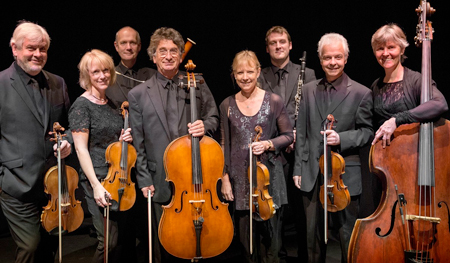 Northeast Ohio has had the pleasure of hearing London’s Academy of St. Martin in the Fields Chamber Ensemble twice in the past few months. Last May, eight string players from the Academy’s expandable and contractible large chamber music group visited the Tuesday Musical Series in Akron to play Brahms, Shostakovich, and Mendelssohn. Last Tuesday, a string quintet enhanced by three wind players opened the Cleveland Chamber Music Society’s 66th Season with Antonín Dvorak’s Quintet in G and Franz Schubert’s Octet in F. String Quartets are able to conjure up a vast palette of sonorities, but the addition of a double bass, clarinet, horn, and bassoon can increase the possibilities exponentially.
The strings of the ensemble (violinists Tomo Keller and Harvey de Souza, violist Robert Smissen, cellist Stephen Orton, and double bassist Lynda Houghton) began the evening with the Dvorak, a piece that more often fills the role of a concert-closer. Once the players had settled in — a few lapses in intonation attributable to a long travel day were quickly mended — they produced a mellow and deeply engaging account of a work that, as Peter Laki’s program notes suggested, combines the rigor of German musical forms with distinctly Czech approaches to melody, harmony, and rhythm.
The music of Dvorak’s Quintet exudes cheerfulness, except for brief moments when darker emotions momentarily cross its brow. The ASMF strings found and projected both its exuberance and its more introspective passages. The double bass contributed hugely to the richness of the string sound.
The centerpiece of the evening’s program came after intermission with the Schubert Octet — the second of fourteen performances the ensemble will give during its 19-day tour of North America. The strings were joined by clarinetist Timothy Orpen, bassoonist Lawrence O’Donnell, and hornist Stephen Stirling.
Before the modern profusion of lawsuits, imitation really was considered the sincerest form of flattery. Beethoven used Mozart’s quintet for piano and winds as the model for his own, and Schubert closely followed the blueprint of Beethoven’s Septet when he wrote his Octet on commission for the clarinetist Count Ferdinand von Troyer — only departing from Beethoven’s plan by adding a second violin and switching the order of two movements. No plagiarism proceedings were filed in either case.
The result was a delightful, 55-minute Divertimento for string quintet, clarinet, horn and bassoon full of beautiful melodic invention and general Gemütlichkeit. The Chamber Ensemble played it masterfully and with flawless ensemble. Particularly impressive details were the long unison passages between first violin and clarinet in the Adagio, the elegant transitions between variations in the fifth movement, the finely tapered phrases in the Menuetto, and the wind blend in the finale (a wonderfully cheerful conclusion laced with the surprises of sudden pauses and dramatic key changes).
Depending on where you sat, you might have (as these ears did) heard a bit more from the winds than the players intended. The horn sound in particular rebounded off the walls under the Plymouth Church balcony. That made the Octet sound a bit more like a horn concerto in spots, but happily, Stephen Stirling’s playing was spotless.
Published on ClevelandClassical.com October 11, 2015.
Click here for a printable copy of this article
