



by Daniel Hathaway
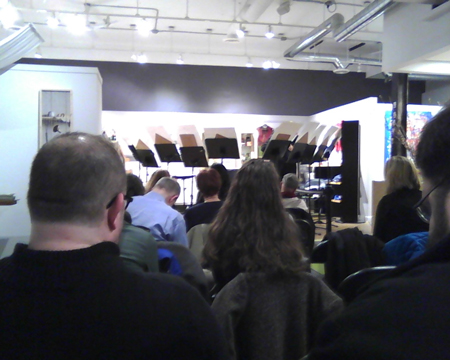 The second of two performances by contemporary flute guru Carlton Vickers sponsored by No Exit under the aegis of NEOSonicFest took over most of the available space in the Heights Arts gallery on Saturday evening, March 5. The audience, tucked in among a variety of exhibits of culinary-themed art, heard an intense hour’s worth of recent music written for one of the most ancient of musical instruments.
The audience heard Carlton Vickers, but they may not have seen him. Though the space was intimate, the special demands of works by Jason Eckardt, James Erber, and Brian Ferneyhough required Vickers to play from oversized scores deployed on multiple music stands that mostly obscured the flutist from view (see photo).
The four pieces on the program took Vickers and his flutes through every imaginable extended technique of which the instrument is capable. Eckardt’s Multiplicities (1993) alternates registers and involves spitting into the mouthpiece.
James Erber’s Desire Lines (2013-14) for alto flute — which the composer writes was variously inspired by a Roman road through the English Lake District, stories by Edwardian author Arthur Machen about the byways of suburban London, and the composer’s own architecturally-detailed street-dreams — is full of breathy meanderings and air sounds. (Another inspiration, Erber writes, was a mannerist painting depicting an explosion in a cathedral.)
Brian Ferneyhough’s Sisyphus Redux (2009) actually visits some conventional flute sounds. Playing on alto flute, Vickers also utilized microtones, rotated the mouthpiece of the instrument, and played more spit attacks.
Ferneyhough’s Unity Capsule (1975), the oldest work on the program, was also the most striking. Vickers said it took him ten years to prepare it, and that he was one of the few flutists in the world who was willing to take on the task. It began imperceptibly (Vickers crouched down behind a score page) then explored a vast range of sounds — tongue clicks, pops, murmured vocalizations — ending with a grand pause, then a sigh. The flutist looked exhausted after his 23-minute musical ordeal.
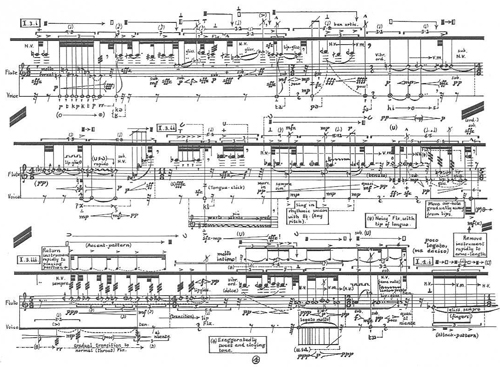 Afterwards, the audience was invited to inspect the score, which involved all ten of Vickers’ music stands as the performer moved from left to right. Is this what the schematic for a nuclear power plant looks like? Vickers explained that it was only a set of instructions. Every performance could be different — and this one was astonishing.
Published on ClevelandClassical.com March 22, 2016.
Click here for a printable copy of this article
