

by Daniel Hathaway
 TODAY’S HAPPENING:
The vocal and instrumental musicians of Akron’s Holy Trinity Lutheran Church and St. Sebastian Catholic Church join forces at 7:30 pm for An Advent Procession of Lessons and Carols at Holy Trinity. You can attend in person or watch the live stream, which will be available for the next week.
Oberlin’s Fridays@Finney tonight at 7:30 pm hews to an avian theme with performances of Ottorino Respighi’s The Birds, Shulamit Ran’s Grand Rounds & Olivier Messiaen’s Oiseaux Exotiques by the Oberlin Orchestra & Contemporary Music Ensemble led by Rafael Jiménez and Timothy Weiss. Attend in-person, or join the live stream.
Guest vocalists Vanessa Rubin, Evelyn Wright, and Ava Preston will be featured with Cleveland Jazz Orchestra at 8:00 pm at BLUE Jazz+ in Akron. If that’s not convenient, “Sing a Song for the Holidays” repeats on Saturday at the Maltz PAC in University Circle.
And Quire Cleveland makes the second stop on its three-concert tour of “Carols for Quire XI: Mary’s Song” tonight at 8 pm at Our Lady of Peace Church on Buckingham Ave. in Cleveland. It’s free. Read a preview here.
TODAY’S ALMANAC:
On December 3, 1883, Oberlin College began classes as the first institution of higher learning in the U.S. to admit both women and men.
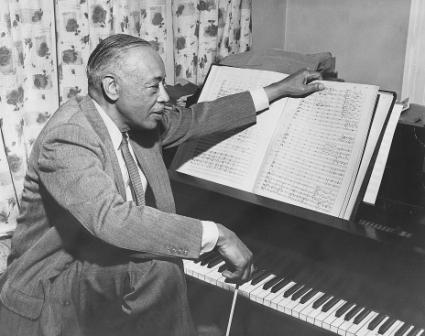
And on this date in 1978, composer William Grant Still (pictured above), one of Oberlin’s first Black students, passed in Los Angeles at the age of 83. (He was awarded an honorary doctorate from the school in 1947.) Still has recently received long-overdue attention for his extensive catalogue of works that includes symphonies, ballets, operas, choral works, art songs, chamber music and works for solo instruments. A good reason to go exploring! Start here to access a web site maintained by his family and click away!
Let’s continue our December list of premieres with a look at the first performance of Samuel Barber’s Prayers of Kierkegaard by Charles Munch and the Boston Symphony on this date in 1954.
Commissioned by the Koussevitzky Music Foundation in 1942, the gestation of Barber’s one-movement piece for soloists, chorus, and orchestra, was prolonged by a few interruptions — notably World War II.
Barber chose to set words by the 19th-century Danish theologian Søren Kierkegaard, whose writings had always appealed to him, but the composer avoided Kierkegaard’s complicated philosophy, turning to some simple and beautiful prayers instead,
Although it’s difficult to imagine in today’s media world, Time Magazine devoted an unsigned editorial to Barber’s new work, beginning with a description of the piece:
The work begins with plain chant, moves on to orchestral fortissimos. a restrained soprano solo, joyous choral passages and occasional Dies Irae trumpet blasts. But the overall effect is quiet, without either the sweetness or the grandeur expected of religious music. It is clean rather than austere. But at its best, the music matches the tender earnestness of the prayers’ poetry:
Father in Heaven! . . .
Hold not our sins up against us but
hold us up against our sins: So that the thought of Thee should not
remind us of what we have committed But of what Thou didst forgive;
Not how we went astray, but how Thou didst save us!
Time also reported on the critical reception of Prayers:
After last week’s Carnegie Hall performance by the Boston Symphony, the critics emerged dazed, uncertain, but impressed. The Times’s Olin Downes wrote, somewhat existentially, that one “wonders whether many pages of the score are not symbolic rather than expressive, or attemptedly expressive, of what cannot be communicated.” The Herald Tribune’s Paul Henry Lang found the work a “serious, moving and convincing piece.” On one point, most of the critics were agreed: they wanted to hear Barber’s Prayers of Kierkegaard again.
Click here to listen to a live performance of the 20-minute work featuring soprano Leontyne Price, the Cecilia Society Chorus, and the other original performers. Does anyone recall hearing a Cleveland performance of the work?
