


by Kevin McLaughlin
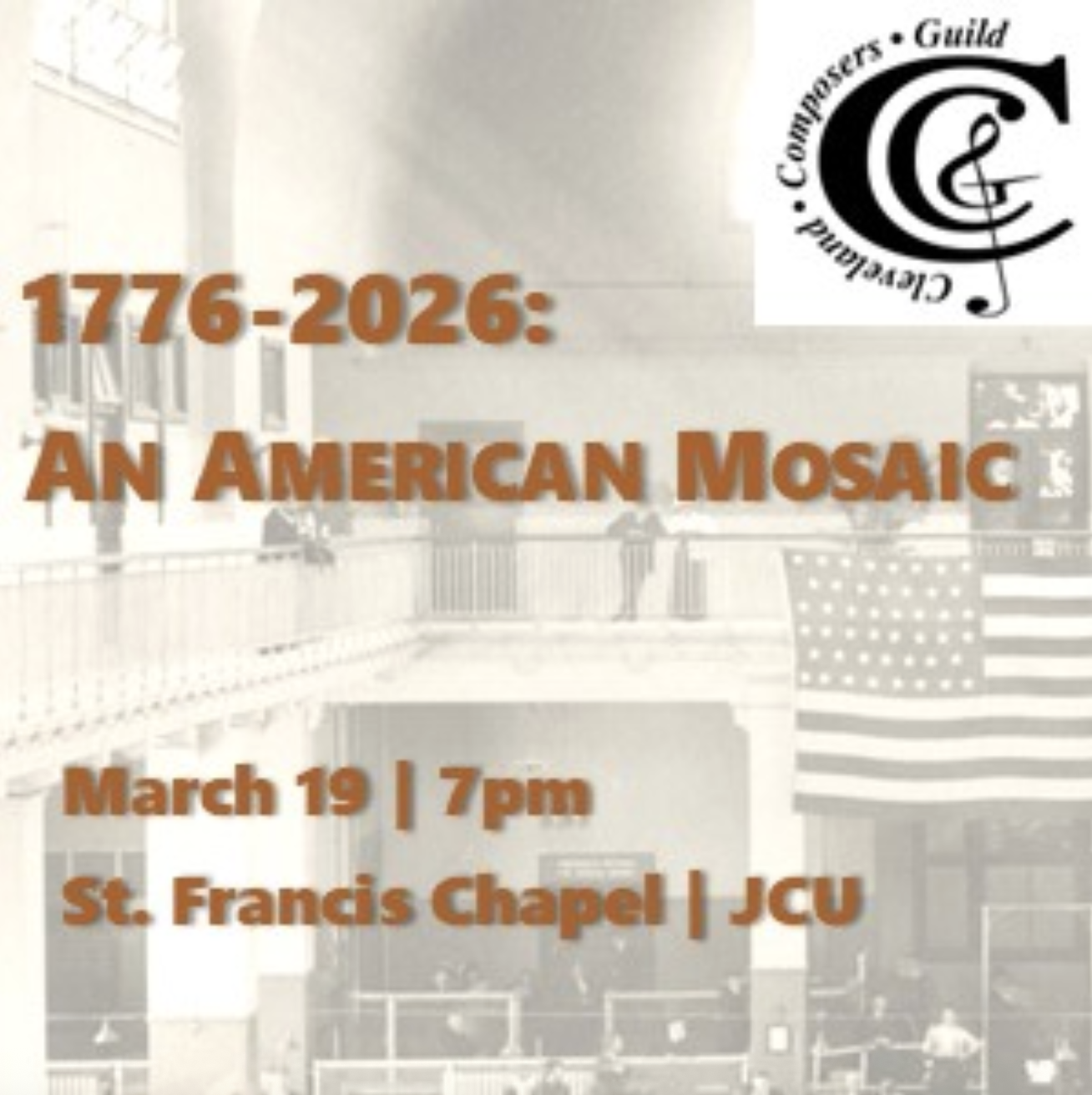 The Cleveland Composers Guild marked the approaching 250th anniversary of the United States on Thursday evening, March 19, at Saint Francis Chapel of John Carroll University with American Mosaic. Faculty performers from JCU joined the university’s Wind Ensemble in a program that paired familiar American fare with recent works by Guild composers — an odd patchwork of band music, art song, and new vocal works that surprised but ultimately pleased.
What linked this varied program was its ballad-like storytelling, direct expression, and an unembarrassed urge to communicate.
Gayle Getts and the JCU Wind Ensemble opened with Aaron Copland’s noble Fanfare for the Common Man in Robert Longfield’s arrangement for band. Written during World War II as part of Eugene Goossens’ fanfare project, Copland’s valedictory has outlived its companions and settled comfortably into the culture. Modest in numbers (about 19 players), the ensemble had a town-band quality — a little rough around the edges — but they were well prepared, and in obvious sympathy with the music they were there to perform.
Jack Bullock’s A Tribute to Gershwin followed, weaving together eleven songs including I Got Rhythm and Someone to Watch Over Me. The players took to them easily, as to a familiar idiom. Getts’ clear direction held things together, and the result was assured. Timothy Loest’s Land of Harp and Song — including three Irish melodies, Kerry Dance, The Last Rose of Summer, and The Minstrel Boy — quietly introduced the evening’s underlying theme: the immigrant’s contribution to the American mosaic. Solos on flute, alto sax, trumpet, and snare drum added distinction.
The rest of the evening turned to Guild composers, performed by a professional vocal quartet — soprano Laura Fisk, mezzo-soprano Claire Connelly, tenor Timothy Culver, and baritone John Gray Watson — accompanied by the excellent pianist Allison Hillier.
Ryan Charles Ramer’s Speech of Chief Seattle (2025) sets the well-known address attributed to the Suquamish leader on the subject of land and belonging. Watson’s baritone, emerging from within the ensemble, brought authority and warmth to the role of Seattle: such lines as “My words are like the stars that never set” carried particular gravity. Ramer writes in broad, anthem-like spans that favor clarity over complication — a directness that serves the text well and lends the music a quietly monumental quality.
Lorenzo Salvagni’s Mamma mia, dammi cento lire (2025), based on a Lombard folk song, unfolded as a compact scene: a young woman bound for America meets with maternal resistance and ultimately disaster at sea. The singers — especially Fisk and Connelly — gave poised, affecting performances. On the page, the narrative reads like melodrama, its tragedy almost comic in its swiftness, but the music is genuinely sad, evoking the human cost.
Matthew Saunders’ “Ganz alleine” (All alone) approaches the immigrant experience from a more inward angle. Watson’s solitary figure speaks plainly — “Here I sit on cold stones… surrounded by a foreign world” — while the music answers with unsettled harmonies and shifting textures. Fisk’s presence, as a not entirely consoling maternal voice, subtly complicates the scene. The two singers were closely aligned, and the piece carried a quiet poignancy.
Two songs from Ricky Ian Gordon’s Genius Child (1995) setting poetry of Langston Hughes brought a change of scene and mood. Gordon moves easily among styles — classical, popular, theater — and writes with a keen feeling for the voice. In “Kid in a Park,” a child sits as the world moves around him, unsure of his own place in it. “Border Line” is a reflection on liminal states — between living and dying, for example — where distinctions begin to collapse. Claire Connelly sang both songs beautifully, her bright, focused tone and expressive face making their inward drama palpable.
Robert Rollin’s piano solo Romance, drawn from the Mexican corrido “Roman Castillo,” set a lyrical line against shifting harmonic ground. There’s jazz in it, though in glimpses. Hillier played with clarity and continuity, letting the music unfold as a steady current — less concerned with arrival than with motion itself.
Stephen Stanziano’s All the Colors (De Colores) returned to folk material in an open, communal spirit. Its barnyard alliteration and simple refrains invite audience participation (though, inexplicably, no one did). Connelly’s bright, centered tone and irresistible smile carried the piece, tipping the mood toward unforced joy.
Jeffrey Quick’s Auswandererlied (Emigrant Song), based on a traditional German folk song, closed the vocal set with a shared account of departure and arrival. A group leaves home, bids farewell, crosses the ocean, and finds its footing in a new land, sustained by faith and shared purpose. Quick moves between homophony and gentle counterpoint, yet keeps the musical language clear, allowing sorrow and resolve to coexist. The piece begins in a parlor style and gathers momentum as the journey progresses — a structural gesture suggesting movement rather than mere narration. The quartet leaned into that shared experience; Hillier maintained a firm rhythmic underpinning.
The Wind Ensemble returned with two staples: Joplin! (arranged by L.C. Harnsberger) and Sousa’s The High School Cadets. The Joplin sparkled and the Sousa stirred. A welcome closing.
Programs like this serve as both meeting places and working studios — composers, performers, and listeners taking one another’s measure. This one honored its premise: an American mosaic of voices, set side by side, part of a larger picture in the making.
Published on ClevelandClassical.com March 25, 2026
Click here for a printable copy of this article
