

by Stephanie Manning
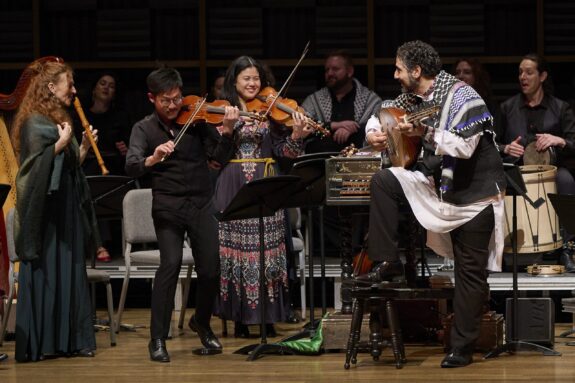 Every performance of “O Jerusalem! Crossroads of Three Faiths” is guaranteed to be a little different. Not only are there plenty of opportunities for the performers to improvise, but Apollo’s Fire has also made tweaks to the music selections in the years since the first performances.
Even so, “much has changed since I created this program in 2018,” artistic director Jeannette Sorrell acknowledged in the program book and onstage on April 10. Music that brings together Israeli and Palestinian performers feels heavier in 2026, two-and-a-half years after war erupted in the Gaza strip.
The concerts presented this April approached this reality with both seriousness and joy, a blend both true to the spirit of the original program and respectful of the current moment. I heard the Friday performance at the Cleveland Museum of Art’s Gartner Auditorium. The two musical and cultural consultants, Daphna Mor (Jewish) and Ronnie Malley (Arab), worked with Sorrell to add some new repertoire for this revival.
“O Jerusalem!” is a six-part musical tour of the ancient city, primarily exploring its four quarters: Jewish, Christian, Armenian, and Arab. Before that, the ensemble set the tone with the lamenting “Ir me kero, Madre, a Yerushalayim” paired with the upbeat “Kuándo el Rey Nimrod,” led by soprano Sonya Headlam and baritone Edward Vogel.
Narrative sections are baked into the proceedings, strengthening the connections between performer and audience. Mor described her affectionate, multilingual upbringing in Israel before having fun with the traditional Ladino folk song “Ija Mia” (My Daughter). Playful violin and drum solos from Alan Choo and Anthony Taddeo, respectively, represented the various unfitting suitors that the titular daughter humorously rejects.
Among the Sephardic ballads and Medieval Hebrew prayers of the Jewish Quarter, a standout was “Eli Elijahu,” a traditional Iraqi piyyut. Mezzo-sopranos Aryssa Leigh Burrs and Inbal Hever smoothly intertwined their voices with Vogel’s before Mor held her shawm up like a trumpet, blowing through the reed to make a joyful noise.
Part III, “The Christian and Armenian Quarters,” held more upbeat tunes as well, from cantigas to passacaglias. But Lucine Musaeliam turned things contemplative with “Havun-Havun,” a sacred Armenian chant that she sang while playing viola da gamba. The lights dimmed and the spotlight narrowed in on Musaeliam, who kept her eyes mostly closed as she sang with a beautifully pure tone, supported by contrabassist Sue Yelanjian.
One of the program’s defining characteristics has been its inclusion of selections from Monteverdi’s Vespers of 1610, which are scattered throughout Part IV, “Mosque, Synagogue, and Cathedral.” Some previous reviewers opined that switching gears to Monteverdi feels a bit unnecessary within the arc of the program — I found this true for the 2026 version as well. The lack of narrative elements in this section also makes it feel slightly adrift.
Still, this repertoire is Apollo’s Fire’s bread and butter, and they perform it beautifully. Vogel sang a particularly lovely rendition of “Nigra sum sed formosa” with theorbo player William Simms.
During the section on the Arab Quarter, Malley talked about his experience growing up in a Muslim household in Chicago. Draped in a black and white keffiyeh, he enthusiastically strummed his oud during the traditional Arabic tune “Longha Farahfaza.” A moment of reflection arrived with “Dabke Palestino,” a folk medley that laments Palestinian exile and featured trio vocals from Malley, Hever, and Mor.
The sixth and final part, “Neighborhood Celebration,” recognizes the history of interfaith festivities in Jerusalem with the celebratory “La Komida la Manyana.” Joyful sections of improv produced whoops and cheers from both players and audience, as they did in the ensuing encore.
Introducing “La Komida,” Sorrell shared the story of her father, a Holocaust survivor who immigrated to the U.S. to build a career and family. Ultimately, she said, “we must all treat each other with love.”
Photo by Malcolm Henoch
Published on ClevelandClassical.com April 22, 2026
Click here for a printable copy of this article
