

by Mike Telin
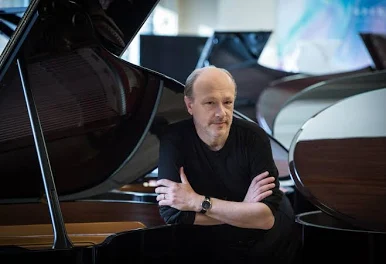 “I’m looking forward to being back in Cleveland, It’s almost like a second home,” pianist Marc-André Hamelin said during a telephone conversation. “I believe my first visit was at the Art Museum. I played the complete Iberia — that was a little over 20 years ago.
“But it’s always a joy to be back in Severance. The combination of the atmosphere and acoustics — there’s hardly anything better. And I’ll be experiencing it for the first time as a solo recitalist, which I’m very excited about.”
On Tuesday, May 5 at 7:30 pm in Mandel Concert Hall, Marc-André Hamelin will present the final concert of The Cleveland Orchestra’s Recital Series with a program featuring music by Joseph Haydn, Ludwig van Beethoven, Mieczysław Weinberg, and Sergei Rachmaninoff. Tickets are available online.
Mike Telin: You’re starting with Haydn’s D major sonata: what a spirited piece. You’re going to grab the audience right away.
Marc-André Hamelin: Besides the fact that it’s a wonderful piece — it’s a little jewel in its own way — it’s perfectly put together. But it’s also a very old friend. I was playing it when I was a boy. I think that starting a recital with pieces that are really friendly to you is particularly pleasurable because your own entry into the evening is not going to be fraught with worry. That’s partly why I did that, but also because of the musical merits of the piece itself.
Haydn was a great master, and his imagination was inexhaustible. That’s one of the things I admire about him.
MT: And then Beethoven’s 3rd sonata grows out of that very nicely.
M-AH: Aside from the fact that it was dedicated to Haydn, it’s also a piece I’ve been playing for quite a while. And I feel that it’s one of the very best of his early sonatas.
MT: Then, Mieczysław Weinberg’s Sonata No. 6. What attracts you to Weinberg’s music?
M-AH: I am preparing a recording of Weinberg’s piano music, so I wanted to have a chance to play some of it in concert at least a few times. So I included it and they didn’t say no.
I had owned some of his scores for quite a while, but really didn’t give them a serious look until maybe four or five years ago. I was startled because I found that he definitely had a voice of his own, even though there is a substantial influence from Shostakovich and maybe Prokofiev as well. But he’s very much his own man.
There was a big Weinberg boom about 20, 25 years ago, in part due to Gidon Kremer’s advocacy of his music. Then it started being republished in the West, up to then it had only been available in Russia. I was pretty much unaware of that revival of interest in his music and I only came recently to it on my own, so I didn’t embark on the bandwagon.
There are those who might tell you that the ship has already sailed, but if you look at the number of recordings that are still appearing of Weinberg’s music you can definitely say that the interest hasn’t died down. He is now considered a master.
He was extremely prolific and produced seventeen string quartets, twenty-two symphonies, a good number of operas, over one-hundred songs, and tons of chamber music. And he had a pretty good lifespan — he lived from 1919 to 1996. He is definitely one of the most original voices that I know of in the 20th century.
The sonata that I’m playing is actually quite short — it’s only about eleven minutes. It’s in two movements, a slow one, and then something that begins very softly before it starts turning into a fugue, but not really. It’s just a monorhythmic thing that gradually builds into great excitement — it’s almost manic. I think it’s a little rondo actually, but it’s artfully conceived.
I’m still gauging audience reaction to these pieces. There are six sonatas, and each has its own very individual character. Number four is perhaps the most famous, if only because it was premiered by Emil Gilels, who left a wonderful recording of it.
MT: You’re bringing two Rachmaninoff’s, the Etude-Tableaux Op. 39 No.5 and the 1939 version of the Second Sonata.
M-AH: I’ve been playing the second sonata for quite a while. Some people ask me, “Why don’t you play the first version instead of the second?” The simple reason is that I got to know John Ogdon’s recording of the second version, and when I finally heard the first version, I thought, there’s too much clutter there. Some people swear by the first version and will not listen to anything else. But Rachmaninoff himself was satisfied by neither of them.
MT: Is there anything else you’d like the audience to know?
M-AH: I’m just sorry I was unable to go with the original plan, which was to have been a duo recital with Maria João Pires. To our mutual chagrin, she decided to retire. She made the right decision. She felt it was the right time to do so, and I wish her the best. She really knew how to make a piano speak — and to extract colors from it — which is really the most difficult thing to attain when playing this black and white instrument.
Published on ClevelandClassical.com April 28, 2026
Click here for a printable copy of this article
