

by Kevin McLaughlin
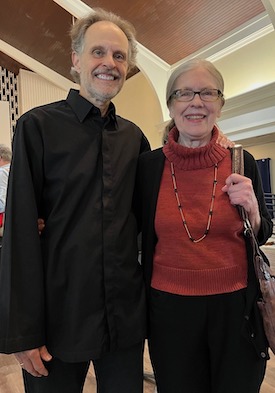 Margaret Brouwer’s music has become a fixture in Northeast Ohio — distinctive, unmistakable, and not easily pinned down. She goes her own way, with stylistic diplomacy: borrowing freely, but never pledging allegiance to any one camp.
On Sunday, April 19, Steven Smith led the Cleveland Chamber Symphony in three works by Brouwer as part of NEOSonicFest, its annual spring exposition of new sounds, at Disciples Christian Church in Cleveland Heights.
First up was Donald Erb’s Harold’s Trip to the Sky (1974). Scored for viola, piano, and percussion, Erb treats the ensemble less as a traditional trio than as three independent voices. The title makes a nod to Lord Byron’s Harold but Erb’s piece doesn’t tell a story. It unfolds in episodes: the viola climbing and exploring, the piano holding its ground, the percussion commenting, like Puck, with wry asides.
A sense of tension runs through the music — passages drawn tight, then slackening, as if its reins had been released. Violist Laura Shuster set a disciplined but restless course, trying out an idea, then moving on. Percussionist Andrew Pongracz, a second protagonist, cut in with a slide whistle, vibraphone, and other quick-change colors, while pianist Joanna Huang theatricalized her instrument by striking the strings with rubber mallets.
Inner Voices (2014), for soprano and mixed ensemble, casts the voice as a textural thread among the instruments as Brouwer focuses in on the quieter currents of anger, loss, and memory. Soprano Lara Troyer captured the listener’s attention, whether she dynamically rose above the ensemble or disappeared into it. The unlikely pairing of voice and trombone proved apt: at times the two moved together in a spare alignment, at others with a rough, brassy edge.
The second movement, with its reference to Delphi “veiled in mist,” unfolds in slow, suspended gestures, as if memory — grasped imperfectly and open to revision — were the subject.
Brouwer has said that City Life, receiving its premiere, took shape as she reflected on the unrest in Minneapolis. In the opening movement, Images, Smith kept the ensemble on a low simmer. Chimes sounded at a distance, the strings edged upward in small steps, and woodwinds and brass raised the tension without breaking the apprehensive mood.
The second movement, “In the Streets,” turns its gaze to the crowd as the tempo quickens and the music grows jittery. Basses and timpani set a firm pulse, and the brass answer with clipped, insistent chords. Motives pass from section to section, gathering force. Whistles and sliding gestures suggest sirens, heightening the sense of impending violence. By the end, Smith draws the ensemble into a single, concentrated surge — what Brouwer calls “a gathering of a mass of determined people.”
Mandala (2001), which closed the program, takes its cue from the sand mandalas of Tibetan monks — designs built, contemplated, then swept away. The dancers of the Ohio Contemporary Ballet, under Zachary Tuazon, traced similar patterns: pairing off, separating, and returning.
A psalm tune, sounded at the outset by trombonist Paul Ferguson from the back of the hall, threads through the piece. It comes apart then reappears in altered forms, handed from player to player.
In the second movement, the circling grows more urgent, at times pressing toward violence before breaking off. Here, Brouwer adds whispered words, not for meaning but for color.
What holds the piece together, beyond the psalm tune, is the sense of continuous motion — the feeling that everything is turning, even when the surface seems still.
Steven Smith led the Cleveland Chamber Symphony with a steady hand throughout, keeping Brouwer’s layered writing clear, balanced, and emotional.
Published on ClevelandClassical.com May 6, 2026
Click here for a printable copy of this article
