


by Daniel Hathaway
 This article was originally published on Cleveland.com
CLEVELAND, Ohio — Do the arts have the wherewithal to take up great subjects like war? Four hundred years ago, Shakespeare sent his Prologue onstage at the top of his play Henry V to apologize in advance to the audience for its shortcomings:
Pardon, gentles all,
The flat unraisèd spirits that hath dared
On this unworthy scaffold to bring forth
So great an object. Can this cockpit hold
The vasty fields of France? Or may we cram
Within this wooden O the very casques
That did affright the air at Agincourt?
In 1961, British pacifist composer Benjamin Britten addressed that question by writing his “War Requiem” on commission for the consecration of the new Coventry Cathedral, which rose next to the ruins from an 11-hour long Luftwaffe bombing raid on the night of November 14, 1940.
The composer structured his Requiem by adding new layers to the texts of the traditional Roman Missa pro defunctis. The most important innovation was the interleaving of nine poems by Wilfred Owen, who developed his voice while serving in the military during World War I, “the war to end all wars.”
Britten’s chosen forces — a large chorus, children’s chorus, a full orchestra, chamber orchestra, and soprano, tenor, and baritone soloists, which some commentators believe were inspired by J.S. Bach’s “St. Matthew Passion” — allowed the composer to identify groups by the character of their musical material.
He also found ways to bring armed conflict directly into the theater rather than merely referring to external events. Britten’s orchestrations are frequently hair-raising, especially in the image-rich Dies irae, which Oberlin musicologist James O’Leary pointed out in his pre-concert lecture was quite obviously inspired by Verdi’s setting.
On Thursday, April 23, in Mandel Concert Hall, guest conductor Klaus Mäkelä led a remarkable performance of the 80-minute, thought-provoking work. Both the large and the chamber orchestras sounded splendid from their atmospheric opening gestures to the gorgeous closing lines of “Let us sleep now,” and in all their incidental solos in between. Flawless brass playing and incisive percussion adorned a number of passages.
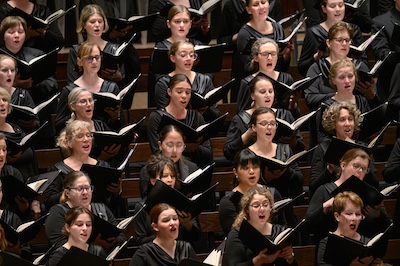
But the War Requiem is above all a choral work, and the choruses were uniformly magnificent on Thursday evening. The Cleveland Orchestra Chorus, prepared by Lisa Wong, covered a vast range of dynamics from ritualistic murmurings to full-throated climaxes, and the Children’s Chorus prepared by Jennifer Rozsa sang sweetly from their off-stage position.
The voices of the three soloists, Tamara Wilson, Andrew Staples, and Ludwig Mittelhammer, easily carried over Britten’s frequently complex orchestration. One of Wilson’s commanding solos might still be resonating in the hall along with memories of wonderful duets by Staples and Mittelhammer.
Another item that may not still be hanging out in the corners of the space but is permanently engraved in the memory from this performance: the dramatically long silence that Mäkelä held after the concluding Amen. That gesture only added to his entirely masterful job in interpreting and pacing this emotional piece.
Photo by Yevhen Gulenko
Published on ClevelandClassical.com April 30, 2026
Click here for a printable copy of this article
