

by Kevin McLaughlin
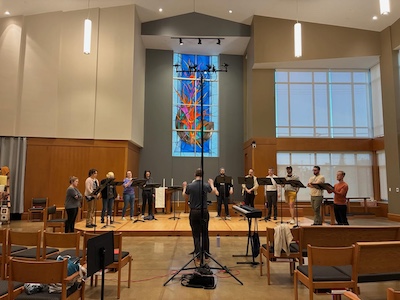 Before the Cleveland Chamber Choir sang a note on Saturday evening in First Lutheran Church in Lorain, the audience had choir practice.
With gentle guidance and help from the chorus, Gregory Ristow got them singing the anonymous L’homme armé melody, antique French pronunciation and all. The tune, now internalized, became a recognizable thread connecting two centuries of Renaissance music.
Under Ristow’s direction, “La fleur de la Renaissance” moved through Mass movements, laments, psalms, battle pieces, and spring chansons, using the L’homme armé melody as both connective thread and point of departure. The evening spanned nearly 200 years, but never felt like a history lesson. Ristow organized the concert as a sequence of changing scenes, moods, and colors, each piece leading naturally into the next.
The choir sang with a lean, focused sound suited to this repertory. What they do supremely well is to control pitch. Phrase endings were held straight and steady, remaining true even through long diminuendos. Textures stayed transparent even in dense counterpoint, and entrances were consistently clean. Ristow favored forward motion over monumentality. This time, he put a smallish chorus of thirteen voices on the field, helping the program avoid the weightiness that can creep into an evening of liturgical music. He also proved attentive to the different national and stylistic accents within the repertory: the grave spaciousness of Ockeghem, the smoother flow of Palestrina, the quicker rhythms of Janequin.
The opening sequence — the anonymous L’homme armé followed by Johannes Tinctoris’s Kyrie from the mass of the same name — immediately demonstrated how the famous tune could be transformed in performance. Presented plainly at first, the melody soon resurfaced in altered forms. As the program continued, it emerged with varying clarity in contrasting contrapuntal settings. Separated by motets, psalms, and chansons, the recurring L’homme armé Mass movements gradually assembled into a kind of “Frankenmass,” revealing a variety of approaches to common material.
The solo quartet in the Tinctoris — Joanna Tomassoni, Megan Long, Joel Kincannon, and Dominic Aragon — sang with directness and good balance.
Several performances stood out for their control of line and texture. Jean Mouton’s Salva nos, Domine unfolded with quiet assurance, its overlapping phrases carefully balanced across the ensemble. Josquin des Prez’s Nymphes des bois, written as a lament for Ockeghem, carried its share of emotional weight. Ristow resisted exaggeration, trusting the close-woven harmonies and darkening sonorities to do their work. The performance gained power through restraint.
The Mass movements based on L’homme armé revealed the choir’s versatility. Busnoys’s Credo had firmness and momentum, while the Sanctus from Palestrina’s Missa L’homme armé showed the ensemble at its most polished, with long phrases carefully tapered and aligned. Josquin’s Benedictus brought a lighter, more flexible sound before DuFay’s Agnus Dei transformed the tune into something more meditative and humane.
Ristow also recognizes the value of contrast. After so much sacred polyphony, Sweelinck’s Psalm setting brought a clearer, more rhythmically direct style before Claude Le Jeune’s Revecy venir du Printans introduced something openly festive. The latter was especially fun, hailing the return of spring with crisp rhythms and buoyant ensemble singing — pairs, trios, and quartets answering one another in alternation. John Mills played tambourine with a straight man’s expression but unexpected spice.
The concert ended with two of Clément Janequin’s great descriptive chansons, La Guerre and Le Chant des Oyseaulx. These works depend less on sheer vocal beauty than rhythmic precision and verbal clarity, and the choir handled the shift masterfully.
La Guerre, the evening’s theatrical highpoint, unfolded in rapid exchanges of battle cries, shouted commands, and bursts of vocalized cannon fire. The Armed Man had become literal — or at least pictorial. Janequin was writing at a transitional moment in military history, when the physical crush of medieval warfare still coexisted with the new soundscape of gunpowder. The voices produced convincing volleys of boums, tin tins, and rattling rhythmic figures in unnerving antiphony. The singers relished the combat with one another across the ensemble.
Le Chant des Oyseaulx brought welcome humor to close the evening, singers tossing avian sounds and nonsense syllables back and forth like angry birds.
Throughout, Ristow conducted with his customary economy and calm authority. Rarely demonstrative, he shaped the long span of repeated L’homme armé references carefully, allowing the concert to feel less like a survey than a living sequence of musical thought.
The result was a performance that illuminated the craft, variety, and humanity of Renaissance music. The Armed Man, as it turned out, came in peace.
Published on ClevelandClassical.com May 21, 2026
Click here for a printable copy of this article
