

by Daniel Hathaway
CLASSICAL MUSIC HIGHLIGHTS THIS WEEKEND:
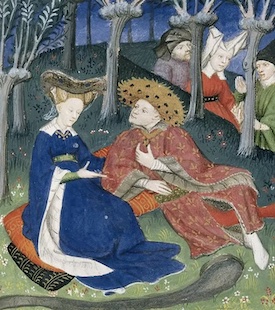 Trobár presents “The Lady” of Medieval Song. An exploration of rarely-performed medieval songs about The Lady, to The Lady, and by The Lady. (Pictured, 7 pm in Tucker Hall at St. Paul’s Episcopal Church, Cleveland Heights, repeated on Saturday at West Shore Unitarian Universalist Church in Rocky River.)
The Cleveland Orchestra, Franz Welser-Möst, conductor, Leila Josefowicz, violin, and Trina Struble, harp, perform Adolphus Hailstork’s Epitaph for a Man Who Dreamed, Bacewicz’s Symphony No. 4, the world premiere of Jüri Reinvere’s Concerto for Violin, Harp, and OrchestraI, and Dvořák’s Hero’s Song. (7:30 in Mandel Concert Hall at Severance Music Center. One performance only.)
MAY 23 – SATURDAY
Cleveland Repertory Orchestra presents “The Art of Joy,” Matthew Salvaggio, conductor, and M. Isaac Ripple, oboe. Zhou Tian’s Joy, Jennifer Higdon’s Oboe Concerto, and Christopher Theofanidis’ Chamber Symphony No. 1. (7 pm at Rocky River Presbyterian Church.)
The Cleveland Orchestra presents the third and final performance of the central event in its Opera and Humanities Festival, Beethoven’s Fidelio, Franz Welser-Möst, conducting, with Sara Jakubiak & Ashley Emerson, sopranos, David Butt Philip & Owen McCausland, tenors, Tomasz Konieczny & Dashon Burton, bass-baritones, Martin Summer, bass, and The Cleveland Orchestra Chorus (7 pm in Mandel Concert Hall at Severance Music Center).
For details of these and other classical music events, please visit the ClevelandClassical.com concert listings
ANNOUNCEMENTS:
Heights Arts announces an open call for performers for its Gallery Concert Series and ARTbar, applications due on May 31. Details here.
The Music Settlement announces its summer camps. Click here to read the announcement.
WEEKEND ALMANAC:
On May 22, 1874, Giuseppi Verdi’s Requiem was first performed at the church of San Marco in Milan, ending a long requiem saga for the composer, who had originally proposed a collaborative work by several Italian composers to honor Gioachino Rossini after his death in 1868. Verdi himself contributed the final movement, “Libera me,” but for various reasons, the project fell through a week before its premiere in November of 1869.
Verdi found an opportunity to recycle that “Libera me” when Alessandro Manzoni died in 1873 and he embarked on writing a new Requiem all on his own in honor of the famous Italian author and humanist.
Click here to watch a performance of the Requiem by CityMusic Cleveland at the Maltz Performing Arts Center on May 2, 2019 led by James Gaffigan. The special Yom ha-Sho’ah performance commemorated the prisoners at the German concentration camp Theresienstadt, who performed the Requiem 16 times in 1944, before being sent to their death at Auschwitz. Soloists are Chabrelle Williams, soprano, Sasha Cooke, mezzo-soprano, and Joshua Blue, tenor. The chorus was prepared by Ben Malkevitch.
(PS: the Requiem for Rossini was finally performed in 1988 in Stuttgart, conducted by Helmuth Rilling. Listen here.)
And as noted above, on May 22, 1813, Richard Wagner was born in Leipzig. Having just mentioned Theresienstadt, it’s now impossible to talk about the composer of the Ring operas without referencing his popularity with the perpetrators of the Third Reich.
British actor and writer Stephen Fry addresses Wagner’s complicated legacy and his own fascination with the composer’s music in his hour-and-a-half long Wagner and Me, available for free in an occasionally spotty posting on YouTube, and for a fee on various streaming services.
And former Cleveland Orchestra assistant conductor Brett Mitchell joins Bill O’Connell in WCLV’s 35-minute video discussion of the Ring. Watch Gods and Monsters: The Musical Journey of Wagner’s Ring Cycle here.
