


by Kevin McLaughlin
 Some operas overwhelm us with spectacle, others with sheer length. Purcell’s Dido and Aeneas, first performed in the late 1680s, does neither. Barely an hour long, it holds a world of feeling — new love, dark magic, and nobility in death.
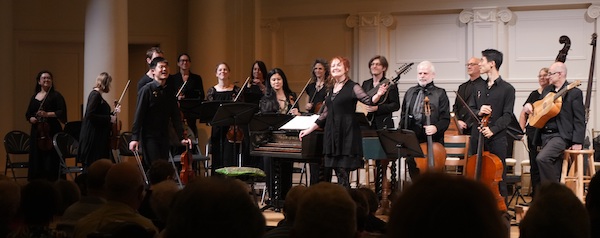
On Friday evening, October 3 at Greystone Hall in Akron, Apollo’s Fire gave the work youthful resonance by returning it to Purcell’s premiere setting, a London boarding school for girls. Jeannette Sorrell’s direction added a Shakespearean pulse — brisk, lively, and human. The performance opened with the chaconne from Purcell’s King Arthur, an elegant and radiant overture that set the evening’s tone.
Sorrell’s newly written prologue replaced Purcell’s lost original and set the scene as a school play that turns suddenly real — a nod to the opera’s first performances by students and to the scale of its story. Her approach emulated the fast-moving style of seventeenth-century English theater, when audiences stood at the players’ feet and tragedy mingled with laughter.
 The plot, adapted by Nahum Tate from Virgil, is brisk to the point of bluntness. Dido, Queen of Carthage, meets and then falls in love with Aeneas, the Trojan refugee. Her confidante Belinda encourages her. A sorceress and her witches send a false god to order Aeneas away. He hesitates, she dismisses him, she dies of grief. Curtain.
Sorrell views the tragedy through a modern lens: “The noble, brilliant queen who is jilted and abandoned by a man who says he’s leaving to follow his destiny,” she told Cleveland Classical’s Mike Telin. “But was it destiny, or betrayal, or just ambition?” Her reading of the score — in both pacing and dramatic emphasis — made the question palpable, placing not just Dido but her righteous agency at the heart of the drama.
Aryssa Leigh Burrs’s Dido moved and sang with natural dignity, her self-possession standing apart from the schoolgirl aesthetic around her. By the end, her stillness deepens into a sorrow vast and resolute. The famous lament (“When I am laid in earth”), sung as the queen processes toward the back of the hall, was simple and intimate — not a set piece, but the natural culmination of a tragic choice.
 Baritone Edward Vogel brought warmth and ease to Aeneas through supple phrasing and a guileless presence. His good-natured turn in the interpolated sea shanties that open the third act did little to aid the play’s claim to villainy. The role often stands in Dido’s shadow, and it did so here — its shorter, plainer lines mark Aeneas not as a betrayer but as a man divided by duty.
Soprano Andréa Walker was a bright-voiced Belinda, her tone and sincerity ringing in the hall as she urged her queen toward happiness. Cody Bowers, as the Sorceress, acted and sang with conspiratorial glee, his countertenor infusing the role with a light agility and an edge both eerie and playful.
 The smaller roles — attendants, sailors, witches — were neatly handled. Walker and Kristine Caswelch as the witches made you want to join them for a weekend in their cave. They were respectfully evil, though with a schoolgirl’s flair for mischief. Apollo’s Singers gave the evening its backbone, singing Purcell’s madrigal-like choruses with sparkling polish.
The closing chorus, “With drooping wings,” became a communal act of mourning, as the queen and her courtiers walked slowly down the center aisle and the audience shared their heartbreak.
Conducting from the harpsichord, Sorrell drew elegant playing from the strings. Under her direction, a natural flow took hold: darker passages carried feeling without weight, and the dances were kept buoyant with subtle distinctions of grace, lift, and swing. The continuo team — harpsichord, lutes, cello — added momentum and color. The strings, propelled by concertmaster Alan Choo, played with both delicacy and punch. Quick tempos created a momentum that was sure but unforced, one scene slipping naturally into the next.
 In her booklet notes, Sorrell reminds listeners that Dido, though written for a girls’ boarding school, “was scandalous for its time — its themes very adult.” Apollo’s Fire captured that paradox fully. In just an hour, Sorrell and company shaped a drama both taut and compassionate, proving that Purcell’s genius lies not in scale but in proportion — and in his uncanny gift for making an ancient heartbreak feel freshly human.
Performances continue from October 9 through 12. Click here for times and locations.
Photo credits: Freddy Fletcher.
Dance and staging credits: Julie Andrijeski choreographed the Triumphing Dance at the end of Act 1, the Ritournelle in the Grove Scene (Diana’s hunting dance), the Sailor’s Dance, and the Final Witches’ Dance (Act 3), using Baroque dance steps.
The rest of the stage direction, including the theatrical Witches’ dances in Acts 1 and 2, was done by Jeannette Sorrell.
Published on ClevelandClassical.com October 7, 2025
Click here for a printable copy of this article
