

by Kevin McLaughlin
 Feza Zweifel, Artistic Director of Arts Renaissance Tremont, called it “a concert built on relationships.” A Legacy of Art — Honoring Chris Haff-Paluck at Pilgrim Congregational Church on Sunday, May 17, felt less like a formal memorial and more like a gathering of musicians bound by years of performances, collaborations, and friendships — many initiated by Haff-Paluck herself.
Founder of Arts Renaissance Tremont and later director of performance and community programs at the Cleveland Institute of Music, Chris Haff-Paluck spent decades creating opportunities for musicians in Cleveland before her passing in 2020. Throughout the afternoon, performer after performer recalled concerts she organized, introductions she made, and collaborations she encouraged.
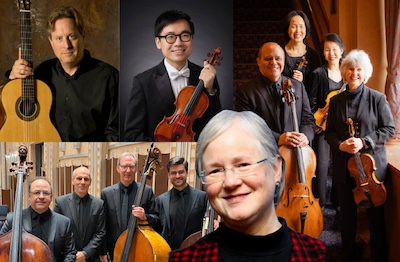
A quartet of bassists from The Cleveland Orchestra — Maximilian Dimoff, Mark Atherton, Thomas Sperl, and Brandon Mason — opened the program. Dimoff recalled that Haff-Paluck loved “unexpected ensembles” and regularly welcomed bass quartets onto the ART series. Haff-Paluck, herself a bassist, had previously invited Cleveland Orchestra members to perform, including for a 2014 conc.
The first movement of Colin Brumby’s Suite for Double Basses set a collegial tone, alternating between courtly elegance and rustic humor. Enrique Granados’s Intermezzo from Goyescas, arranged by Evan Halloin, brought a softer lyricism, the players sustaining long phrases with ease.
The quartet found the warmth and easy good humor in Hartmut Schmidt’s Danse élégante des Vignerons, a score given to Atherton by a stranger he met on a mountain near Salzburg during a recent orchestra tour, while Emmanuel Chabrier’s España closed the set with Spanish exuberance.
Guitarist Jason Vieaux followed with a short solo set shaped as much by memory as performance. Speaking from the stage, the guitarist remembered Haff-Paluck as “a musician’s advocate”— someone who created performing opportunities and fostered collaborations throughout Cleveland’s musical community. He recalled her support for his partnership with harpist Yolanda Kondonassis, which led to recordings and many joint concert appearances. “She was a wonderful lady, and we miss her very much.”
Vieaux let two Bach Preludes, BWV 998 and 1007, unspool with patience and clarity, emphasizing the music’s conversational quality, and allowing Bach’s counterpoint to emerge with natural grace.
Albéniz’s Asturias provided the afternoon’s most overt display of virtuosity, but even here Vieaux avoided turning the performance into mere display. The rapid figurations remained sharply articulated without overwhelming the music’s lyrical shape, while the quieter middle section opened into something more inward and songful.
Vieaux’s own Tidal Pools closed the set in a reflective vein, its shifting harmonies and pop-inflected melodies suggesting memory without sentimentality.
After intermission, Cleveland Orchestra assistant principal second violinist Jason Yu took on the high-wire act of Eugène Ysaÿe’s Sonata No. 1 in G minor. Less personally connected to Haff-Paluck than some of the other musicians, Yu kept his remarks focused on the piece itself — one he had once planned to devote a dissertation to before professional opportunities intervened. Ysaÿe modeled the sonata loosely after Bach’s Sonata in G minor for solo violin, refracted through the expanded harmonic language and technical demands of the early twentieth century. Yu played with complete command, bringing unusual clarity to the double-stopped lines while projecting the work’s dramatic, monologic force.
The Amici String Quartet closed the program with Samuel Barber’s Quartet, Op. 11. The ensemble chose the work consciously. In conversation with Mike Telin of ClevelandClassical, violinist Mari Sato said the quartet selected it because it “seemed like a natural choice for remembering someone,” describing it as “sorrowful” but ultimately hopeful.
Cellist Ralph Curry recalled first meeting Chris Haff-Paluck when both were first-year students at CIM, and spoke warmly about the quartet’s longstanding relationship with the ART series she founded.
Although Barber’s quartet is best known for its central Adagio, the Amici resisted treating it as an isolated statement, instead shaping the work as a continuous dramatic arc. The opening movement carried a lyric urgency as the players balanced tight ensemble with a sense of flexibility and flow. In the Adagio, the ensemble trusted Barber’s long lines to generate their own emotional force. The final movement — infected now by the Adagio’s lyricism — gained bite, energy, and sweep while driving toward its terse conclusion.
The strength of this concert was its refusal to sentimentalize. Musicians spoke in specifics — introductions made, concerts organized, careers encouraged, friendships sustained. On Sunday, Haff-Paluck’s legacy lived on in the relationships she helped build and in the excellence of the performances.
Published on ClevelandClassical.com May 27, 2026
Click here for a printable copy of this article
