by Mike Telin
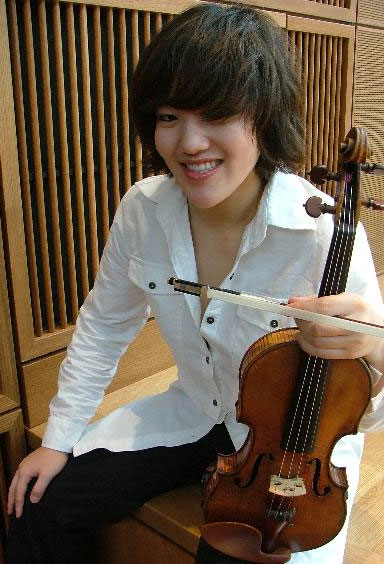 Cleveland based violinist Jinjoo Cho has been named one of six contestants to be advanced to the final round of the 9th Quadrennial International Violin Competition of Indianapolis. [Read more…]


by Mike Telin
Cleveland based violinist Jinjoo Cho has been named one of six contestants to be advanced to the final round of the 9th Quadrennial International Violin Competition of Indianapolis. [Read more…]
by Mike Telin
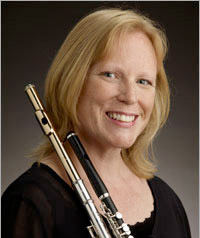 “As a child, I loved classic fairy tales as collected and told by the Brothers Grimm, Hans Christian Andersen, and others,” American composer Gabriela Lena Frank writes about her new work, Will-o’-the-Wisp: Tone Poem for Piccolo and Orchestra. “As a composer, I’ve often enjoyed using some my childish and fancifully personalized re-interpretations of myths to inspire pieces, with varying degrees of overt Latin American musical (especially indigenous Indian) influences. [And this] is one such piece.” On Thursday, May 1 beginning at 7:30 pm in Severance Hall, Cleveland Orchestra Principal Piccolo Mary Kay Fink performs the world premiere of Frank’s new concerto under the direction of David Robertson.
Will-o’-the-Wisp was commissioned by The Cleveland Orchestra for Mary Kay Fink, although finding a composer for the project turned out to be a long process. “I was working with the artistic administrators of the orchestra. I would suggest a composer and they would make suggestions back to me,” Fink said in a recent telephone conversation. “We approached a few composers who turned down the offer because they were too busy.”
As luck would have it, Fink attended a recital given by Canton Symphony principal flutist Katherine DeJongh which included a piece by Gabriela Lena Frank. “I had not heard of Frank and was unfamiliar with her music,” Fink recalled, “but I loved her piece. It was my favorite work on the recital.” [Read more…]
by Mike Telin
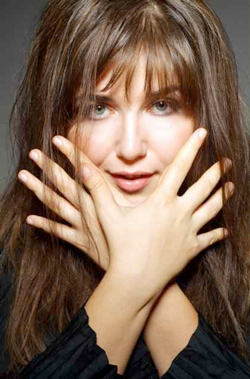 The Cleveland Institute of Music will take a different approach to its Mixon Masters Series this season. “Return of the Composer/Virtuoso” will bring performing composers to the Mixon stage in 2013-2014, beginning with Russian-born composer-pianist Lera Auerbach on Tuesday, September 17 at 8:00 pm. Auerbach will perform her 24 Preludes and Mussorgsky’s Pictures at an Exhibition on her Cleveland debut recital.
The preludes are personally important to her. “I have always loved cycles of 24 preludes”, Auerbach said in a telephone conversation from Berlin. “I have studied and played many of them like Chopin, Scriabin and of course Bach. I always knew that one day I would be writing my own 24 preludes but I didn’t anticipate what would happen. I had such a great time writing the piece. It gave me a canvas to explore — there are so many possibilities. It was such a fantastic journey to take that when I finished writing the 24 preludes for piano I just couldn’t stop! I couldn’t believe it was over and there were no more preludes to write.”
As it turned out, Auerbach didn’t quit after those 24 but immediately began writing another two dozen for violin and piano. “But after I finished those I was still hungry for more so I decided to keep on going and I wrote 24 for cello and piano.” [Read more…]
by Mike Telin
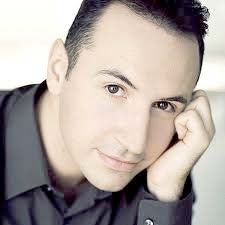 This week at Severance Hall, Robin Ticciati will lead The Cleveland Orchestra in concerts that feature Liadov’s Enhanted Lake and Sibelius’s Symphony No. 2. The program also includes one of the most popular piano concertos in the repertoire, the Concerto No. 2 by Sergei Rachmaninoff, with Macedonian pianist Simon Trpčeski as soloist.
Given the popularity of this concerto, we took the opportunity to once again visit the Orchestra archives to see what archivist Deborah Hefting could tell us about Rachmaninoff’s personal appearance and performance of the piece with the orchestra in 1942. We also spoke to Simon Trpčeski and asked him about the challenges of playing such a well-known piece.
“I need to say that it is a great challenge, as I think it is for any pianist who is playing such a popular piece like the Rachmaninoff 2nd concerto”, Trpčeski told by telephone from his home in The Republic of Macedonia. “One always tries to find something, even if it is a little thing [to do differently] in each performance, since it has been played millions of times.” [Read more…]
by Mike Telin
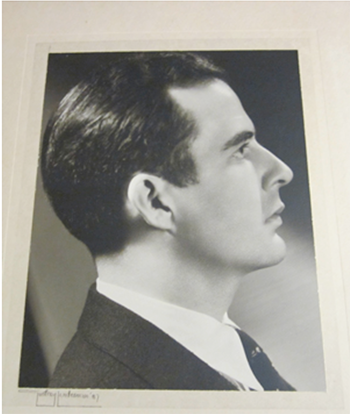 Marin Alsop will make her Severance Hall debut on December 8, 9 and 10 with Barber’s Symphony No. 1, Bernstein’s Serenade with Peter Otto as soloist, and Saint-Saëns’ Symphony No. 3 (“Organ”) featuring Joela Jones. Barber’s symphony received its American premiere in 1937 by The Cleveland Orchestra at Severance Hall, an event that inspired us to take a look in the Cleveland Orchestra Archives to see what critics had to say about the work and composer.
At a very young age, Samuel Barber was already aware that he was destined to become a composer — a fact he made quite clear to his mother at the time. The Archives preserve an article from International Musician of December, 1961, where John Briggs writes
Early in this century an eight-year-old resident of West Chester, Pal, already with a number of compositions to his credit, left a note on his mother’s dressing table. It read in part:
“To begin with, I was not meant to be an athelet (sic) I was meant to be a composer, and will be, I’m sure…Don’t ask me to try to forget this…and go play foot-ball.—Please—Sometimes I’ve been worrying about this so much that it makes me mad! (not very).” [Read more…]
by Mike Telin
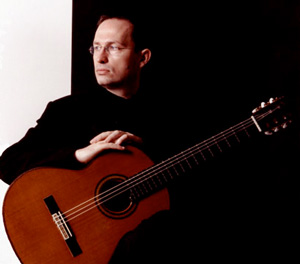 Bosnian-born guitarist Denis Azabagić has won first prize in virtually every classical guitar competition in the world. He opens the Cleveland Classical Guitar Society’s Masters Series with a ticketed concert on Saturday, October 1 at 7:30 at First Unitarian Church of Cleveland in Shaker Heights (see the Calendar Listings for details), and will give a free master class there on Sunday at 1 pm. We reached him by telephone in Chicago, where he is on the faculty of the Chicago College of Performing Arts at the Roosevelt University.
Mike Telin: How are things going in Chicago?
Denis Azabagić: Busy! I am head of the department now and there is a lot of teaching.
MT: A friend of mine referred to you as the King of Competitions because you have been awarded 24 prizes. How did winning these prizes help to establish your professional career?
DA: I was fortunate to be successful at the competitions, and it was also a way for me to make money. [Read more…]
by Mike Telin
 Preparing for interviews and the writing of features is interesting as well as fun, in that through the internet and social media sources such as Facebook, Twitter, and YouTube, one can usually discover at least some “human interest” facts about most artists.
In the effort to “connect” with their audiences, classical musicians have dug into their creative souls and are now using the Internet to share their own thoughts on music, as well as a variety of other topics, with the public. I am thinking especially of Jeremy Denk’s witty blog “Think Denk: The Glamorous Life and Thoughts of a Concert Pianist”. At this time of this writing, Joshua Bell’s Web site said that he had 641 fans currently on-line. One can also learn about the non-musical enthusiasms of cellist Steven Isserlis on his Web site, and pianist Stephen Hough now has 2,404 Twitter followers. The Cleveland Orchestra’s principal flutist, Joshua Smith, has been making regular Facebook postings about the new Jörg Widmann concerto he will be premiering at the end of May. Other Cleveland Orchestra members we are aware of who have Web sites and blogs include Barry Stees, Eliesha Nelson, Frank Rosenwein, Franklin Cohen, Massimo La Rosa, and Michael Sachs.
Will there come a time when classical musicians can rival Lady Gaga’s 173,000 Facebook likes? I am not sure, although Cleveland Classical.com contributor and blogger Timothy Robson (whose day job is deputy director of the CWRU Library) told me that after tweeting from a Lady Gaga concert in Milan, he picked up a lot of new Twitter followers as a result. Although he went on to say, “I’ll bet they were really surprised when I went back to my usual Twitter stream of classical music and library topics.”
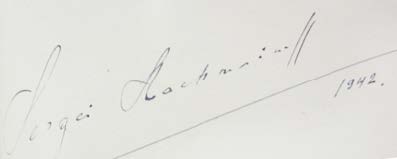
All of which makes one wonder how feature writers prepared before we had the ability to Google someone’s name and have at least five to ten articles about that person appear on the screen in front of you? Looking forward to The Cleveland Orchestra’s next set of concerts, when Horacio Gutiérrez will play Rachmaninoff’s second piano concerto — what would the eminently famous Sergei Rachmaninoff do to connect with his fans if he was living today and had access to Web sites, blogs and Twitter? Or did he have his own means of promoting himself in his own day? A recent visit to The Cleveland Orchestra archives at the invitation of the Orchestra’s archivist, Deborah Helfing, turned up some fascinating material relating to Rachmaninoff’s personal appearances with The Cleveland Orchestra. (Rachmaninoff’s autograph, above, courtesty of The Cleveland Orchestra Archives).
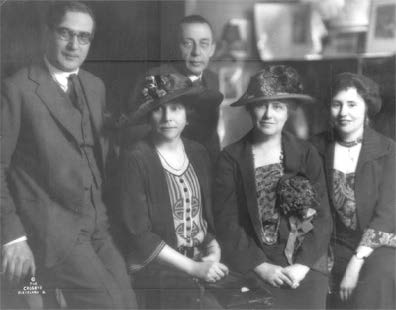 Rachmaninoff first came to Cleveland in 1923 to perform his second piano concerto at Masonic Auditorium on March 29 and 31, an event that coincided with the 25th anniversary of Adella Prentiss Hughes’ reign as Cleveland’s musical impresario. He returned in 1932 just after the Orchestra moved to Severance Hall, and four more personal appearances followed: November, 1937 (the Rhapsody on a Theme of Paganini), October, 1939 (Piano Concerto No. 1), March, 1941 (Beethoven Concerto No. 1 & the Paganini Rhapsody) and January, 1942 (Piano Concerto No. 2). The 1923 and 1932 engagements were led by Nikolai Sokoloff, the rest by Artur Rodzinski. (Above, photo of Sokoloff and Rachmaninoff, Mrs. Rachmaninoff, Adella Prentice Hugues & Lyda Sokoloff, 1923 photographer unidentified, courtesy of The Cleveland Orchestra Archives).
Early on, it took impresarios like Adella Prentiss Hughes — at the time the only female manager of a major symphony orchestra — to create the hype for an artist and to fill the concert hall with patrons. Advance publicity for the 1923 appearance promised that the concert would “be an occasion to mark musical history in Cleveland”. The pairing of two eminent Russian artists — and friends — would provide the audience with a glimpse into “the cosmic soul of Russian music”, and Sokoloff was considered to be “one of Rachmaninoff’s foremost interpreters in the orchestral world” (2000 article by Carol Jacobs, courtesy of The Cleveland Orchestra Archives).
By the 1940’s management companies had developed elaborate publicity materials for their artists. In 1940-1941, NCB Artists Services produced “Press Materials on Sergei Rachmaninoff” (courtesy of The Cleveland Orchestra Archives) — preceding his last two Cleveland appearances. The collection includes eighteen human interest stories for local managers to customize and distribute to the local press. Story topics include: “Electric muff keeps Rachmaninoff’s hands warm”, “Four pianos taken on Rachmaninoff tour”, “Rachmaninoff not gloomy, his family says” and “Rachmaninoff was once ‘a lazy, mischievous boy”. The management adds, “It is suggested that only one story be sent out at a time”.
Other story titles require a bit more explanation. “Rachmaninoff never satisfied with his own works, is continually revising them” goes on to note that “the composer spends days during the summer months working over them” and that “newspaper critics occasionally chide him because he does not play the C Sharp Minor Prelude the way it was written”.
Rachmaninoff responds, “I have revised it since it was published”. The story ends with the fascinating non sequitur, “As relaxation from his composing and revising, Rachmaninoff spends part of each day during the summer on his speedboat…He is no good as a mechanic and can’t make repairs if anything goes wrong. But he loves to pilot his boat about Long Island Sound where he now spends the summer”.
In “The audience never errs” the composer says, “Taken individually the people in an audience may all be poor critics of music, but as a complete body, the audience never errs. It is never wrong in its reaction to a performance”. On the other hand, Rachmaninoff noted that he never considers the audience’s taste in drawing up his programs. “No, I think only of my own taste”.
Further to the “Rachmaninoff not gloomy” story, Sofia Satin, his sister in law, explains “In public he is modest and reticent, and people think he is gloomy. But he really has a wonderful sense of humor and can laugh heartily”.
Amplifying on the title “Play my music just as you choose, says Rachmaninoff”, the composer asks himself, “Have I any special feeling as to how other pianists should play my compositions? To be quite honest, no…especially if I am not there to hear them!”
And what about that Lazy Boy story? “We have his word for it that as a boy he persistently shirked his piano practice. He much preferred to go skating or to amuse himself with the exhilarating sport of jumping on and off moving trams”. The tendency persisted after he went off to study at the St. Petersburg Conservatory, for “he very soon discovered that even if he did not practice, he played better than his more plodding but less gifted companions”. Laziness led him to develop his improvisation skills. When his grandmother asked him to play for her guests at tea time, he couldn’t remember the pieces he was supposed to study, so he improvised works of his own and attributed them to well known composers. “I knew the ladies would not know the difference”.
That sense of mischief persisted into Rachmaninoff’s later years. Nikolai Sokoloff’s Reminiscences (unpublished manuscript courtesy of The Cleveland Orchestra Archives) recalls a visit Sokoloff paid to Rachmaninoff’s villa in Rarbouillet in advance of the pianist’s 1932 performances in Cleveland. Upon arrival, Sokoloff asked Rachmaninoff if he could “wash his hands”, and was pointedly directed upstairs to the door on the right, not on the left. When the conductor pulled the flush handle, the plumbing tinkled forth “The Carnival of Venice”, a tune Sokoloff whistled as he re-entered the drawing room, producing riotous laughter from the usually melancholy host. The curious device turned out to be a gift from piano mogul William Steinway, who, thinking Rachmaninoff was usually too serious, repeatedly sent him jokes.
All of this information would make good fodder for Facebook entries, blog posts and a whole series of tweets, all to keep the Rachmaninoff fan base apprised of important personal details.
Daniel Hathaway contributed to this article.
Published on clevelandclassical.com March 23, 2011
When we at ClevelandClassical.com first discussed writing about our “standouts” of the 2009-2010 concert season, I thought it was a great idea. What could possibly be difficult about this task? However when I really began to think about the 65 concerts that I attended between September 2009 and the first week of June 2010, the simple task quickly became daunting. For me, there are so many reasons for one to enjoy, or not to enjoy a concert. These reasons accompanied by the fact that each organization and or ensemble have their own missions guiding how they choose to fill a role in Northeast Ohio’s vibrant classical music scene, too often led me to feel that I was comparing apples to oranges. Therefore I have chosen to write about my own “standouts” in two distinct sections. First, is an overview of concerts that I feel deserve a big hand of applause, and second, my own picks of complete performances by an artist or ensemble that for one reason or another are still engraved in my musical memory.
I begin by giving hearty congratulations to James Feddek and the Cleveland Orchestra Youth Orchestra, Liza Grossman and the Contemporary Youth Orchestra, Christopher James Lees and the Akron Youth Symphony, and Joanne Erwin and the Northern Ohio Youth Orchestras. I thoroughly enjoyed hearing the performances of these young musicians. They are our future performers and more importantly our future audiences. These ensembles also have a lot to say musically. [Read more…]
by Mike Telin
Cellist David Requiro and pianist Elizabeth DeMio continue a long collaboration with a concert on Arts Renaissance Tremont’s series at Pilgrim Congregational Church on Sunday, April 18 at 3. We spoke with David in New York and Elizabeth in Cleveland.
David Requiro
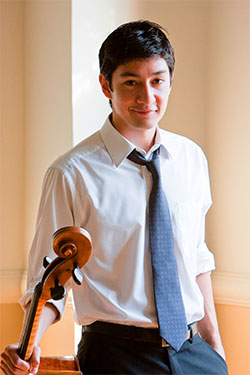 Mike Telin: You studied in Cleveland and then at the University of Michigan, correct?
David Requiro: Yes, and it’s been nice to keep my ties to Cleveland. I spent four years at CIM. I loved it there. I love many things about Cleveland and CIM. I studied with Richard Aaron, and I followed him the University of Michigan as well. The chamber music program at CIM is at the highest level, and I was part of a very serious string quartet for three of my four years. I participated in some very intense quartet seminars. Even the orchestra program I thought was just top notch. So its been great to maintain those ties after leaving, partially through the recordings I’ve been doing. Nathaniel Yaffe, the engineer – producer – editor, is kind of a one-man show. He’s also a former Richard Aaron student. It’s been really nice working on these recordings at CIM, working with Liz and Nathaniel, as well as working with CIM cellists. The debut album that you have was recorded in what was then the brand new Mixon Hall. That was a fabulous experience too. We are actually going to finish up some Beethoven recording sessions right after this recital. This will be the complete works of Beethoven. We’re recording it in Harkness Chapel, and I think Harkness is very fitting for that kind of repertoire. I think it will turn out very nicely. [Read more…]
—a conversation with Mike Telin
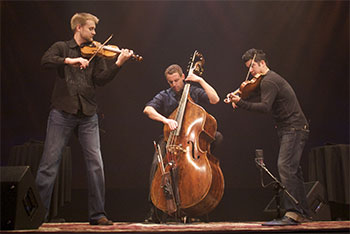
Time for Three (photo: Journey Group)
Time for Three premiered Christ Brubeck’s new concerto for two violins, double bass and orchestra with Randall Craig Fleischer and the Youngstown Symphony on March 20. We spoke with the trio by conference call at a radio station in Harrisburg, PA to talk about Time for Three and the new concerto.
Nick: Hi Mike, this is Nick Kendall, one of the violinists.
MT: Yes, we met a couple of weeks ago right after your Oberlin concert.
NK: Yea, that’s right. We have the other guys here as well.
Ranaan Meyer: Hello this is Ranaan, nice to meet you.
MT: Nice to meet you too
Zach De Pue: hello it’s Zach
MT: Hello.
ZDP: You know I lived in Cleveland for a year, and I still have my Browns season tickets.
MT: Do you?
ZDP: Yes I do
MT: Wow you are one of the few who has bothered to keep them.
(lots of laughing) [Read more…]