


by Daniel Hathaway
 The twelfth and final event of ChamberFest Cleveland 2016 was a festive, multimedia concert at the Maltz Performing Arts Center on Saturday, July 2. The event was built around Igor Stravinsky’s L’Histoire du Soldat, complete with puppetry and video projections — with free admission for 17 and under, and ice cream for all afterwards.
The Stravinsky came last, with a modernized version of Charles Ferdinand Ramuz’s 1917 narration declaimed by veteran actress Dorothy Silver, larger-than-life puppets designed by Alison Garrigan and operated by Talespinners Children’s Theatre, video projections created by T. Paul Lowry, and score superbly played by the unconducted ensemble of violinist Noah Bendix-Balgley, bassist Nathan Farrington, clarinetist Franklin Cohen, bassoonist Fernando Traba, trumpeter Brandon Ridenour, trombonist Charles Vernon, and percussionist Alexander Cohen.
Like many tales and legends, The Soldier’s Tale has a moral: don’t ask for more than you need (a lesson bitterly learned by this violin-playing soldier, who has traded his fiddle and his soul to the devil for a book that reveals all he needs to know to gain wealth, women, and everything he could desire).
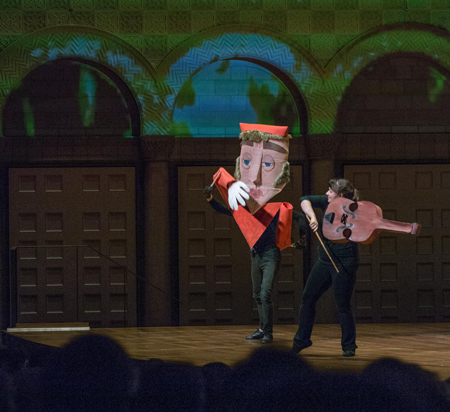
Silver was a superb narrator, cleverly delineating the voices of the characters and adroitly pacing the story. Puppet operators and cohorts Melanie Boeman, Devon Turchan, Timothy Maca, Carrie Williams, and Dayni Mahar expertly worked the huge width of the Maltz stage, transmitting outsized gestures to the large audience with the help of similarly plus-sized props. Lowry’s projections on the stage screens and former synagogue’s side walls cleverly suggested scene changes and, ultimately, the fires of hell. One particularly neat gesture was the gradual outlining of two of the venue’s arches in bands of light that moved from bottom to top.
The first performance of L’Histoire in 1918 was conducted by Ernest Ansermet, and most subsequent iterations have had a leader at the helm — a glance at the score with its constantly-changing meters will tell you why. On Saturday, no such intervention was required. The performance was tight and nuanced, and balances were excellent.
With a running time of about an hour, and considering its special qualities, finding companion works for L’Histoire to fill out a whole evening is a conundrum. ChamberFest Cleveland went in two directions for Saturday evening, adding two brief pieces that involved Stravinsky players, and placing a big Dvořák work at the center of the program — no soldiers, devils, or other thematic elements were involved in either choice, but no strange bedfellows either.
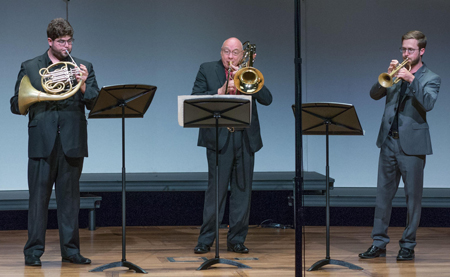
The concert began with Cleveland native Eric Ewazen’s Philharmonic Fanfare, written in 1997 to celebrate the retirement of three brass players from the New York Philharmonic. (On Saturday, the stand-ins for the retirees were trumpeter Brandon Ridenour, hornist Benjamin Jaber, and trombonist Charles Vernon.) Cheerful and melodic, the fanfare made a fine virtual curtain-raiser.
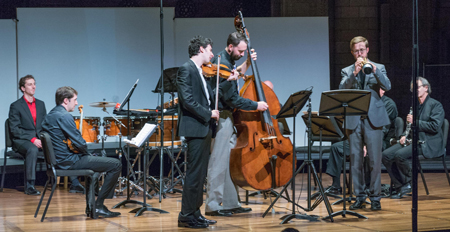 And before the Stravinsky, Ridenour entertained the crowd with his jazzy take on the “Agnus Dei” from J.S. Bach’s Mass in b minor. Non-attendees will just have to take our word that the piece worked superbly in the versatile hands of violinist Itamar Zorman, bassist Nathan Farrington, and Ridenour. Don’t be surprised if you hear this combo — and this piece — in a lounge bar sometime soon.
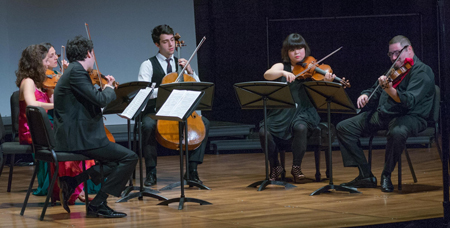 The Dvořák work was his String Sextet, Op. 48, one of the first pieces that raised the composer to international prominence following its debut in 1879. You could wire this piece into the festival’s theme of “Tales & Legends” by virtue of its folksy qualities — it seems to carry a narrative that lies just beyond words. Or you could just luxuriate in its sonorities and beautiful, lyrical melodies. If the sextet might have sounded even more striking in a smaller hall, that takes nothing away from the superb playing of Itamar Zorman, Diana Cohen, Michael Klotz, Yura Lee, Julie Albers, and Timotheos Petrin on Saturday evening. Watching Zorman’s evocative facial expressions was its own treat.
Photos by Gary Adams.
Published on ClevelandClassical.com July 5, 2016.
Click here for a printable copy of this article
