



by Mike Telin
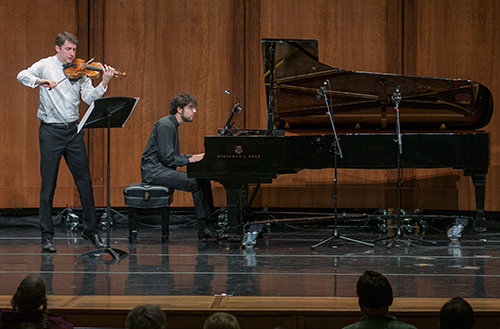 ChamberFest Cleveland wrapped up its seventh season with an excellent concert on Saturday, June 30 at the Maltz Performing Arts Center. “Dawn of a Revolution” included works by Claude Debussy, a world premiere by Sebastian Chang, and a musical tapestry woven with inspired new choreography by David Shimotakahara.
The performance of Debussy’s sublime Violin Sonata by Noah Bendix-Balgley and pianist Roman Rabinovich was, in a word, stunning. Playing with a smooth, liquid tone, Bendix-Balgley made the intricate lines of the opening Allegro vivo sound easy. He brought clarity to the recurring, downward triadic motif that ties the movement together. Rabinovich matched that clarity with his light touch. The duo made everything so effortless it was easy to forget how complicated Debussy’s writing is. The Intermède: Fantasque et léger was highlighted by refined, well-shaped lines and nuanced articulations, while the Finale: Très animé exuded thoughtful energy, bringing this gripping performance to a brilliant close.
In an interview with ClevelandClassical.com, composer Sebastian Chang explained the title of his new work, Cryptogenic Infrastructure Fantasy. “Cryptogenic is usually a disease of unknown or obscure origin, and infrastructure fantasy because the structure is loose. So, that’s what the title means — it’s of unknown origin and fires from the hip.”
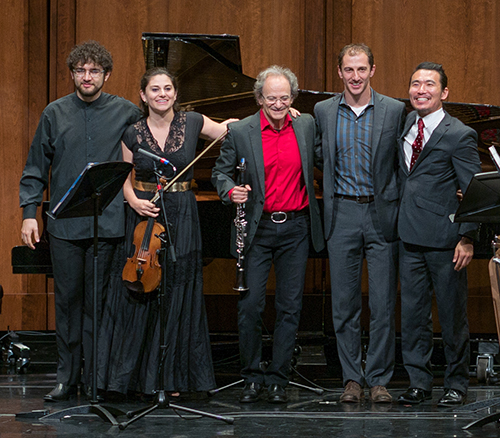 Commissioned by ChamberFest in honor of the now extended Cohen family — Roman Rabinovich and Diana Cohen were married last summer — the piece is scored for the slightly unusual combination of violin (Diana Cohen) clarinet (Franklin Cohen), timpani (Alexander Cohen), and piano (Roman Rabinovich).
The eight-minute work opens with a grand tutti march, which is quickly interrupted by fast, technical flourishes in the violin, clarinet, and piano. The opening then returns, this time with added sharp, tricky rhythms. As the violin and clarinet fight for the lead, the timpani begins to take over. A slower, Arabic-sounding section features a lovely duet for the violin and clarinet, which gradually builds to a dramatic conclusion. The Cohen Family Quartet played the idiosyncratic piece with superb technical flair, bringing out the wit of each section. Although the jury is still out about the inclusion of timpani in a chamber piece, Alexander Cohen played with judicious dynamics and punctuations. All-in-all, Cryptogenic Infrastructure Fantasy is a fun work that fit the spirit of the occasion.
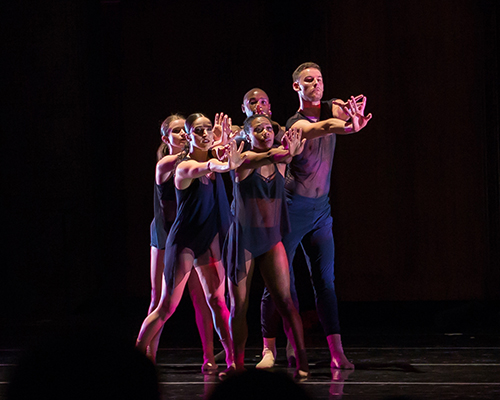
 The musical pastiche that makes up Dawn of a Revolution centers around Ligeti’s Musica Ricercata. These iconic pieces were interspersed with works ranging from the classical period to the late 20th century, performed by violinists Noah Geller and Diana Cohen, violist Matthew Lipman, cellist Julie Albers, and pianist Roman Rabinovich. This inspired concept was taken one step further with the imaginative choreography of David Shimotakahara for the expert dancers from GroundWorks Dance Theater — Gemma Freitas, Alexis Britford, Annie Morgan, Robert Rubama, and Tyler Ring.
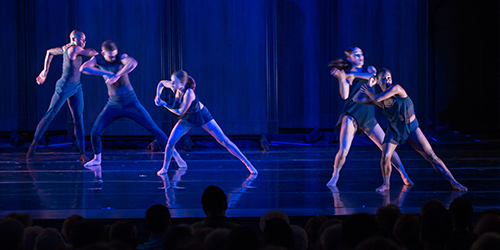 As we have come to expect from Shimotakahara, his choreography was guided by the music. He also made the wise decision not to add movement to every one of the eleven musical selections. But when he did, his neoclassical style worked beautifully. He created a party scene during the Alla danza tedesca from Beethoven’s Quartet Op. 130, while the dancers only appeared during the slower middle section of the Assez vif from Ravel’s String Quartet. And in Rabinovich’s and Geller’s mesmerizing performance of Arvo Pärt’s Spiegel im Spiegel, the long lines of the choreography mirrored Pärt’s score wonderfully.
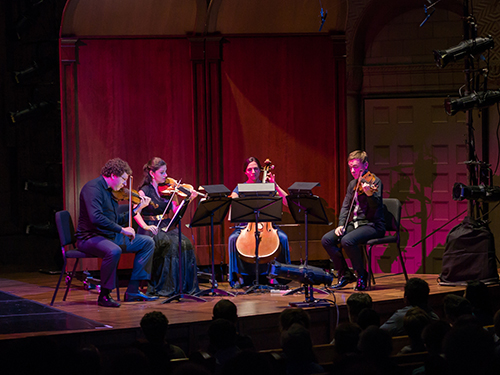 During the splendid playing of the Furioso from Ginastera’s Quartet No. 2, the quick back-and-forth hand motions of the dancers were perfectly in sync with the rhythm of the music. Shimotakahara’s setting of Musica Ricercata No. 11 was spellbinding as the forces grew from a single dancer to the full company. As Rabinovich’s final note faded away, the large audience sat in silence until the spell was finally broken.
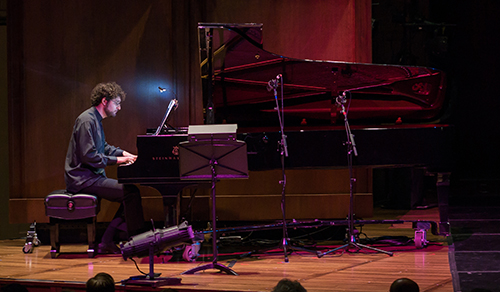 Throughout, the quartet players were on the top of their game — the Allegretto from Shostakovich’s Quartet No. 8 (not danced) was terrific. Still, a shoutout must be given to pianist Roman Rabinovich who outdid himself during his masterful interpretations of the Musica Ricercata Nos. 1, 2, 4, 5, 7, 10, and 11.
 The evening did what a concluding Festival concert should do — make you eagerly look forward to the next season.
Photos by Gary Adams.
Published on ClevelandClassical.com July 10, 2018.
Click here for a printable copy of this article
