


by Kevin McLaughlin
 At the Cleveland Institute of Music’s Mixon Hall on Friday, June 20, ChamberFest Cleveland presented “Variations on Love and Loss.” Complemented by a friendly acoustical space and a convivial throng, the program spanned a wide emotional range, from deep grief to luminous joy.
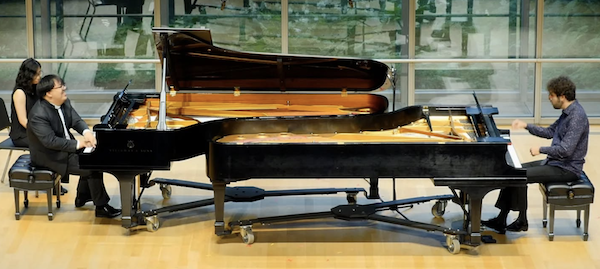
Witold Lutosławski and fellow composer Andrzej Panufnik originally performed Lutosławski’s Paganini Variations in cafés around Warsaw during the German occupation of Poland in World War II, where public concerts were banned.
The duo wrote it partly to showcase their talents, and pianists James (Zijian) Wei and Roman Rabinovich brought fearless bravura to the work. The performers tore through each variation, trading volleys of octaves and whiplash runs. It was part sorcery, part acrobatic display — and entirely exhilarating.
Violinist Kristin Lee and cellist Raman Ramakrishnan joined Wei for Bright Sheng’s Four Movements for Piano Trio. The composer described the first as having a “heterophonic texture” — all three instrumentalists play a single melody, but each one subtly varies the tune in rhythm and phrasing. Here the result sounded like Asian folk music and also jazz — spontaneous and improvisatory.
In the remaining movements, the players shifted characters and colors. Lee and Ramakrishnan both brought charm to the second movement, based on a Sichuan folk tune, while Wei urged us to dance. The third surprised with its rhythmic bite and jagged energy. In the closing “Nostalgia,” the group achieved a quiet intimacy with Lee’s stratospheric whispers, Ramakrishnan’s gentle support, and Wei’s delicate touch.
The world premiere of Judith Markovich’s Oh, my son… — a searing meditation on grief, guilt, and fragile renewal — stood as the emotional summit of the evening. 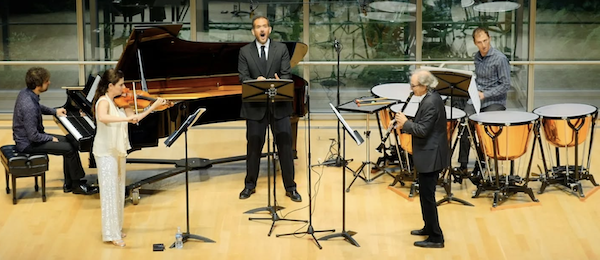 Drawing on David Stern’s tragic proem (Stern’s term for a blending of prose and poetry) “A Father’s Lament” retells the events leading to the suicide of Stern’s son, Alan. The six-movement work offered a stark and arresting musical narrative, made particularly so by tenor and narrator Dominic Armstrong who delivered the text with clarity and compassion.
In “Searching the Silence” the tenor sounded as if he were reliving the terrible events in front of us, his voice rising from whispered disbelief to anguished declamation. Franklin Cohen’s clarinet moaned, shadowing Armstrong in “Paradox” with passages that flickered between lyricism and unease. Violinist Diana Cohen led the way through the “Maze of Torment” in phrases that were lyrical, brittle, and searing, and imitated a squeaking door sul ponticello with eerie precision.
In “Symphony of Sorrow,” pianist Roman Rabinovich led the ensemble in a dirge-like pulse, while Alexander Cohen’s timpani pounded out a somber heartbeat that raced in fearful anticipation. The penultimate movement, “Scars on the Sun,” fused stillness and heat, its dissonances seeping like wounds that refuse to close. And in “Ripples of Rebirth,” the ensemble found a fragile path forward — no resolution, but a glimmer of hope and continuation.
As a musical response to tragedy, Oh, my son… was harrowing and deeply human — a brave act of storytelling that left the hall in silence, followed by heartfelt applause.
A measure of solace arrived with the final work. The sound of Schubert is often what one longs for in chamber settings — an amalgam of the ethereal, intimate, and deeply psychological. How wonderful that the next music to spool out of the players was the Schubert String Quintet in C.
Written in the final year of Schubert’s life but left unperformed for decades, the Quintet adds a second cello — a choice often read as ominous, though this ensemble favored lightness and clarity over heft and gloom.
As the group’s gravitational center, second cellist Raman Ramakrishnan seemed to revel in shaping the work’s character. His agreeable tone surfaced like golden nuggets. In the first movement, he joined cellist Oliver Herbert in a duet so sweet that you wanted to wrap it up and take it home with you. Violist Milena Pajaro‑van de Stadt supplied heartfelt warmth, while violinists David McCarroll and Diana Cohen provided clean, eloquent upper lines.
The introspective Adagio is the work’s sublime center and a well-placed corollary to the Markovich work. Here it was played not for pathos but peaceful surrender. Capacious phrasing and luminous string timbres — especially McCarroll’s soaring violin lines, and divinely-placed pizzicati in exchange with Ramakrishnan — invoked contemplation of the everlasting. The Scherzo followed, taut and crisp, and during the Finale the ensemble united in a common, joyous cause.
Published on ClevelandClassical.com June 26, 2025
Click here for a printable copy of this article
