


by Daniel Hathaway
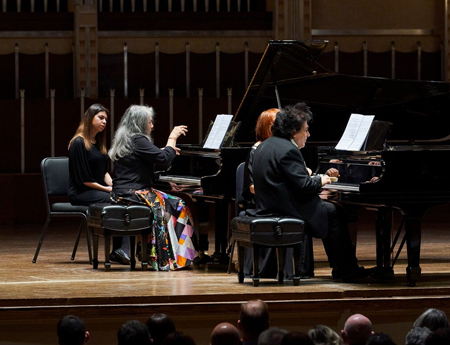 Although Argentine pianist Martha Argerich has never before played here, her reputation guaranteed a full house of ardent fans when she joined Cleveland’s own Sergei Babayan in a duo piano recital on Monday evening at Severance Hall sponsored by the Cleveland International Piano Competition. Their virtuosic playing in music by Mozart and Prokofiev was simply phenomenal, leading the cheering audience to demand two encores at the end — after multiple bouquets of flowers had made their way to the stage.
Seated at instruments arranged cheek-to-cheek but slightly offset, the pianists performed two sets of excerpts from Prokofiev’s stage and screen works in colorful arrangements by Babayan, flanking a pristine reading of Mozart’s D-Major Sonata, K. 448.
The first Prokofiev suite comprises a dozen movements from the ballet Romeo and Juliet, beginning with the jarring chords of the Prologue. High drama alternated with tender lyricism as the scenes progressed through portraits of the Montagues and Capulets, a quarrel, the stately Gavotte, and other dances, culminating in great roars of sound with the Death of Tybalt.
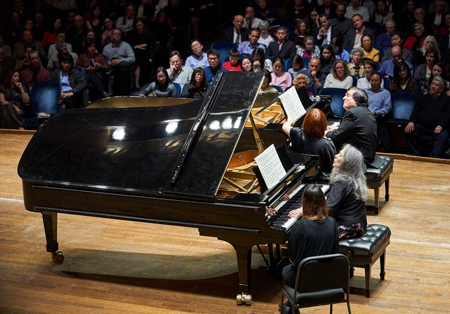 After intermission, in Mozart’s two-piano sonata, the performers traded glistening runs in the opening Allegro, voiced elegant phrases in the Andante, and galloped through the final Allegro at a breathtaking pace, while carefully controlling articulation and phrasing.
Argerich took over the downstage piano for Babayan’s arrangements of seven pieces by Prokofiev, beginning with the ominous tones of “The Ghost of Hamlet’s Father” from the incidental music to Shakespeare’s play. A Mazurka and Polka from Eugene Onegin, a Polonaise from the film music to The Queen of Spades, and two waltzes followed — “Pushkin Valse No. 2” and “Natasha’s and Andrei’s Valse” from the opera War and Peace, all full of character and several with clever endings that gave both the pianists and the audience reason for a giggle or two.
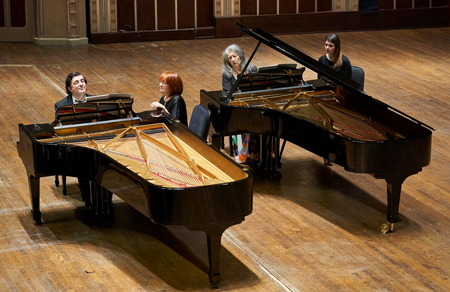 The second suite ended with the bizarre and thunderous “Idée fixe” from The Queen of Spades, in a performance that brought the house to its feet. After several callbacks and the applause having advanced to rhythmic clapping, Babayan brandished a score indicating that an encore was in the cards.
Lesser artists might have sent the crowd home with a bon-bon or two after a program of such intensity, but Argerich and Babayan gave a wonderfully lulling performance of the Barcarolle from Rachmaninoff’s First Suite, followed by the Waltz from his Second. Surely a night to remember in Severance Hall — an experience for which we have Sergei Babayan and the Piano Competition to thank for bringing it to fruition.
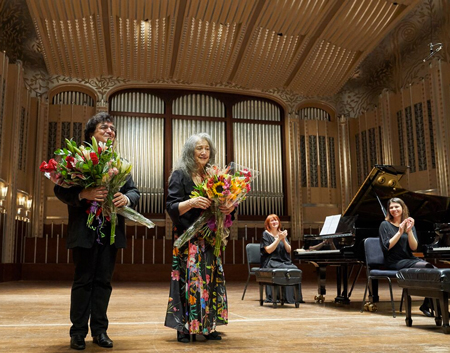
Photos by Roger Mastroianni.
Published on ClevelandClassical.com October 31, 2017.
Click here for a printable copy of this article
