



by Daniel Hathaway
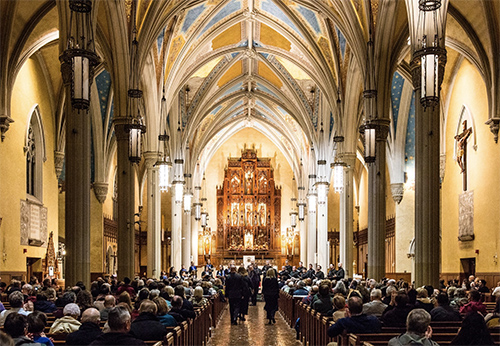 Conductor Scott MacPherson had two things in mind when choosing repertoire for Cleveland Chamber Choir’s first pair of concerts this season. The program had to reflect this season’s concentration on music by women composers, and the works needed to flourish in the lively acoustic of venues in Cleveland and Akron. The first performance, on Friday, November 8 at the Cathedral of St. John the Evangelist, scored high on both counts.
Friday’s concert began dramatically with a drone in low men’s voices. The women of the choir filed in, circling the altar on the crossing platform for a full-throated performance of Hildegard von Bingen’s O virtus sapientiae. Then the entire choir split into two groups down the side aisles of the nave for Estonian composer Umas Sisask’s wordless “Oremus” from Gloria Patri. Reminiscent of the textures of a certain other Estonian composer, Sisask’s piece rose to a thrilling climax.
Back on the platform, the choir moved on to Twin Cities composer Linda Kachelmeier’s O vos omnes, which cast mezzo-soprano soloist Kim Lauritsen in the role of the grieving Mary. A concatenation of Stabat Mater and one of the Reproaches for Holy Week, the work created a seething crowd with its pulsing repetitions, through which Lauritsen’s robust voice carried beautifully.
Soloists Kristine Caswelch, Julie Myers-Pruchenski, Kira Seaton, and Corey Fowler moved down the center aisle to sing the abbellimenti in Gregorio Allegri’s famous antiphonal setting of Psalm 51, which alternates between plainchant, chorus, and soli. Despite its title, Miserere, the early 17th-century composer took no mercy on the solo soprano, who had to nail several high Cs, then drift down from them in the course of the work — the liturgical equivalent of Mozart’s Queen of the Night aria. Caswelch was impressive.
The first half ended with the haunting textures and harmonies of Cecilia McDowall’s Cecilia, Busy Like a Bee, the British composer’s clever setting of a text from Lauds of St. Cecilia’s Day. Anna E. White was the fine soloist, and thanks to the “wet” acoustic of St. John’s, the eerie final chord hung in the air well beyond the cutoff.
Laudate Dominum, a double choir motet by Franco-Flemish Renaissance composer Phillipe Rogier that MacPherson tracked down in the library of a Mexican cathedral, launched the second half with fulsome, festive choral textures.
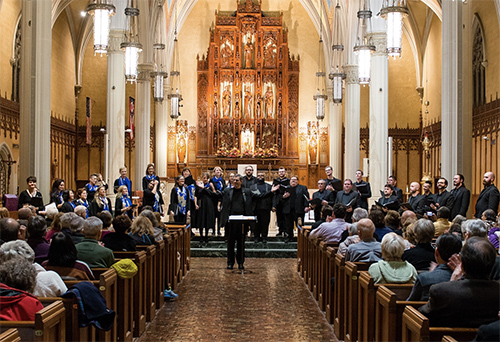 The centerpiece of the evening was Timothy Cramer’s Lux Caelestis, for which the concert was named. Five inventive movements set religious texts in their original languages using extended choral techniques, catchy rhythms, exuberant note clusters, and luminous, complex chords. The singers brought all of Cramer’s dazzling effects off with easy virtuosity, and the composer was on hand to receive a hearty ovation from the large audience.
Eurydice V. Osterman’s one-word Alleluia might be described as Randall Thompson on Speed, but while Thompson characterized his work as “a sad fanfare for the fall of France” in World War II, Osterman’s was giddy and delightful.
An “Optional Selection,” or planned encore, brought mezzo-soprano and tenor soloists Kira McGirr and Joel Kincannon to the front of the choir for Jocelyn Hagen’s Hands, a wordless vocalise with choreography — a joyful ending to yet another engaging Cleveland Chamber Choir concert. The performance was dedicated to the memory of Helen Tremaine Gregory, a longtime friend of Scott MacPherson and “choral enthusiast.” No doubt she would have loved it.
Photos: Elisa Vietri
Published on ClevelandClassical.com November 12, 2019.
Click here for a printable copy of this article
