



by Kevin McLaughlin
 Often called The Vespers, Sergei Rachmaninoff’s All-Night Vigil reaches for something beyond an evening service. Its fifteen movements, rooted in Russian Orthodox chant, rise and surround like incense — not to display magnificence, but to deepen the mystery. Rachmaninoff was so fond of the work that he requested the fifth movement, the Nunc dimittis, be sung at his funeral.
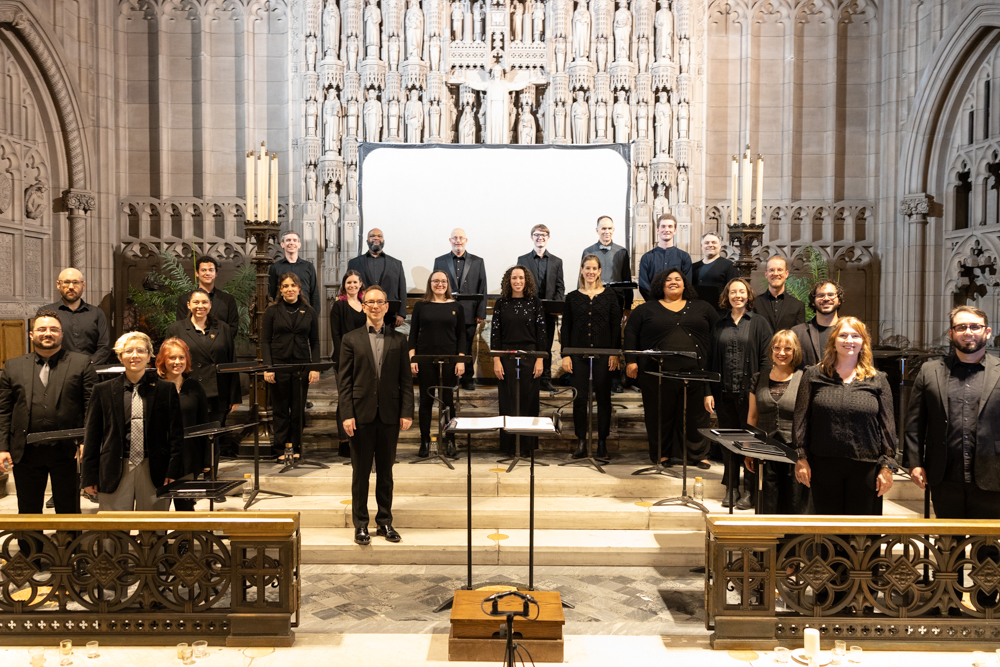
On Friday evening, October 25, the Cleveland Chamber Choir, directed by Gregory Ristow, presented this monumental work in Trinity Cathedral — a resonant space of tradition and calm, where the beauty of the setting matched the beauty of the sound.
Reena Esmail’s A Winter Breviary was the evening’s quiet prologue — a solitary vigil before Rachmaninoff’s communal one. Both composers begin from the same human act of wakefulness, though their prayers differ in tradition.
Esmail orders her three movements — Evensong, Matins, Lauds — after the canonical hours that mark the long night toward dawn. Each also corresponds to a Hindustani raag, where distinct traditions meet and remain true to themselves in coexistence. The texts by Rebecca Gayle Howell have the intimacy of a notebook kept by candlelight — their brief entries describing hope and astonishment.
The Choir’s bright, transparent sound suited Esmail’s lean textures. We Look for You (Evensong) begins with a chain of suspended chords, hovering between expectancy and repose. In Matins, the darkest and most dramatic of the three, voices pierced the Cathedral’s resonance with sharp dissonances and a long, searching ascent. In the closing Lauds, they thinned to a whisper — a single thread of sound. Ristow shaped these moments with patience and an ear for the virtue of stillness.
With lights lowered and candles lit, the Choir’s presentation of the Rachmaninoff was reverent and modestly theatrical. Larger choruses may have their advantages — harmonic clouds thrive on mass and amplitude — but a smaller ensemble offers other rewards: the opportunity to follow individual lines, hear the inner architecture, and appreciate the craft behind the devotion.
Rachmaninoff drew on three chant traditions — the ancient Znamenny chant of the Russian Orthodox Church, the recitational Greek style, and “Kiev” chant — weaving them into vivid polyphony. The profundo basses were especially pressed: the part plunges to depths that might make even these professionals blanch. It is a demand that keeps the Vigil from frequent performance. Yet the back row descended to the task nobly, anchoring the choir with warmth and gravity, their stamina crowned by the glorious low B-flat at the close of the Nunc dimittis (“Now lettest Thou”).
Among the soloists were alto Joanna Tomassoni, who brought such a beguiling and tender voice to Bless the Lord, O my soul (second movement) that one wished she had been given more to sing. In O Gladsome Light (movement four), tenor Joel Kincannon sang with a pure, even line. And tenor Peter Wright added a glowing warmth to Lord, Now lettest Thou Thy servant depart in peace (fifth movement), rising, in his turn, to help stave off the darkness.
The chorus proved itself to be a disciplined body. The Vigil is no easy hike, but apart from two short water breaks after movements eight and eleven, they maintained their focus and cohesion throughout the hour. The performance remained blended, sonorous, and human — as if cooperation itself were an act of devotion.
Ristow’s pacing favored breadth over zeal. One heard the music’s dignity as much as its holiness. The clarity of the performance revealed Rachmaninoff’s sympathy with the New Direction composers — contemporaries who sought to revitalize ancient chant with late-romantic harmony. If the incense rose from tradition, the architecture was modern.
Heard together, the two works framed a long, moving night of the soul: Rachmaninoff’s communal watch in candlelit gold, Esmail’s solitary vigil beneath winter stars. Each celebrates, in its own language, the patience of waiting — through prayer, through collective singing, through simple attentiveness — and the quiet joy of light returning.
Photo by Mandy Coy
Published on ClevelandClassical.com October 29, 2025.
Click here for a printable copy of this article
