





by Daniel Hathaway
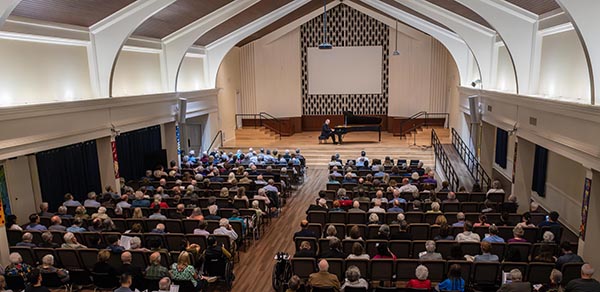
 Cleveland audiences have recently enjoyed a double dose of Garrick Ohlsson’s piano wizardry. After stepping in for Igor Levit with The Cleveland Orchestra in March, Ohlsson returned to close out the Cleveland Chamber Music Society season with a predictably wonderful recital at Disciples Christian Church on Tuesday, May 7. The four works on his program — a Beethoven sonata, a Schubert fantasy, a contemporary Australian piece, and a Chopin triptych gave the large audience plenty to rave about.
Beethoven’s Sixth Sonata is something of an entremet among the three works of his Opus 10. Shorter and lighter in spirit than its siblings, it made a delightful curtain raiser. Ohlsson played the opening movement with an elegant clarity, inviting his listeners to join in the fun he was obviously having.
Ohlsson nicely shaped the opening of the minor-key Allegretto that replaces the customary Scherzo, letting it grow to full bloom. He adroitly balanced the chords that support the second theme, and made a seamless transition back to the opening material.
The chase was on as fun returned in the third-movement Presto, which the pianist made sound so easy that anyone should be able to do it.
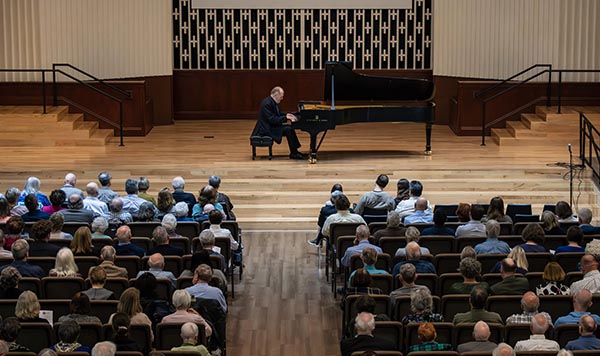 The torso of the evening’s program was Schubert’s Fantasie in C, dubbed “The Wanderer” after the composer’s song on which it’s based. Ohlsson played the first movement with full-bodied tone but well-controlled dynamics and gave each of its contrasting emotions thoughtful character.
His beautiful phrasing of melodic material and well-balanced chords distinguished the second movement, and he played its cascading notes with poetic grace. In the third, the most playful and lyrical, he directed every phrase toward its destination, no matter how long it took Schubert to arrive there.
The finale set the audience off on another circuitous journey — this isn’t called “The Wanderer” for nothing — but both composer and pianist held your attention until the very end, Schubert with his persistent long-short-short rhythmic motive, Ohlsson with his immaculate technique and gift for narrative.
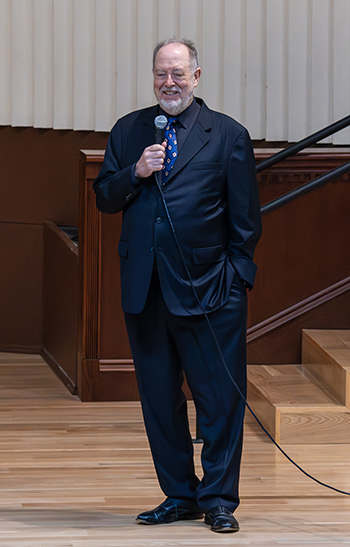 Tasmanian composer Thomas Misson’s Convocations was commissioned for Ohlsson’s tour of Australia last year. In his spoken introduction the pianist quipped that “the most important thing to know about new music is how long it is. This is about ten minutes.”
Its lean, dreamy texture took the audience into another sound world, one with hints of New Agey impressionism and a full spectrum of dynamics that jerked emotions back and forth. Ohlsson’s committed performance treated it as a masterwork.
The winner of the 1970 Chopin International Competition ended the evening with magisterial accounts of the Polish virtuoso’s Variations brillantes, the Nocturne in B, and the B-flat minor Scherzo, never allowing Chopin’s tunes to get lost in his filigree, never becoming self-indulgent, and magically playing big and intimately all at once.
What for an encore? Ohlsson sent the enraptured crowd home with a gorgeously nuanced performance of a piece he said was “too famous to announce.” It took only the first two chords to identify Debussy’s Clair de lune.
Photos by Ron Werman.
Published on ClevelandClassical.com May 13, 2024.
Click here for a printable copy of this article
