


by Mike Telin
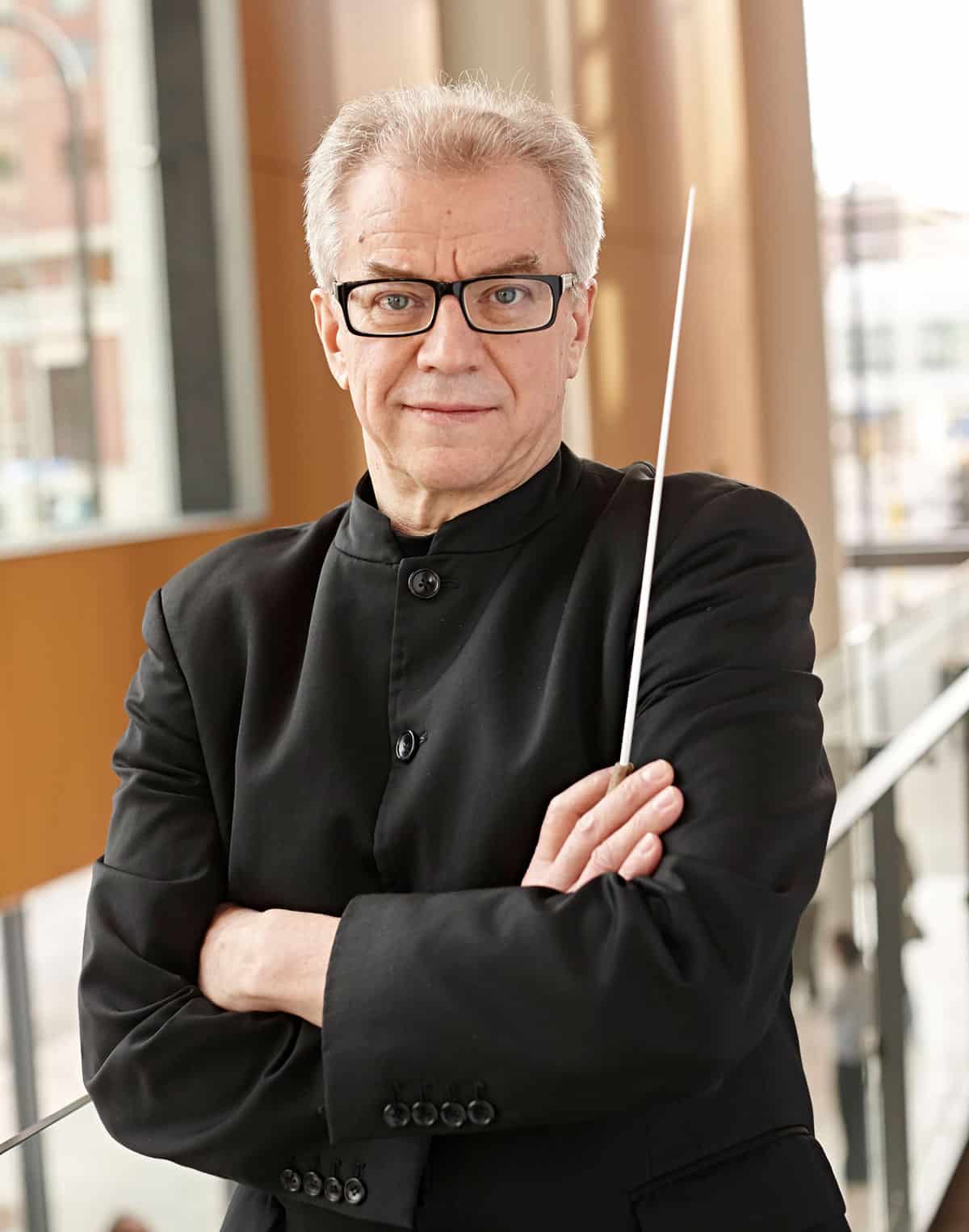 “It’s great to come to Cleveland, because the Orchestra is always willing to do their best,” conductor Osmo Vänskä said during a recent interview. “And they expect that if someone is on the podium, that person should have the same attitude and have done their homework.”
On Saturday, July 12 at 7:00 pm, Osmo Vänskä will revisit Blossom Music Center to lead The Cleveland Orchestra in a program that includes Jean Sibelius’ En Saga and Carl Orff’s Carmina Burana. Tickets are available online.
Speaking to him via Zoom from his home in Minneapolis, I began our conversation by asking him if there is a connection between the Sibelius and Orff. “To be honest, I don’t know if they’re connected,” Vänskä said. “There are many ways to come to a final program. Obviously in this case the concert was about Carmina Burana, and we needed another piece to start with.”
The conductor noted that En Saga is a work by a young Sibelius and has many folk music connections. “It’s quite wild, and then the entire ending has a long clarinet solo that I have played when I was a clarinetist.” Vänskä began his musical career as an orchestral clarinetist, first with the Turku Philharmonic and later with the Helsinki Philharmonic.
“I just love the piece so much. I never feel that Sibelius is difficult to understand, but maybe this is the easiest piece for people to listen to.” Vänskä explained that the title, En Saga, is Swedish for “fairy tale,” and unlike the composer’s other tone poems, it has no program or literary source, so everyone can make up their own story.
“For example, in Finland you might be sitting around a fire in the forest near a lake, and you might be eating a sausage. And people are talking to each other about things that happened a long time ago — stories they heard from their grandparents. I find that to be a good description of the piece. But there’s no wrong story, so there are many possibilities for people to connect to it.”
Shifting our attention to Carmina Burana, I asked the conductor why he thinks the work is so popular. “It has really great melodies,” he said. “And I think there is a nervous excitement from the very first chorus. It also has a huge number of people coming together.”
Vänskä likened the opening chorus, “O Fortuna,” to being at a stadium rock concert. “The band starts playing their famous song and then the whole audience is singing with them — but they don’t have candles anymore, now they have iPhones. That is the feeling you get during that piece, that we all are involved.”
The text is based on 24 poems mostly from 11th and 12th century monasteries that cover many topics including fate, drinking, gambling, and lust — still familiar subjects in the 21st century. “The texts of Carmina Burana, and their connection to happiness and enjoying life, are opposite to how the monasteries are telling it, and I think that is very interesting.”
Depending on your point of view, Vänskä said he often wonders if Orff was creating something serious or if it was some sort of joke. His favorite example is the tenor aria “Olim lacus colueram,” which is usually sung in falsetto to depict the suffering of its character. “The swan is singing while the chef is roasting it: ‘I’m thinking about my life, how I saw the landscape when I was flying there, and now here I am burning.’ You cannot take that seriously.”
On Saturday, that role will be sung by a countertenor. “The last three times I have conducted the piece, I did it with a countertenor,” Vänskä said. “Great ones have this color to their sound which is different from a female or a tenor singing falsetto. And we have a very good soloist in Reginald Mobley.”
Vänskä said the piece also requires a baritone who is not only a fine singer, but an actor as well. “It’s not easy. There is a lot of fast text not only for the baritone, but also for the chorus. Many times things happen twice, but there are cases when the music happens three times, and the tempo is already marked quite fast. The first repeat should be faster and the third time should be even faster. So you need to have singers who can make the text clear. We have a great soloist in John Brancy, and the Blossom Festival Chorus is fantastic.”
The piece also includes a difficult part for solo soprano and a prominent role for a Children’s Choir. “Shelén Hughes is a wonderful soprano, and I hear The Cleveland Orchestra Children’s Chorus is excellent,” Vänskä said. “I often think of children’s choirs in this piece like the paintings of kids who look like small angels — they have a good sense of humor and they know what’s going on.”
Published on ClevelandClassical.com July 9, 2025
Click here for a printable copy of this article
