

 by Daniel Hathaway
DIARY MOVES TO A DIFFERENT COLUMN:
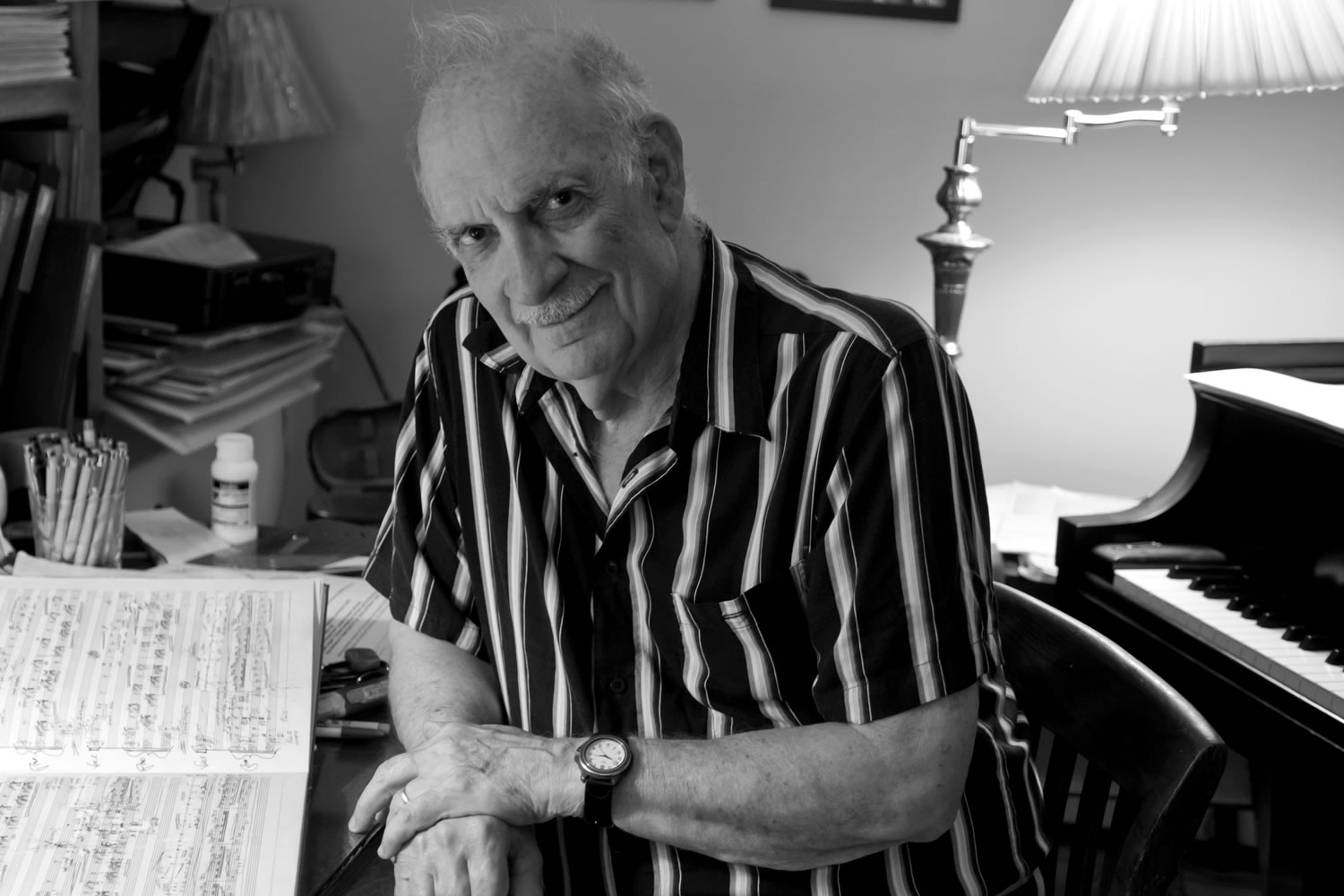
Since we initiated the Diary near the beginning of the pandemic, this daily feature has become increasingly important as a repository for breaking news, concert updates, links to interesting articles on other classical music sites, anniversaries, and musings on topics of their choice by our writers, who alternate in curating its contents. Today, the Diary moves to the top of the main column of the Front Page, where it will be more immediately visible, and act as a headliner for the day. Click here if you’re interested in sponsoring a day’s worth — or a week’s worth of Diary posts. (Photo: George Crumb)
TODAY’S EVENTS:
Go online today at 2:00 pm for two hours with host Erik Charnofsky, who takes a step outside the familiar, and introduces listeners to a variety of works by Widor, D’Indy, George Lewis, Palestrina, and E.J. Moeran on “Not Your Grandmother’s Classical Music” (sorry, Gran!) The internet feed comes from WRUW.
NEWS BRIEFS:
Amid all of the recent concert cancellations and postponements, it’s refreshing to learn that a touring ensemble has extended their stay in Cleveland to give an extra performance. The Barcelona-based string quartet Cuarteto Casals, already scheduled to play Haydn, Beethoven, and Shostakavich on the Cleveland Chamber Music Society series on Tuesday, February 22 at Plymouth Church, will also appear at Disciples Christian Church on Wednesday, February 23 with more Haydn, plus quartets by Mendelssohn and Shostakovich. Click here for ticket details.
We’ve just added two concerts by Cleveland’s medieval vocal trio Trobár to the calendar this week. Singers Allison Monroe, Elena Mullins, and Karin Weston will combine their voices with vielle, rebec, harp, psaltery, and flute in Il Dit / Elle Dit: Love and Dialogue in the World of Christine de Pizan, a “not-so-traditional” Valentine’s Day program on Friday, February 11 (St. Paul’s, Cleveland Heights), and Saturday, February 12 (Hildebrandt Artist Collective). Download the flyer here.
And we’ve added more information about the pair of Cleveland Chamber Choir performances later this month featuring music by British composer Cecilia McDowall, who will travel to Cleveland to give master classes and participate in rehearsals of her music. That repertoire will include the premiere of her CCC commissioned work, On the Air (Dear Vaccine), which sets from hundreds of entries in the Choir’s world-wide poetry project, Dear Vaccine—A Global Vaccine Poem. In addition to works by Tallis, Stravinsky, and Britten that have influenced McDowall’s own compositions, the program will include McDowall’s The Presence, performed by a massed choir that will put CCC together with collegiate ensembles from CWRU, CSU, KSU, and YSU.
R.I.P. GEORGE CRUMB:
Today’s New York Times carries Vivien Schweitzer’s obituary for composer George Crumb, who passed away on Sunday, February 6 at 92 at his home in Media, Pennsylvania.
Crumb was a musician’s musician, as evidenced by numerous postings on social media by his colleagues, many of whom mentioned a favorite work from his catalogue.
Oberlin musicology professor Steven Plank, who also played trumpet professionally, wrote:
I was sorry to read of the death of George Crumb. Recording his Echoes of Time and the River was a very memorable part of my Louisville Orchestra days. Interestingly, I recall that when we performed it on a subscription concert we paired it with Beethoven 5th, and during rehearsal he seemed quite glad to be hearing it!
CIM composition professor Keith Fitch wrote:
For so many of us, he opened up such a sense of possibility, of imagination, of unconceived sound words, and, yes, courage (it took real courage to write those early pieces which were so far outside of what one was “supposed” to write). I could effuse about his impact on me when I first encountered his music as a young, wanna-be composer, but I’ll let the work speak for itself. Here is his iconic Black Angels from a performance we did at CIM celebrating his 90th birthday in the fall of 2019.
Click here to watch Black Angels, performed by the CIM New Music Ensemble, James Thompson, violin Julian Maddox, violin Tess Krope, viola, and Daniel Blumard, cello.
Former Oberlin composition professor Aaron Helgeson wrote:
From time to time, when interviewing Composition applicants, I like to play them a couple bits of music and see what comments and questions they come up with.
One is a video of Angélica Negrón’s paralyzingly beautiful electronic singer/songwriter set.
The other is this gem of a moment from George Crumb’s Quest.
I play these because there’s so much to talk about. But I also play them because if there’s nothing to be said about this music, it’s hard for me to imagine saying anything about music at all.
George Crumb, your music is one of the reasons I got into this mess. You mattered. You still matter. Thanks from me.
Baldwin Wallace composition professor Clint Needham recommended Crumb’s Idyll for the Misbegotten for flute and percussion.
And former CIM composition professor Margaret Brouwer passed along a remembrance of Crumb written by violist Wendy Richman, a founder of the International Contemporary Ensemble:
George Crumb was one of the first “big deal” composers I had the chance to work with. My first time playing Black Angels, with Kyu-Young Kim, Gabe Kitayama-Bolkosky, and Eric Stephenson, was thanks to Margaret Brouwer at CIM (spring 2000). We worked so hard to put it together, and the school even rented electric instruments (Zetas, I think) *just in case* he preferred those to amplified acoustic instruments — the score says “electric violin 1, electric violin 2,” etc. He pooh-poohed them almost immediately. “Ah, no, I just meant…ELECTRIC. You know, they didn’t have THOSE back then.” His soft West Virginia accent and gentle demeanor took us all by surprise: after all, he’d written this crazy-sounding piece with insect sounds! and demon references! and string players playing tam-tams!
TODAY’S ALMANAC:
February 7 marks the birth in 1897 of American composer Quincy Porter in New Haven, Connecticut, the first performance of Samuel Barber’s Violin Concerto in 1941, and the death in 1994 of Polish composer and conductor Witold Lutoslawski in Warsaw.
Porter taught on two separate occasions at the Cleveland Institute of Music, as well as serving on the faculties of Vassar, the New England Conservatory, and Yale. Cleveland Orchestra violist Eliesha Nelson chose to include his 1948 Viola Concerto on her 2009 all-Quincy Porter album. Listen to her performance here with John McLaughlin Williams and the Northwest Sinfonia, and click here to hear the violist and the conductor answer some questions.
Click here to listen to the official premiere performance of the Barber Concerto with violinist Albert Spalding and the Philadelphia Orchestra under the direction of Eugene Ormandy from the Academy of Music in Philadelphia on February 7, 1941.
And before Lutoslawski left the stage, in 1990 the BBC joined other news sources to produce a documentary about his life and work. Watch his conversation with Krzysztof Zanussi here.
When the composer fled Warsaw in 1944, he left most of his manuscripts behind, and those were lost in the almost complete destruction of the city by the Germans. His 1954 Concerto for Orchestra established his prominence as a composer. Listen to a Cleveland Orchestra performance of the work under Christoph von Dohnányi here. (The recording pairs the Lutoslawski piece with Bartók’s Concerto for Orchestra.)
