


by Daniel Hathaway
NEWS BRIEFS:
 Marlene Rosen Memorial Concert:
On Sunday evening, May 10 at 7:30, the Oberlin Conservatory of Music will host a memorial tribute concert for Marlene Rosen, who served on its voice faculty for 40 years before her passing on August 5, 2025. The event in Warner Concert Hall will feature performances and remarks by former students and colleagues, followed by a reception in Warner Lobby. Read Oberlin’s remembrance of Rosen here.
Tuesday Musical announces prize winners:
Fifteen musicians competed in the Final Round/Winners Concert of Akron’s Tuesday Musical 2026 Scholarship Competition in Guzzetta Recital Hall at the University of Akron on Sunday afternoon, May 3. First prize of $2,000 went to flutist Dylan Masariego, a master’s degree student at the Cleveland Institute of Music, and second prize of $1,000 was won by classical guitarist Solis Dornan, a student at Oberlin Conservatory. Violinist Christoforos Petridis, also an Oberlin student, claimed the People’s Choice Award of $500. Read more here.
TODAY’S ALMANAC:
May 4 in classical music history marks some important beginnings that ultimately led to the modern grand piano, the phonograph record, and the international orchestral tour.
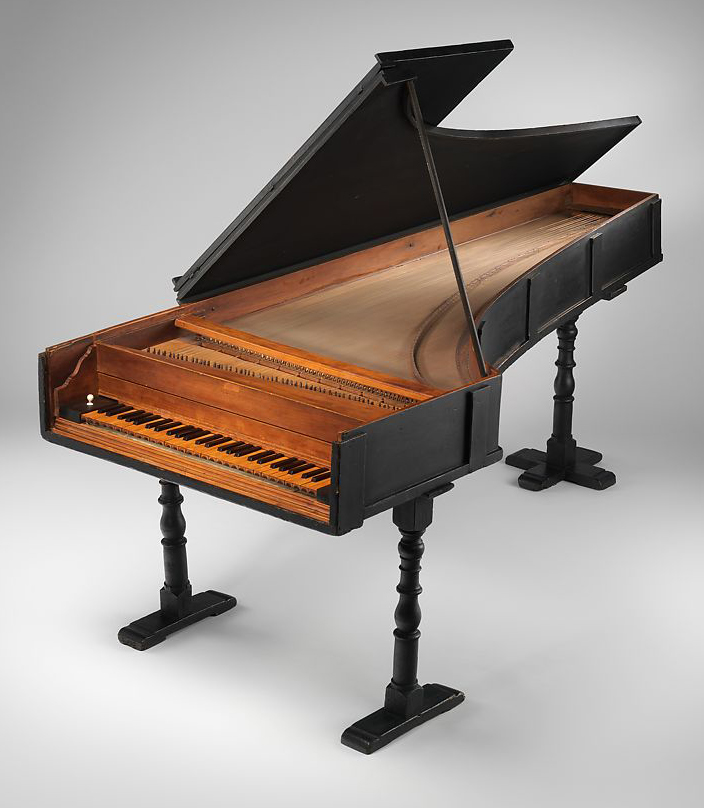 Italian craftsman Bartolomeo Cristofori, born in Padua on May 4, 1665, was responsible for inventing the first practical pianoforte, an instrument that looks just like a harpsichord until you raise the hood. Inside, instead of quills that pluck strings, a hammer mechanism strikes them and then retreats, allowing the performer to play soft, loud, or at any dynamic level in between. Thus Cristofori named his invention the “gravicembalo col piano e forte.”
Cristofori’s pianoforte mechanism was so sophisticated that no major improvements were made for the next 75 years, and the basic concept has persisted to today. You can see the 1720 model he built in Florence in the musical instrument collection of New York’s Metropolitan Museum, read about it here, and listen to Domenico Scarlatti’s Sonata in d played on it here by Dongsok Shin.
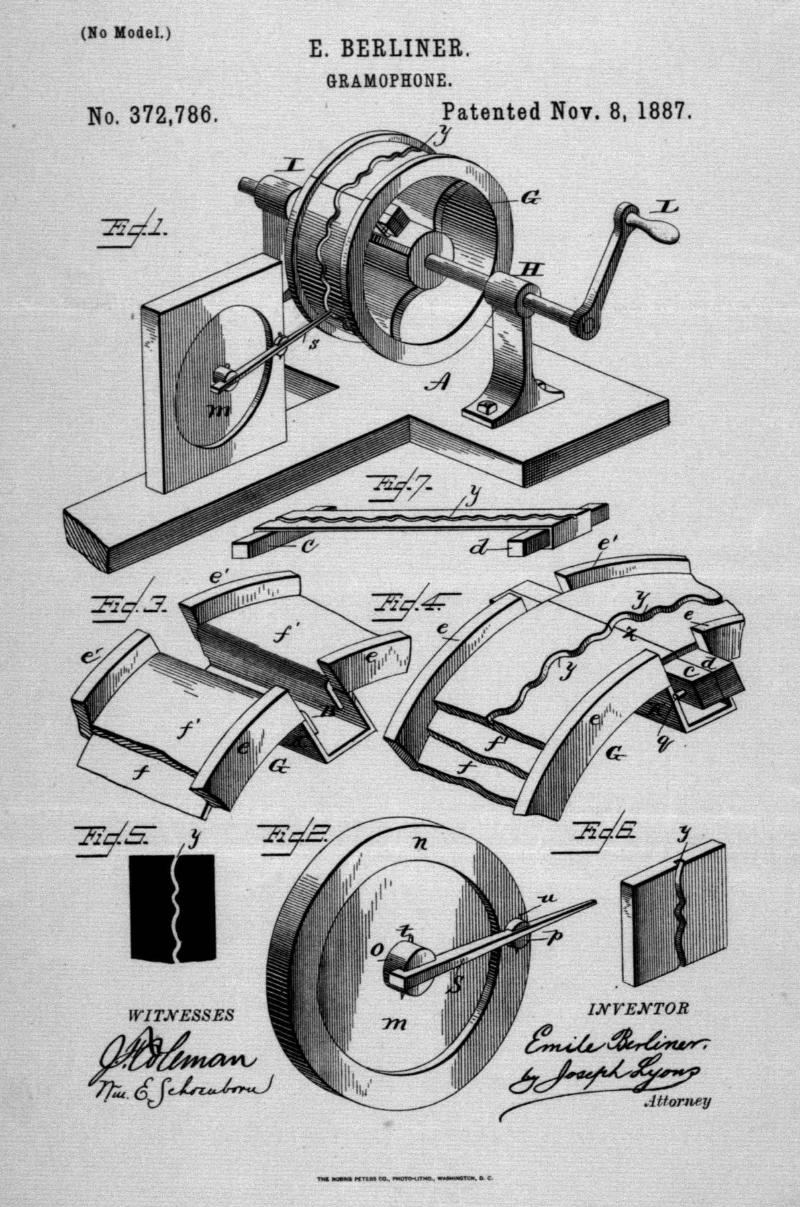 A number of late 19th century inventors were involved in creating machines that would reproduce sound, but on May 4, 1887, Emile Berliner was the first to file a patent application (U.S. patent 372,786) for a device he called the gramophone. His machine “recorded a lateral pattern on lamp-blacked paper wrapped on a cylinder, similar to the phonautograph of Leon Scott, but with an oil applied to the surface mixed with lampblack to make a fatty ink better able to be engraved with a cutting stylus.” Read about it in The Early Gramophone.
That a lot remained to be done before Sony could develop a single disc capable of reproducing Beethoven’s Ninth Symphony is suggested in the first news story about Berliner’s invention. A two-page article in Electrical World dated November 12, 1887 described a device driven by a weight box and controlled by a paddle-wheeled governor that recorded four minutes of sound on an 11-inch glass disc at 30 rpm.”
And on May 4, 1920, The Symphony Society of New York — which eventually became the New York Philharmonic — played the opening concert of its debut European Tour at the Paris Opera, making it the first American ensemble to perform overseas.
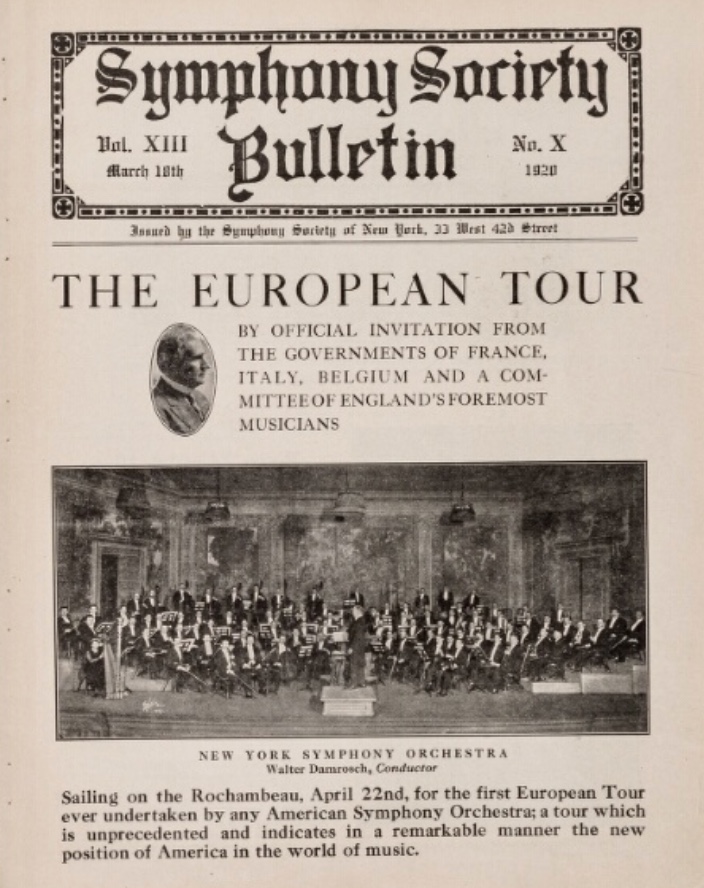 The Symphony Society Bulletin of March 18, 1920 noted that the European Tour was being undertaken “by official invitation from the governments of France, Italy, Belgium and a committee of England’s foremost musicians.” The Orchestra embarked on the transatlantic crossing aboard the Rochambeau on April 22, beginning “a tour which is unprecedented and indicates in a remarkable manner the new position of America in the world of music.”
The May 4 performance, led by Walter Damrosch, included Berlioz’ Overture to Benvenuto Cellini, Beethoven’s Third Symphony, d’Indy’s Istar: variations symphonique, and Ravel’s Daphnis et Chloe, “Fragment Symphonique.” The Orchestra’s European adventure lasted nearly two months, culminating in a June 20 matinee at London’s Royal Albert Hall.
On this May 4th, it’s good to look back and recall that cultural exchanges have until recently been important tools of international diplomacy, and not merely expensive expressions of musical vanity.
