

by Daniel Hathaway
 HAPPENING TODAY:
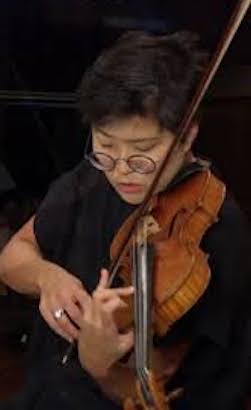
Tonight at 7:30, on the Lorain County Community College Signature Series in Elyria, violinist Clara Kim (pictured) plays her program People and Places — six works by JunYi Chow, Jessica Ackerley, Anne Leilehua Lanzilotti, Sarah Gibson, and Christopher Stark, each inspired by a location that shaped their creation.
For more information, please visit our Concert Listings.
TODAY’S ALMANAC:
Let’s start reflecting on October 27 in music history with the inspiring story of German organist and composer Helmut Walcha, born in Leipzig on this date in 1907. Blinded as a result of a smallpox vaccination at the age of 19, Walcha went on to become assistant organist at the Thomaskirche in Leipzig, moving on to the Friedenskirche in Frankfurt am Main in 1929, then to the Dreikönigskirche there in 1944, where he spent the rest of his career until his death in 1991.
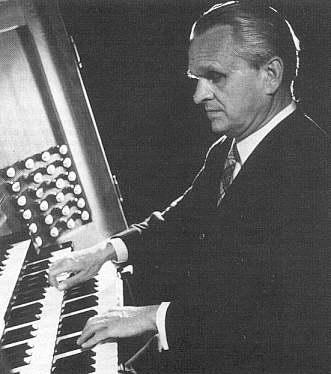 Walcha learned complex organ works — including the entire output of J.S. Bach, which he recorded twice — by having his wife play short phrases which he immediately memorized. One of his many students, George Ritchie, recounts that process here.
Walcha’s recordings employed a number of historical organs. Click here to listen to J.S. Bach’s Passacaglia et thema fugatum on the Arp Schnitger instrument in the St. Laurenskerk in Alkmaar, the Netherlands, and here for Walcha’s interpretations of music by Vincent Lübeck and Nikolaus Bruhns on the Schnitger at the Church of St. Peter and St. Paul, Cappel, in Lower Saxony — an instrument rusticated there from Hamburg whose pipework escaped being melted down during World War I because the country roads were impassable.
On this date in 1782, Italian composer and guitar and violin virtuoso Niccolo Paganini was born in Genoa. In spite of chronic illnesses, he became the premier violin soloist of his day. Although the guitar was his constant companion on concert tours, Paganini regarded it as a private instrument better suited for playing with friends.
His superhuman technique led to rumors that he had made a pact with the Devil, a superstition that delayed a Catholic burial for some 36 years after his death in 1840. That technique is preserved in his famous 24 Caprices. Canadian violinist James Ehnes brings his own splendid technique to No. 24 here, recorded by the CBC at a recital in Koerner Hall at the Royal Conservatory in Toronto.
October 27 marked the birth in 1927 of American composer Dominick Argento in York, Pennsylvania. The composer of 14 operas and a great swath of choral music, Argento divided his time between the U.S. and Italy (he spent part of each year in Florence), finally moving to the Twin Cities in 1958, where he established a long professional relationship with Plymouth Church and its music director Phillip Brunelle, who talks about that in the first episode of Musical Moment.
The University of Maryland devoted ten days in 2012 to a celebration of Argento’s vocal works, including the first performance of the composer’s Cabaret Songs. Watch a behind-the-scenes video here.
 Finally, German composer Hans Werner Henze died on October 27, 2012. The late Christoph von Dohnányi returned to town in February, 2013 to lead The Cleveland Orchestra in Henze’s Adagio, Fugue, and Mänadentanz, an arrangement of part of the third act of the opera The Bassarids (read our review here), and Franz Welser-Möst led the orchestra in Henze’s Il Vitalino raddoppiato with violinist Julia Fischer in May, 2017 (reviewed here).
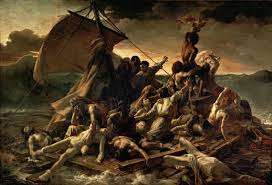
Probably Henze’s most famous work, Das Floß der Medusa, a requiem for Che Guevara based on the Géricault painting of the same name, was produced in Hamburg in 2017. Watch here.
