


by Daniel Hathaway
 WEEKEND PERFORMANCES:
The Cleveland Orchestra will play its last pair of subscription concerts before the Holiday season kicks off with a dozen performances by the Orchestra and Chorus between December 9 and 19.
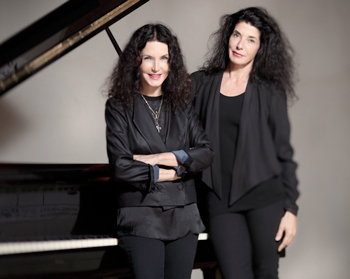
On Friday at 7:30 pm and Saturday at 8, guest conductor Gustavo Gimeno leads an interesting program that features pianist sisters Katia Labèque & Marielle Labèque in Bryce Dessner’s Concerto for Two Pianos. The evening begins lightly with Ravel’s Suite from Ma Mère l’Oye (”Mother Goose”), and ends with Céasar Franck’s dark-toned Symphony in d. Read Mike Telin’s interview with Gimeno here and his conversation with Bryce Dessner here.
On Sunday, Carl Topilow and Cleveland Pops officially turn on the symphonic Holiday Lights with a 2:00 pm concert in Playhouse Square.,
INTERESTING READ:
Read a WKSU feature about young classical guitarist Damian Goggans, whose promising career path began with lessons through the Cleveland Classical Guitar Society at Citizens Leadership Academy, advanced to a Musical Pathways Fellowship at the Cleveland Institute of Music, and after graduating from high school at the Cleveland School for the Arts earlier this year, brought him to the Oberlin Conservatory on a full scholarship.
WEEKEND ALMANAC:
Lots happened in classical music history on November 26, 27, and 28, but let’s take a moment to reflect on the careers of two Boston women composers who may not be as well-known as their contemporary, Amy (Mrs. H.H.A.) Beach.
Margaret Ruthveen Lang, born on November 27, 1867, and Mabel Daniels, also born on November 27 but in 1879, were closely connected to Boston’s important cultural institutions, especially the Handel and Haydn Society (America’s oldest continuing musical institution) and the Boston Symphony Orchestra.
Lang, unlike Beach, was encouraged in her compositional endeavors by her husband and family, and wrote some 200 songs during her career. Her A Dramatic Overture was performed by the Boston Symphony in April, 1893, and she was honored on her hundredth birthday in 1967 with a special concert that also recognized her as the Orchestra’s longest subscriber — a total of 91 years). Click here to listen to her piano piece, Starlight.
Daniels’ career was more centered in academia. She graduated from Radcliffe magna cum laude and went on to study in Munich, where she was the first woman to successfully audition for the score-reading class at the conservatory. Returning to the United States, she taught at Radcliffe and Simmons College and spent 24 summers at the MacDowell Colony, where she premiered The Desolate City for chorus and orchestra in 1913, and Deep Forest, later performed in 1939 at Carnegie Hall. She also provided works marking Radcliffe’s 50th and 75th anniversaries. Click here to follow the score with a performance of Deep Forest, and here to watch a Philip Brunelle “Musical Moment” devoted to Daniels’ music.
Incidental thought: how did Boston, a musically conservative town, produce more than its fair share of women who can be considered pioneers, rebels, and eccentrics? (Add to that list such figures as the art collector Isabella Stewart Gardner.) Are there more such individuals and their music we should know about?
Joseph Haydn tied the knot with Maria Anna Keller in St. Stephen’s Cathedral in Vienna on November 26, 1760, launching what has been described as a mutually unhappy marriage, but around which swirls a major identity problem. Who really was Haydn’s wife? Dive into that topic here.
And on November 28, 1632, Italian-born French composer Jean-Baptiste Lully was born in Firenze, beginning a distinguished career that ended in tragedy when he wounded himself in the foot with the 6-foot staff he pounded on the floor to keep time for the orchestra while rehearsing his Te Deum. Refusing to amputate his foot, he developed gangrene, and died on March 22, 1687. More subtle means of keeping performances together — already used in Lully’s time — have made conducting slightly less hazardous, as Jordi Savall demonstrates with Le Concert des Nations in Utrecht in 2010.
