

by Daniel Hathaway
HAPPENING TODAY:
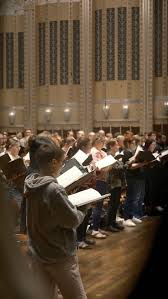 Tonight at 7:30, Klaus Mäkelä leads The Cleveland Orchestra, Cleveland Orchestra Chorus, and Children’s Chorus in the first of three performances of Benjamin Britten’s monumental War Requiem, with soprano Tamara Wilson, tenor Andrew Staples, and baritone Ludwig Mittelhammer, in Mandel Concert Hall at Severance Music Center.
NEWS BRIEFS:
The Violin Channel reports that “Cellist and composer Joshua Roman has been named a recipient of the 2026 Renée Fleming Neuroarts Investigator Awards. Roman and his research partner, Dr. Elizabeth Bast, will receive $25,000 to study musical treatments for long COVID symptoms.” Read the article here.
TODAY’S ALMANAC:
According to some sources, “The Bard of Avon,” William Shakespeare, was born on April 23, 1564, and it’s a fact that he died on the same date in 1616. Setting aside the contentious question of whether or not the son of a glove maker from Stratford-Upon-Avon actually authored the plays and poems attributed to him, we’ll honor both his arrival and departure dates with a setting of words from The Merchant of Venice, Act 5, Scene 1.By moonlight, Lorenzo and Jessica are discussing music both earthly and celestial, and Lorenzo comes to the conclusion that
The man that hath no music in himself,
Nor is not mov’d with concord of sweet sounds,
Is fit for treasons, stratagems and spoils;
The motions of his spirit are dull as night
And his affections dark as Erebus:
Let no such man be trusted.
Ralph Vaughan Williams wrote A Serenade to Music to mark the 50th anniversary of the first concert conducted by Sir Henry Wood, who led the popular “Proms” (Promenade Concerts) for 50 years. The original work featured sixteen soloists chosen by the conductor and the composer, who at times sing as a choir. Members of the London Symphony, the BBC Symphony, and the London Philharmonic joined together for the first performance at the Royal Albert Hall on October 5, 1938 (listen to the first recording here.)
Here, in one album, are three versions of the piece from Vaughan Williams’ pen: for soloists (with the London Philharmonic conducted by Sir Adrian Boult), for chorus and orchestra (with the Royal Philharmonic Choir and Orchestra, led by Vernon Handley), and for orchestra alone (with the Northern Sinfonia under Richard Hickox).
