



by Daniel Hathaway
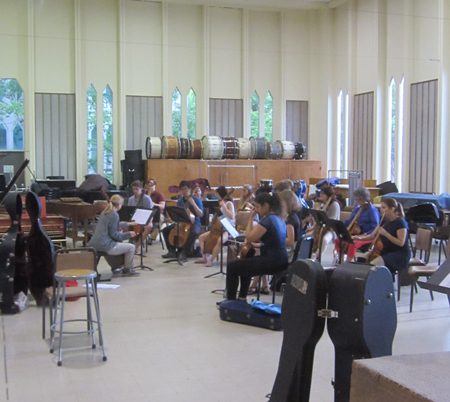 BPI people don’t tend to sleep in (no matter how late they’ve been up the night before), but perhaps the most reliable early birds are the beginning viola da gamba players, who circle their wagons every morning at 8:00 sharp.
That’s an instrument that inspires ardent devotion among experienced historical string players and great curiosity in neophytes — some people who have never picked up a bow are giving the gamba a try this week. We’ll hear more from both types of gambists as the week continues.
Oberlin graduate and BPI alumnus Skip Sempé joined the faculty for week two, making his first official appearance in Tuesday morning’s harpsichord class. His reputation as director of the France-based ensemble Capriccio Stravagante made us eager to get to know his musical philosophies.
First up for consideration was a William Byrd Pavan and Galliard. Sempé introduced his theory of “suspicious” or “unstable” as opposed to “predictable” music (a mysterious idea that would get explained as we went along). He said it was silly to compliment someone on their beautiful touch, because touch is built into the instrument by the maker. “The difficult part is how you let the keys up.”
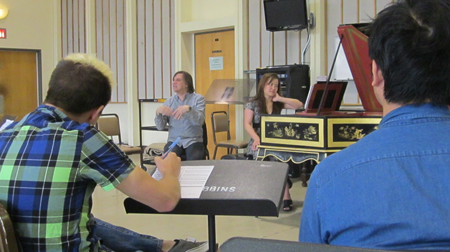 On the subject of playing cadences, Sempé also passed on some bon mots from his teacher Gustav Leonhardt (“Can’t this be more simple?) and his colleague Jordi Savall (“When the music is over, there’s nothing more.”)
In Sweelinck’s Fantasia chromatica, Sempé noted that “the most suspicious music is chromatic.” He suggested to the player, who seemed to be “permanently slowing down,” to emphasize the offbeats, a typical Renaissance gesture. That advice also applied to another Byrd Pavane and Galliard: make agogic accents as though they were being played by a drum. Sempé cited Jordi Savall’s percussionist as an exemplar of vibrant rhythm, and said that he’d been inspired to buy himself a drum to explore its secrets.
In spite of Sempé’s remarks about who to credit for beautiful touch, I thought that the first performer to play this morning definitely displayed that quality, so I sat down with Houstonian and first-time BPI attendee Evan Clarner to ask about his harpsichord background and future plans.
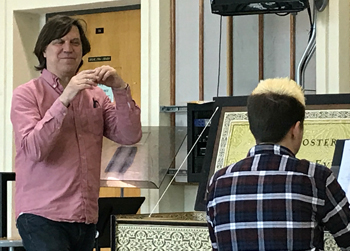 Clarner said that he’d been playing piano since he was six, but not seriously. Then he discovered Baroque music while playing oboe in grade school. “I’ve always liked weird things, and the harpsichord became my new passion.”
Although there were plenty of instruments in Houston he could practice on, Clarner said it was difficult traveling into town to spend time with them. “Eventually my parents gave in and got me my own instrument — the last gift of my life. I didn’t want a car, or video games, or all that fancy stuff, I wanted a harpsichord.”
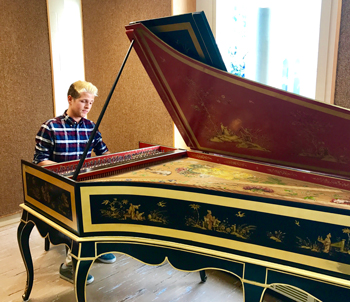 He got his wish in the form of a Willard Martin French double. “It was made in 1983 for a wealthy doctor who sold it through the Harpsichord Clearing House. It’s something you can keep your whole life, and it won’t lose its value.”
Clarner has just completed his junior year in early keyboard performance at the University of North Texas. Only recently did he come across BPI. “I’ve heard a lot of good things about it. I’ve done harpsichord master classes in the past, but this is a program where you can get a taste of the whole Baroque music world in perfect balance.”
“I try to do as much as I can at BPI,” he said. “I’ve sat in through the fortepiano masterclasses, I go to Baroque dance, which really helps give you a taste of what the music’s for, and we have the small and large ensembles. That’s the great thing about BPI — you’re not just focusing on one thing.
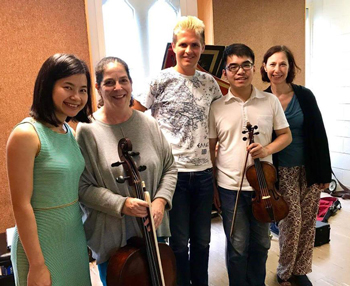 “This week, I’m playing a Telemann quartet for two flutes, recorder and continuo. Last week I was in an all-string ensemble, and now it’s all winds. Playing with wind instruments is really different. They have a different approach to how you start a note, and winds and strings handle their dynamics in a different way. The variety is really helping my continuo skills.”
Clarner is also grateful for the opportunity to be coached by different mentors. “Lisa, Mitzi, Mark, and Skip all have very different personalities. You don’t want to work with just one person because you’ll end up playing just like them.” And he finds master classes very different from one-on-one lessons. “It’s good experience being put on the spot,” he said, “and you’re talking more about the music and its purpose.” He also finds BPI’s mix of ages and abilities inspiring. “It’s helpful to have such a variety of skill levels. So much you can observe both watching a professional and an amateur.”
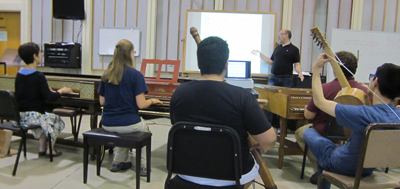 And the continuo class that runs four nights a week from 8:00 to 10:00 has rekindled Clarner’s interest in a subject he’s already studied for three years. “With Joe Gascho, you can learn and have fun at the same time. It challenges you, but I can’t imagine a better way of being taught.”
What’s ahead for Evan Clarner? “I’m just starting my senior year. Then I plan to audition in Europe, in Paris and London.” He said that music might not be what he ends up doing with his life, adding that he does have a backup career. “I’ve gone to culinary school and I work as a pastry chef to pay the bills.”
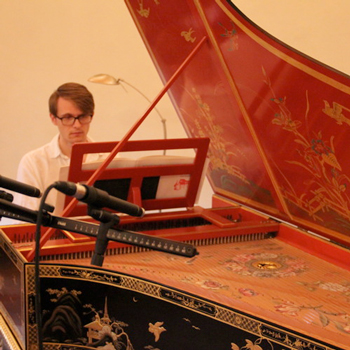 A high point in Tuesday’s schedule was Mark Edwards’ 2:00 pm performance of Bach’s Goldberg Variations — played without repeats so as to fit into the allotted one-hour period. Playing from memory, Edwards — who began teaching at Oberlin last fall — shaped a reading both lyrical and virtuosic, assisted by a harpsichord that sang beautifully into Kulas Hall. The crowd called for an encore, and Edwards gave them a delectable Forqueray chaconne.
Yesterday I neglected to mention an informative lecture, “Travels and Tours: Artistic Maneuvers in the Early Modern Period” given on Monday afternoon by Dr. Andaleeb Badiee Banta of Oberlin’s Allen Art Museum. Banta engagingly drew non-art historians into the inspiration artists gained through travel, and she covered a lot of territory in only fifty minutes.
Published on ClevelandClassical.com July 3, 2017.
Click here for a printable copy of this article
