



by Daniel Hathaway
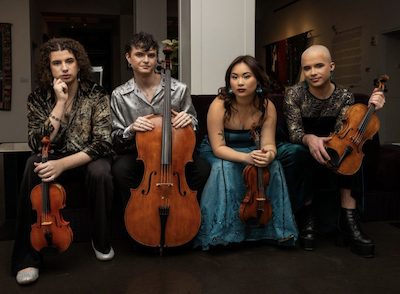 Fresh from winning the grand prize at the prestigious Banff Competition on the last day of August, the Poiesis Quartet (Sarah Ying Ma & Max Ball, violins, Jasper de Boor, viola, and Drew Dansby, cello) took a late October victory lap at the Oberlin Conservatory, returning to their place of birth as an ensemble to give master classes and solo with the Oberlin Orchestra.
Judging from the turnout in Finney Chapel on Friday, it might not have been a prizewinning idea to schedule a major orchestra concert on a college campus on Halloween, but there was nothing slim about the sound that the stage full of musicians produced. Brilliantly scored works by Carlos Simon, John Adams, Angélica Negrón, and Zhou Tian, were conducted with precision by Rafael Jiménez.
The Poiesis were on hand to join the orchestra as soloists for John Adams’ witty concerto for string quartet and orchestra Absolute Jest (2011), a dizzying anthology of musical quotations that reminds us from the very beginning that Beethoven’s themes are memorable not only for their notes but maybe even more for their rhythms. Adams plays with that idea for nearly half an hour as quotations fly past from the scherzos of Beethoven’s late quartets only to be reassembled in clever ways.
Peter Laki wasn’t jesting when he wrote in his program notes, “There are only a few brief moments of relative tranquility in the course of this 25 minute piece… Most of the time, the music is characterized by a high degree of nervous energy, reaching a veritable state of pandemonium more than once.” Both the Poiesis Quartet and the Oberlin Orchestra played at the top of their game. Many bow hairs were sacrificed in the process and the result was loud and fun!
The evening began with Carlos Simon’s Fate Now Conquers (2020), a much shorter (5 minute) work inspired by a line Beethoven copied into his 1815 notebook from the Iliad. In its brief duration, the piece graphically invokes the uncertainty of life and incorporates a handsome cello solo played on Friday by Dylan Bachmann.
Another brief respite came after intermission with Angcélica Negrón’s Campos Flotantes (“Floating Fields”), a nostalgic, 7-minute soundscape that explores landscapes the composer feels are drifting away into evanescent memories.
The concert ended with something much more tangible: Zhou Tian’s Transcend (2019), a piece commemorating the 150th anniversary of the completion of the Transcontinental Railroad, commissioned by thirteen American orchestras that operated near or along the right-of-way.
Speaking from the stage, Chinese-born composer Zhou Tian noted the particular sacrifices that Chinese and Irish laborers had made during the construction from 1862-1869, and said that he was inspired to create this work “to tell a musical story, to celebrate human perseverance, and to pay tribute to my own cultural heritage.”
The most cinematic of the four works on this program, the three movements are vividly depicted in music: “Transcend” with poundings like blasts of dynamite, “Promise” with a vocalise inspired by traditional Chinese music, and “D-O-N-E” with the Morse code rhythms of the one-word message telegraphed on May 10, 1869 announcing the completion of the rail line.
The performance was wonderful, and surely much more of a treat for players and attendees alike than passing out candy to spooks in bed sheets.
Published on ClevelandClassical.com November 13, 2025
Click here for a printable copy of this article
