

by Mike Telin
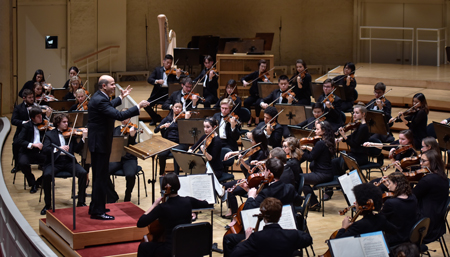 The Oberlin Conservatory has been at the nation’s forefront in the training of undergraduate musicians for 150 years. The school’s outstanding programs encompass a variety of musical disciplines, and have produced an impressive list of world-renowned performers, composers, and innovators. On Saturday, January 30, in Symphony Center, Chicago, the conservatory’s orchestral program took center stage when Raphael Jiménez led the Oberlin Orchestra in outstanding performances of works by Hector Berlioz, Richard Strauss, and Igor Stravinsky. The concert was presented as part of Oberlin’s sesquicentennial celebration tour to Chicago.
Jiménez did not play it safe with the tempo during the opening bars of Berlioz’s Roman Carnival Overture, sending a clear message that his orchestra is a force to be reckoned with. He drew a rich, clear sound from the strings throughout the work, and the blend of the winds and brass was impeccable. Casey Kearney sounded exquisite in the famous English horn solo, and the viola section completed the love duet with charm. The energy of the ending Italian dance brought the overture to an exciting conclusion.
Set to poems by Hermann Hesse and Joseph von Eichendorff, Strauss’s Four Last Songs are among the most heart-rending pieces of music ever written. Although Strauss had previously written some 200 songs and 15 operas, the Last Songs are notable in the composer’s output for their lush, melismatic style. The songs, all but one of which deal with the subject of death, imbue a sense of calm and serenity, qualities that soprano Marcy Stonikas brought to her mesmerizing performance.
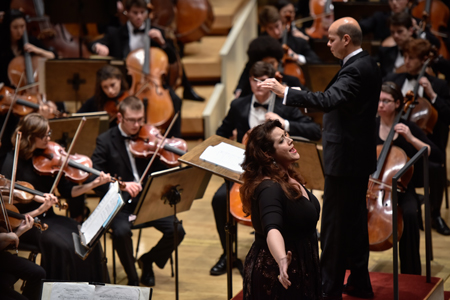 Stonikas, an Oberlin alumna, is a fast-rising star in the opera world, boasting an expansive list of accomplishments. Singing with a rich, golden-hued tone and clear diction, she elegantly shaped the lines in “Frühling” (Spring). Her delivery of the poem’s final lines (“Your blessed presence trembles through all of my limbs”) was heartfelt. “September” was simply beautiful, and she added special nuance to the line “Summer smiles, astonished and weak.”
Bringing her hand to her forehead as she sang, “Brow, forget all thinking,” beautifully shaped the third song, “Beim Schlafengehen” (While Falling Asleep). Her keen sense of phrasing and liquid tone in the final “Im Abendrot” (At Sunset) brought the performance to a memorable conclusion.
Raphael Jiménez and the orchestra were responsive collaborators throughout the cycle, allowing Stonikas to project easily even through Strauss’s thickest orchestrations. Kudos to principal horn Bailey Myers and concertmaster Gregory Gennaro for their wonderful solos. Holding the silence long after the last notes had faded, Jiménez gave the audience a moment to contemplate what they had just heard.
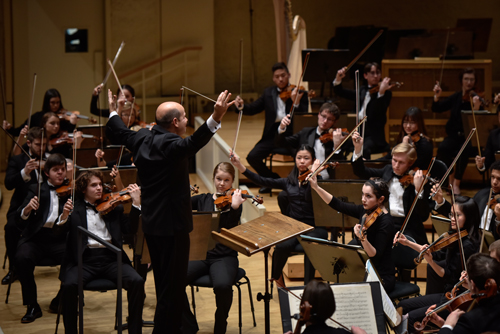 The second half of the program consisted of a single work, Stravinsky’s groundbreaking ballet score, Le Sacre du Printemps (The Rite of Spring). Although it caused a riotous reaction from the audience during its premiere at Paris’s Théâtre des Champs-Élysées in May, 1913, the piece soon become a modern classic. It has also become one of the works by which the prowess of a symphony orchestra is measured.
Conducting from memory, Raphael Jiménez led an inspired performance that was rhythmically solid, technically secure, and musically engrossing. Again, he didn’t play it safe when it came to tempos, and his players responded with verve, digging into the work’s many difficult passages with gusto. Although each of the ballet’s fourteen scenes depicting pagan Russia were vividly brought to life, Jiménez was also impressive with his nuances during the transitions. His decision to pull back the tempo during the eleven drum beats that announce the choosing of the sacrificial young girl gave an extra spark to the fast material that followed. The relentless drive of the final “Sacrificial Dance” brought the outstanding performance to a memorable conclusion. The large audience responded with a long and enthusiastic ovation.
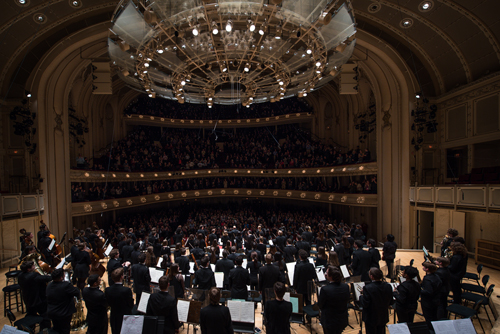 Many exceptional section and individual solos distinguished the performance. Bassoonist Thomas English played the opening with a relaxed, singing tone. The duet between English hornist Casey Kearney and alto flutist Tasi Hiner was eerily haunting. And e-flat clarinetist César Palacio and bass clarinetist Alex Dergal deserve a special nod for their excellent work.
To say that this concert was impressive for an ensemble of young players would be an understatement: this is an orchestra that any city would be happy to have as its resident professional ensemble.
Photos by HumanArtist Photographers
 Mike Telin serves as Executive Editor at ClevelandClassical.com. After receiving his musical training in bassoon at Oberlin Conservatory, he went on to perform with such Northeast Ohio orchestras as the Canton Symphony, Akron Symphony, Cleveland Chamber Symphony, and Trinity Chamber Orchestra. He served as Executive Director of Music & Performing Arts at Trinity Cathedral for fifteen years. Currently he team-teaches Introduction to Music Criticism at Oberlin College and Conservatory and has team-taught public interest research at Baldwin Wallace University.
Published on ClevelandClassical.com February 9, 2016.
Click here for a printable copy of this article
