



by Stephanie Manning
 This article was originally published on Cleveland.com
CUYAHOGA FALLS, Ohio — When the goddess Fortuna spins her wheel, your fate is on the line. That’s the idea behind “O Fortuna,” the famous dramatic tune that has become part of pop culture thanks to its use in commercials and TV shows.
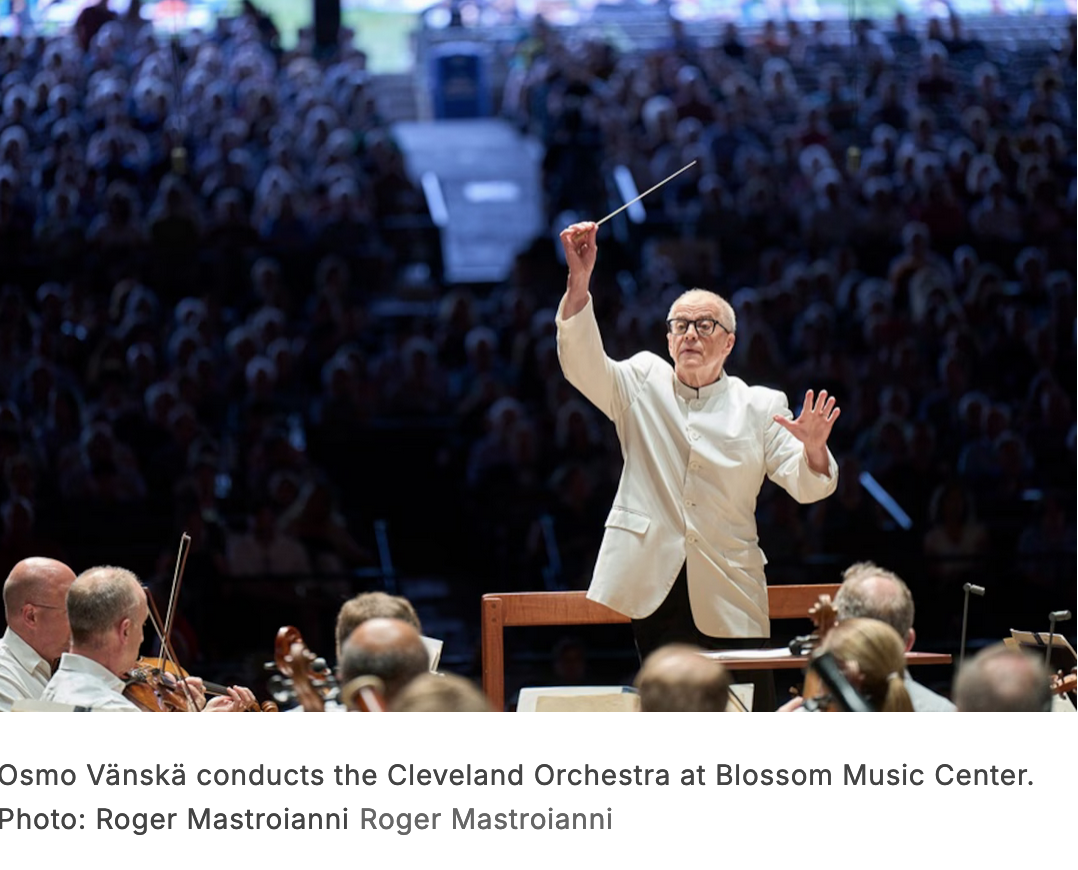
Those crashing waves of sound, lamenting life’s cruel twists of fate, both open and close Carl Orff’s “Carmina Burana,” which headlined The Cleveland Orchestra’s concert on July 12. Conductor Osmo Vänskä led the Orchestra, the Blossom Festival Chorus, and the Cleveland Orchestra Children’s Chorus in a lively performance of the work at Blossom Music Center.
The hour-long cantata, based on a 13th century collection of poetry by wandering scholars, is more than just doom and gloom. The different movements include texts about blossoming springtime, hedonistic reveling in the tavern, and the coming together of young lovers. The huge musical forces the piece requires make it a natural fit for a venue like Blossom, where even the loudest moments won’t overpower the space.
The enthusiastic Chorus, prepared by Lisa Wong, gave their all in sections like “Were diu werlt alle min,” complete with the final shouted “Hei!” They sang medieval Latin and German with crisp articulation, and upped the intensity for each repetition of the joyful “Ecce gratus et optatum.”
Baritone John Brancy’s focused, powerful sound made him an attention-grabbing presence during his featured movements. Although his singing of “Estuans interius” was a bit cautious, he became much more animated as the drunken abbot in “Ego sum abbas” and flexed his excellently controlled falsetto in “Dies, nox et omina.”
Soprano Shélen Hughes’ standout moment arrived during her beautifully sweet “In trutina.” In “Olim lacus colueram,” the story takes an unsettlingly humorous turn, when countertenor Reginald Mobley’s plaintive-voiced swan laments being roasted over a fire.
Just like the vagaries of fate, the performance had its ups and downs. Vänskä lost some momentum in “On The Green,” where Orff’s reliance on repetition is at its most obvious, and coordination between singers, soloists, and orchestra sometimes wobbled. But the youthful energy of the Children’s Chorus, prepared by Jennifer Rozsa, was a highlight during movements like the lovely “Amor volat undique.”
“Carmina Burana” ends as dramatically as it begins, once again decrying Fortuna’s twists of fate. The roar that went up after the final chord was akin to a rock concert — and the feeling was electric.
The evening began with En Saga, a tone poem by Finnish composer Jean Sibelius that is sunny, heroic, and suspenseful. Vänskä let the brass loose during some exciting chorales, but many quiet string moments got lost in the pavilion’s cavernous acoustic. Principal clarinet Afendi Yusuf delivered a long, thoughtful solo before the ending faded into the mist.
Published on ClevelandClassical.com July 16, 2025
Click here for a printable copy of this article
