


by Mike Telin
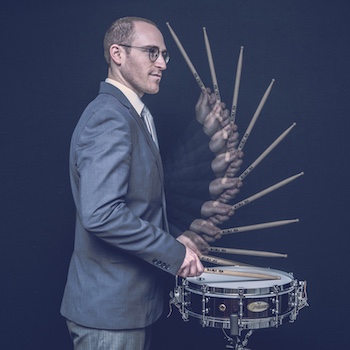 “I wasn’t sure if music was even going to stick until I found myself enthralled by percussion,” Jeff Stern said during a telephone conversation.
“It suits me in a lot of ways, particularly because it has so many options in the kinds of instruments you can play, and the kinds of music and musical settings that it lends itself to.”
On Wednesday June 17 at 7:30 pm in Mixon Hall, Stern, who serves as Instructor of Percussion at the Peabody Conservatory as well as the executive director, co-artistic director, and founding percussionist of the two piano, two percussion group the icarus Quartet, will make his ChamberFest debut.
I began our conversation asking him how he will fit into a Spanish Baroque trio sonata.
Jeff Stern: The piece is by two members of the Pla family. There’s no percussion part, so I’m playing an accompanimental role. I will be following along with the score, but mostly using my ears and intuition to come up with parts that enhance the music, complement it, and kind of ground it rhythmically.
MT: Do you have any particular instruments in mind?
JS: It’s still TBD. With this kind of music, generally less is more, so there are a few instruments that have made their way into these traditions. A lot of them that come from this era are connected to particular ethnic origins. Like Irish music has the bodhrán. and it’s played a certain way. But that also finds its way into Medieval music.
For this Spanish music there’s a fair chance I’ll be using a riq, which is an ancient form of tambourine. It’s played upright and isn’t quite as full or bright as the modern tambourines. But it’s a little more drum leaning with the jingles as well. So this will be a new experience for me.
MT: You’re playing Benjamin Yusupov’s Quintet for Marimba and Strings on June 20 at Federated Church. Did you already know the piece?
JS: I did not. I play almost exclusively contemporary music and I work with a lot of composers in creating the works. But it’s not uncommon for me to be introduced to a composer’s work for the first time, which is the case with this one.
MT: Have you enjoyed learning it?
JS: Absolutely — it’s really virtuosic. It was originally written for piano and I believe Benjamin adapted it himself. He might have worked with a performer in making that initial transfer over to the marimba because the language of those two instruments is pretty different. They’re both keyboard instruments laid out in the same way, but the physicality is very different. So it’s unique for a piece to be written in a way that actually suits both instruments.
I’ve done a fair share of transcriptions and adaptations — guitar tends to work really well because you’re going from six strings down to four mallets. Piano can work, but it’s always amazing when it does because boiling down ten fingers into four mallets is more challenging.
But this piece happens to be written in a way that is well suited to making a few edits and fitting really well on the instrument. So it’s been a fun challenge. And I’m looking forward to playing with some killer musicians.
MT: Who are your colleagues?
JS: Milena Pajaro-Van de Stadt is the violist, Julie Albers is the cellist and I believe the violinists are Julia Schilz and Andrew Wan.
MT: When did you first realize you wanted to be a percussionist?
JS: I played a few different instruments before making my way to percussion. I think the first love was the drum set — I wanted to be a rock star.
Then being in my school band program and getting more involved with the marching band, I had a drumline phase and was in Drum & Bugle Corps, which is a young professional group that tours around the country in the summers.
Then I got called by the concert music world. I went to my first percussion concert as a freshman at the University of Massachusetts. Some of the older students in the studio knew about the legacy of percussion at Yale. So they said, ‘Hey, we’re driving an hour and a half down to hear this concert. You should come.”
So I did and was just blown away — it had all the groove that I was drawn to in playing drum set. It had all of the athleticism and accuracy and precision that came from my time in the drumline world. But then there was this intimacy of people engaging with each other, and communicating at a really palpable level. The scope of the communication that was emanating from the stage I couldn’t escape. It was very powerful — something that intoxicated me from the beginning. And I knew right then that this is what I want to do. This is where I want to be.
Another moment that comes to mind is my experiences playing with wind and string players and finding how I had to adapt my sound and my approach to the ways in which I even physically play the instruments. Having that be a constant inspiration to become even more imaginative on my instruments, to try to do something different and expanding the range of what you could do with those different timbres and people coming at music from different angles — that all became a very strong calling card as well.
MT: The icarus Quartet is an amazing ensemble.
JS: I didn’t imagine ending up in a two piano, two percussion group, which is essentially a percussion quartet. Nevertheless, the power of those pianos, the depth that it provides is just a very fun way to make music and recontextualize the things that I’m doing and have it serve some interesting and exciting types of music.
MT: I love percussion ensembles. It’s the one instrumental group that truly has the world inside it.
JS: Absolutely. It’s great to hear you say that.
Published on ClevelandClassical.com June 10, 2026
Click here for a printable copy of this article
