


by Daniel Hathaway
 This article was originally published on Cleveland.com
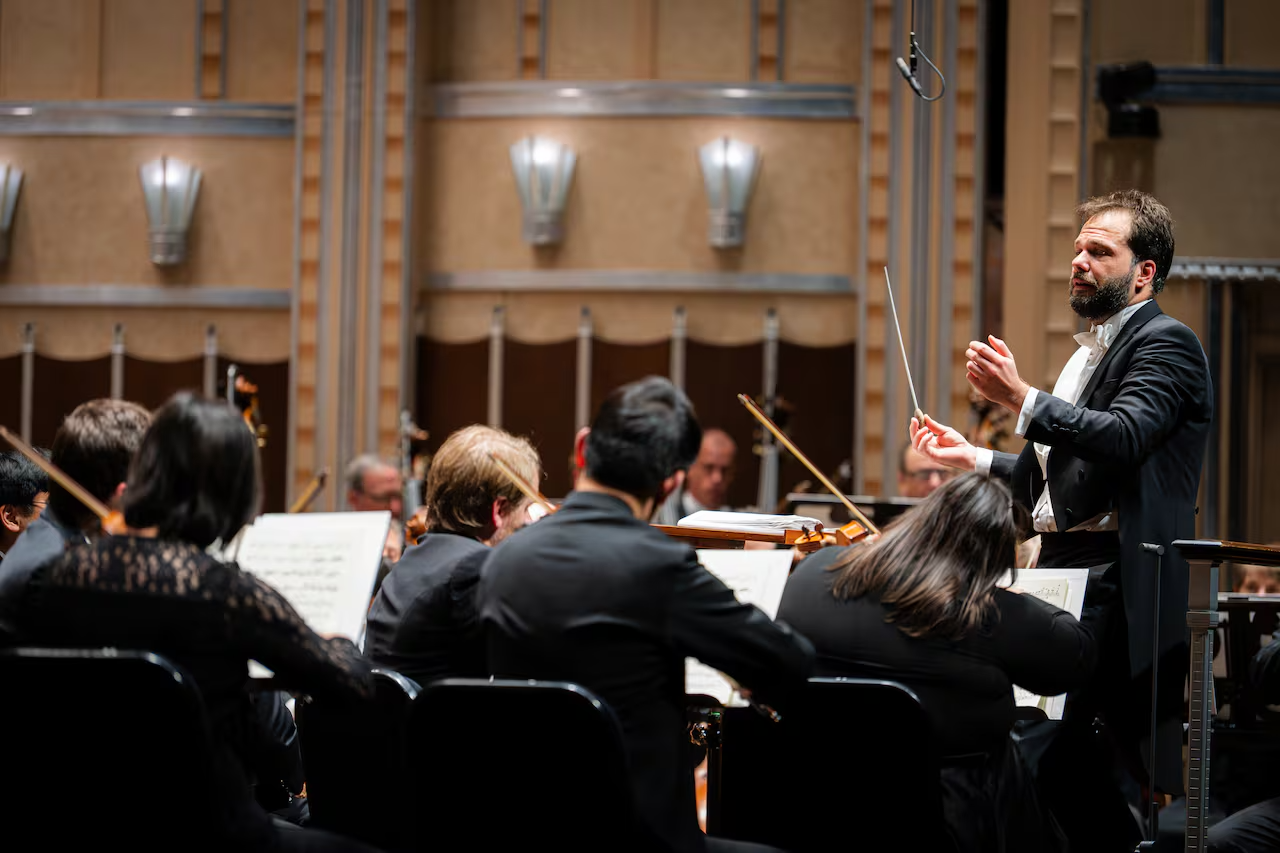
CLEVELAND, OHIO — Back home after touring Europe for three weeks, The Cleveland Orchestra attracted a large and admiring crowd to Mandel Concert Hall at Severance Music Center on Friday evening, October 30.
They turned out probably for a variety of reasons: to hear their orchestra again near the beginning of a new season, to witness the return to the podium of Czech guest conductor Petr Popelka, to bask in the sonic glory of Gustav Mahler’s Fifth Symphony and admire the sophisticated wit of Joseph Haydn’s Symphony No. 80, or for all of the above.
The program was intentionally lopsided with the Haydn clocking in at 20 minutes, the Mahler at 70. Filing both works under the category of “symphonies” is to say very little about their nature or content beyond the fact that they’re conceived for large ensembles of musicians making harmonious sounds together.
And size doesn’t always equate with complexity. The Mahler is an endurance test, to be sure, packing what its composer said should be “a whole world” into its pages, but the finale of the Haydn punches above its weight with its rhythmic complexity.
Mahler 5 began with a funeral march boldly introduced by principal trumpet Michael Sachs interleaved with serene string passages. Popelka coaxed the dynamic extremes Mahler requires out of the lush, emerald sound of the ensemble, whose blend never faltered even as it gradually faded away. The final pizzicato was like a last breath of air.
“Stürmisch bewegt, mit grösster Vehemenz” captures the emotional tone of the second movement. Popelka immersed himself in the music, drawing stormy passion from the orchestra. The brass were triumphant during a chorale. A gradual building of volume dissipated into a quiet ending.
Principal horn Nathaniel Silberschlag played his solo part in the third movement scherzo standing. His rich, burnished tone, whether soft or full, filled the hall with magic. Popelka threw himself into the many moods of the music, but always in good taste.
Whether or not you’re a fan of the Visconti film Death in Venice, the fourth movement Adagietto: Sehr langsam is a high point of Mahler 5. Popelka took Mahler at his word — the tempo was slow, but steady, allowing the symphony’s most beautiful music to unfold naturally, without the over-massaging of passages that can make some performances mawkish or overly sentimental.
After those enchanted moments, Popelka and his players brought the symphony to a thrilling conclusion in the Rondo-Finale, prompting immediate applause and shouts of appreciation from the audience.
Before that, Popelka led a performance of Haydn’s 80th symphony that didn’t quite settle in at the beginning, although its path forward became smoother as time went on. He took the opening movement’s Allegro Spiritoso marking at its word with a spirited playing of the lilting tune.
The agreeable Adagio and Menuetto offered some lovely, soft playing. The charming trio featured pointed staccatos. In the finale, Presto, the ensemble continued to gel even as rhythms became more complex, bringing bravura and a beautiful palette of colors to Haydn’s imaginative music.
Photo by Aireonna McCall-Dubé
Published on ClevelandClassical.com November 5, 2026
Click here for a printable copy of this article
