

by Kevin McLaughlin
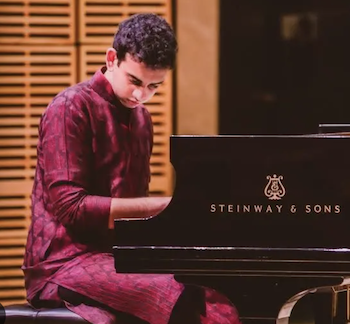 Pianist Utsav Lal’s solo concert at the Lorraine and Bill Dodero Center for the Performing Arts in Gates Mills on Tuesday evening July 22 offered “Indian classical music reimagined for the Western grand piano.” The experience was a gradual one: you became aware of a rare sensual and spiritual atmosphere — and then, if you allowed it to, a gently meditative state overtook you.
One of Indian classical music’s defining traits is the irregularity of intervals and pitches — something you might hear from a sitarist or a vocalist — yielding a broader expressive palette. To fully appreciate Lal’s work, one had to set that convention aside and receive his Western reinterpretation on its own terms.
Titled “A Concert of Indian Classical Music with New Interpretations,” the program unfolded in three parts, each exploring a different raga and aspect of the Hindustani tradition, filtered through Lal’s inventive yet respectful musical lens.
The first section, Alap–Jod–Jhala, was a solo journey into the depths of an evening raga. Lal began unhurriedly, inviting the audience to listen as the raga emerged pitch by pitch — less a performance than a meditation. The Alap unfolded in rubato style, serene yet purposeful, with Lal lingering on principal tones to heighten their emotional power. As the Jod introduced rhythmic movement, the music gathered momentum. By the time he reached the Jhala, Lal had built to a thrilling intensity, with ascending and descending flourishes that conveyed the raga’s narrative as vividly as any vocalist might.
Part Two introduced tabla player Nitin Mitta, whose nuanced and virtuosic playing opened the door to rhythmic dialogue and interplay. Devoted to the Gat, or fixed composition, this section began in madhya laya (medium tempo), with Lal establishing the raga’s framework before letting improvisation take flight. Sparkling taans — fast melodic runs — returned gracefully to the fixed theme. The jugalbandi, or musical conversation, was especially riveting: playful and teasing, with phrases echoed, inverted, or reimagined by the two musicians. The final tihai — a complex triplet phrase cycling three times to land on the same (downbeat) — earned an enthusiastic response. Mitta was dazzling in his rhythmic variations and stamina.
The final set — which Lal likened to “dessert” after a meal — featured semi-classical pieces familiar across the Indian subcontinent, reimagined with fresh harmonic treatments and subtle nods to other traditions, including modal jazz and Western impressionism.
Lal’s performance generally offered a persuasive case for the piano as a vessel for Indian classical music, even if at times the confines of equal temperament limited expressiveness. Still, the duo’s patient unfolding of ragas, rhythmic variety, and deep commitment to improvisation offered a rewarding bridge between traditions. In a culture increasingly defined by immediacy, the opportunity to listen slowly — and deeply — was its own reward.
Published on ClevelandClassical.com July 31, 2025.
Click here for a printable copy of this article
