


by Daniel Hathaway
 With apologies to Sir Edward George Earle Lytton Bulwer-Lytton, it was a dark and stormy morning at Severance Music Center on March 31, when guest conductor Thomas Adès led The Cleveland Orchestra in a pair of striking atmospheric disturbances, one of his own composition (in The Tempest Symphony), and one by Jean Sibelius (from The Tempest, Op. 109), both originally imagined by William Shakespeare in his play of the same name.
Listed in the First Folio as the first of his comedies, Shakespeare’s magical allegory has recently spurred the invention of a new critical category: romances, although no attempt to file the work under a single heading — or to simplify its plot — has been successful.
Sibelius wrote his incidental music to The Tempest in 1925 on commission from the Royal Theatre in Copenhagen for a lavish production that required 34 separate musical cues. Adès extracted the movements of his symphony from the opera he wrote for the Royal Opera House, Covent Garden, that debuted in 2004. The resulting work, a co-commission by the Dresdner Musikfestspiele for the London Symphony and The Cleveland Orchestra was first performed by the LSO in Dresden in 2022. The performances this weekend marked its U.S. Premiere. I caught the Friday morning matinee, itself remarkable because all the works on the program were first performances for the Clevelanders.
Representing storms through music is a favorite exercise for composers, and both tempests on Friday morning provided moments of thrilling meteorological terror among their representations of roiling seas and blustery winds. Although the percussion department of the Orchestra owns a wind machine that comes out of storage to add substance to arctic soundscapes, it wasn’t needed on this occasion — strings, winds, and brass unleashed plenty of terrifying power in both pieces.
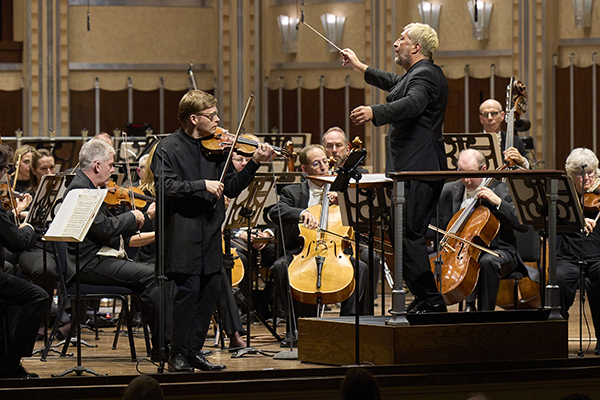 Other movements in both the Sibelius and Adès works represented characters or situations in Shakespeare’s drama, and both composers showed themselves to be men of the theater in crafting evocative portraits and scenarios that were beautifully put across by the ensemble and its soloists. On the podium, Adès also proved to be an eloquent interpreter of his own musical ideas. Frequently avoiding standard conductorial gestures in favor of crafting air sculptures with his hands, he clearly communicated what he wanted from his players.
The rest of Friday’s program was devoted to Adès’ Märchentänze or Fairy Tales, originally conceived in 2020 for violin and piano and suggested by British folklore. Adès adapted them for orchestra in 2021, arranging them with particular attention to the high register of the solo violin, which was masterfully and colorfully played by Pekka Kuusisto. They provided a delightful entremet for reduced orchestra between Shakespeare’s fantastical portraits.
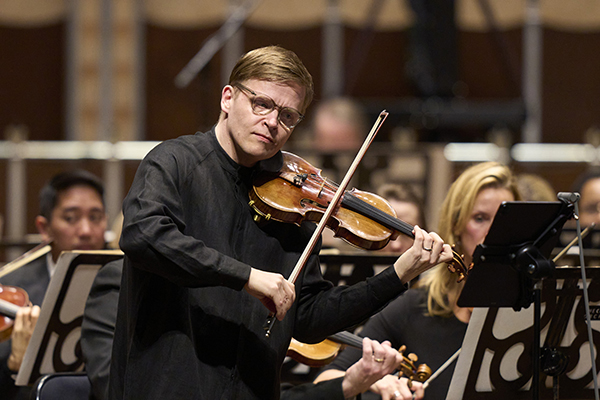 The Orchestra’s Friday programs routinely lop off one or two pieces from the weekend’s repertoire in order to fit them into just over an hour without intermission. This time the victim was Sibelius’ Six Humoresques for solo violin and strings, but the resulting program was more complicated than usual.
Rather than reprinting the menu, a little note at the bottom of the program page read “Friday’s program will be performed in the order of Adès’s Märchentänze and the Tempest Symphony, concluding with Sibelius’ Prelude and Suite No. 1 from The Tempest. Six Humoresques does not appear on this program.” Aside from a bit of dubious grammar, this seemed confusing, and led to more than the usual flipping of pages back and forth.
Photos courtesy of Roger Mastroianni.
Published on ClevelandClassical.com April 13, 2023
Click here for a printable copy of this article
