



by Daniel Hathaway
 On Tuesday, October 18, London’s Academy of St. Martin in the Fields Chamber Ensemble will return to the Cleveland Chamber Music Series at Plymouth Church in Shaker Square to play works by Purcell, Brahms, and Enesco.
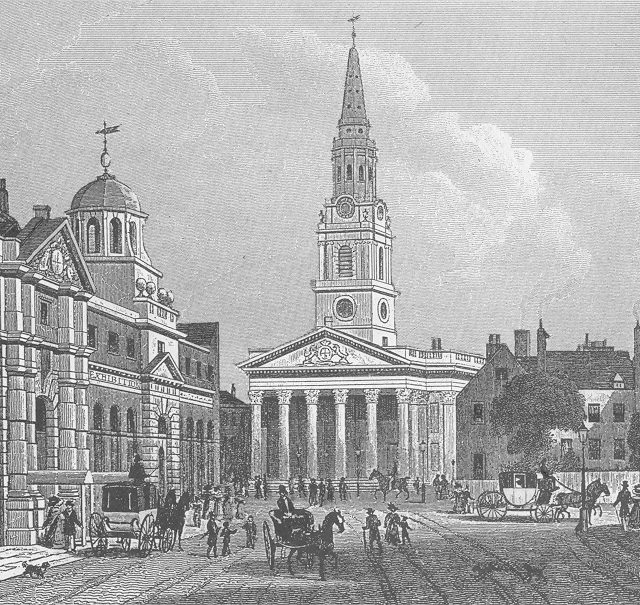
Not many musical groups are so closely associated in spirit and substance with a building as is the Academy of St. Martin with the grand parish church built to the plans of architect James Gibbs in 1720.
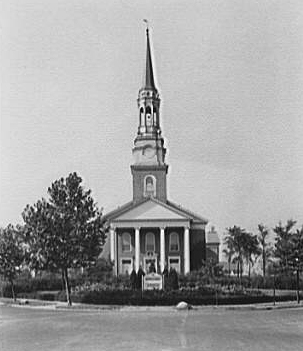
Only the second church to occupy its central London site on Trafalgar Square, St. Martin’s, inspired by Greek and Roman temples, established a style that was widely applied to ecclesiastical buildings during the restoration of the City churches after the Great Fire of 1666 by such architects as Christopher Wren. And made its mark on American Protestant church buildings like Plymouth UCC in Shaker Heights (below).
 St. Martin’s has shared its real estate with the monument to Admiral Horatio Nelson after the Battle of Trafalgar in 1808, with the National Gallery of Art, completed in 1838, and until their eviction at the turn of the 21st century, with a flock of 35,000 feral pigeons, not to mention protesters demonstrating en masse for multiple causes (like the 100,000 Pakistanis who poured into Trafalgar Square one Sunday in the 1970s when I decided to visit St. Martin’s for the first time).
Determined to serve as a cultural center as well as an organization dedicated to religious, societal, and justice issues, St. Martin’s became a thoroughly modern Anglican organization in the mid-20th century. As its website notes, “ From London’s first free lending library to the first religious broadcast, St. Martin’s has broken new ground in defining what it means to be a church.” [Read more…]
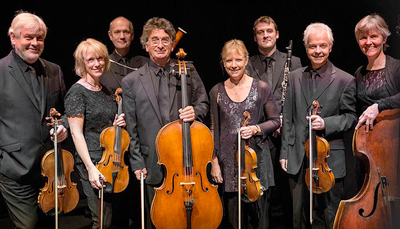
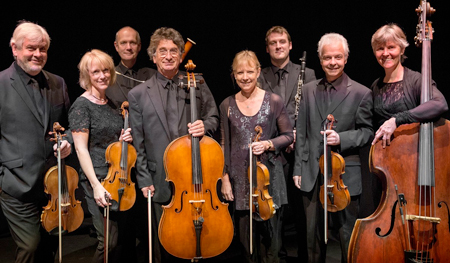 Northeast Ohio has had the pleasure of hearing London’s Academy of St. Martin in the Fields Chamber Ensemble twice in the past few months. Last May, eight string players from the Academy’s expandable and contractible large chamber music group visited the Tuesday Musical Series in Akron to play Brahms, Shostakovich, and Mendelssohn. Last Tuesday, a string quintet enhanced by three wind players opened the Cleveland Chamber Music Society’s 66th Season with Antonín Dvorak’s Quintet in G and Franz Schubert’s Octet in F. String Quartets are able to conjure up a vast palette of sonorities, but the addition of a double bass, clarinet, horn, and bassoon can increase the possibilities exponentially.
 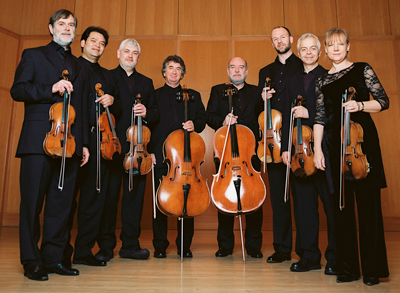 Ever since Haydn established the string quartet as the ensemble de rigueur, chamber music for strings has tended to operate in base four. There are many variants on the quartet (“4 ± n”, as a math teacher might write it), but even when you subtract a violin (Beethoven) or add a viola (Mozart), a cello (Schubert), or a double bass (Dvořák) — or, as in this concert, when you pump it up to a sextet (Brahms) or an octet (Mendelssohn, Shostakovich) — the quartet remains the norm.