



by Daniel Hathaway
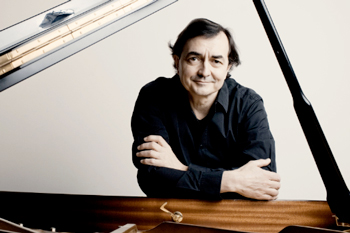 Although French-born pianist Pierre-Laurent Aimard plays a wide range of literature, he has a special affinity for the avant-garde music of Hungarian composer György Ligeti. This weekend, Cleveland audiences will have the excitement of hearing him tackle Ligeti’s phenomenally difficult Piano Concerto in partnership with Franz Welser-Möst and The Cleveland Orchestra. Performances begin on Thursday evening, May 18, and continue on Friday morning, May 19, and Saturday evening, May 20.
Aimard first encountered Ligeti’s music in the mid-1980s, and from 1993 to 2001, the composer entrusted the pianist with the premieres of nearly all of his late Etudes. Ligeti dedicated Nos. 10 and 12 to Aimard himself. He said the pianist had inspired him to compose some of his most complex piano works.
Complex, but remarkably accessible. Speaking by telephone from his home in Berlin, Aimard said, “From the very beginning, I found his music extremely original, and whatever his ideas are, he can communicate them in a clear and efficient way. [Read more…]
 Born in Romania, displaced by the Nazis, educated in Hungary, and finally settling first in Vienna then in Germany after the 1956 Hungarian revolution, György Ligeti spent a lot of his life on the move. Musically nomadic as well, he chased after a number of different compositional styles. Two of Ligeti’s pieces composed thirty years apart formed the backbone of the Oberlin Contemporary Music Ensemble’s arresting program in Gartner Auditorium of the Cleveland Museum of Art on Saturday afternoon, April 11.
  “Expect the unexpected,” eighth blackbird’s spokesman/flutist Tim Munro told our readers in the first of these previews, but he didn’t mean that patrons should go in uninformed. Today, Tim delves into the background of two of the pieces on the ensemble’s program next Tuesday, April 29 at 7:30 in Waetjen Auditorium at Cleveland State University.